


Does this cabbage turn you on?
November 16 2012

Picture: Schwerin, Staatliches Museum/Erich Lessing, Art Resource New York
To the authors of a new study in Volume 35 of Art History,* the above cabbage is 'startlingly erotic'. In The Erotics of Looking: Materiality, Solicitation and Netherlandish Visual Culture, Angela Vanhaelen and Bronwen Wilson have written an engaging piece exploring supposed sexual themes in pictures like Woman Peeling a Carrot by Gerrit Dou (below, Schwerin, Staatliches Museum), which they call 'sexually charged'.
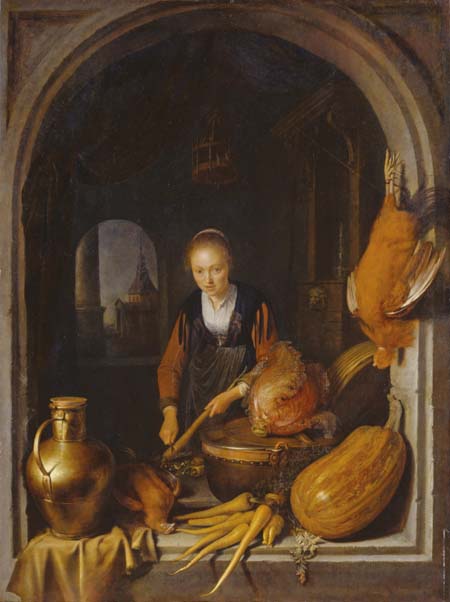
Personally, I'm not entirely convinced by their argument, which I enjoyed reading. But read the article yourself and let me know what you think. The authors rightly establish at the outset of their piece that there is a problem with interpreting pictures like Dou's in an overly sexual way:
Early modern Netherlandish artists did not write all that much about their practice and what little they did write has long frustrated art historians with its seeming refusal to divulge information about what the pictures actually mean. While art treatises devote much attention to the mechanics of art making, they contain no instructions about how to interpret the enigmatic visual motifs that recur especially in the ostensibly descriptive genres such as still life, landscape and genre scenes. Instead, the treatises repeatedly describe both the making and viewing of art in explicitly erotic language.
I'm not so sure. One of the treatises they refer to is Karel van Mander's 1603/4 Lives of the Illustrious Netherlandish and German Painters, which is hardly Forum. Florid certainly, but probably not that erotic. Unfortunately, none of van Mander's text is cited by Vanhaelen and Wilson for the general reader to make their own judgement.
Anyway, the article reminds me of a Dutch-inspired late 17th Century picture we have in stock here at the gallery. It shows Charles II's famous mistress Nell Gwyn (below, the head is based on Samuel Cooper's lost miniature) washing sausages, with a breast exposed, and satirically dressed in virginal white. In this case, we don't really need to find any texts by the likes of van Mander to know that its meaning is sexual. The sausage washing theme goes back to Brueghel the Elder, and is a fairly common one when suggesting an erotic subject matter.
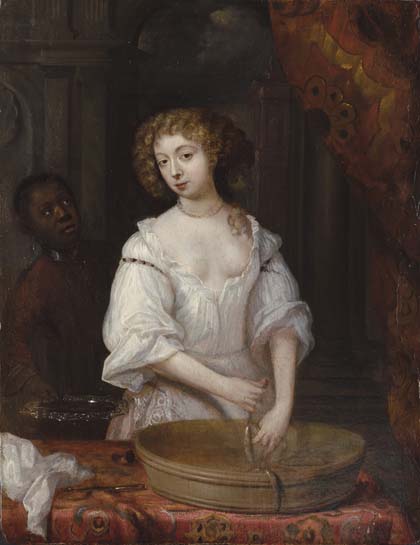
That said, I have always felt that pictures like Nell Gwyn's are not only taking their satirical aim at the sitters, but also at the Dutch genre pictures they're ripping off. Dou's woman may be peeling a large, firm carrot of the sort treasured by Uncle Monty in Withnail & I, but regular readers will know that I'm not one for seeing willies everywhere in paintings. And if we're not supposed to see 'startlingly erotic' cabbages in works just decades earlier by those fathers of still-life, Joachim Beuckelaer and Pieter Aertsen, then I'm not sure we are in Gerrit Dou's work either. At least, not until someone finds some convincing contemporary evidence that we are.
*kindly flagged up to me by Dr Matt Loder from the Association of Art Historians.
