


Van Dyck discovery at Christie's
November 12 2014

Picture: Christie's
Christie's have unearthed the above, previously unknown head study by Van Dyck, and will offer it for sale in December with an estimate of £200,000-£300,000. It relates to the series of head studies for Van Dyck's now lost portraits of the magistrates of Brussels, which were probably painted in the early 1630s. The study is similar in handling to the two studies in the Ashmolean (here and here), one in a private collection (and formerly with the London dealer Fergus Hall, who discovered it in New York), and the study found recently through the BBC television programme, the Antiques Roadshow, with which I was involved. This last study was offered at Christie's in the summer, but failed to sell with an estimate of £300,000 - £500,000.
Christie's sent me an image of the picture some time ago, and I had little hesitation in agreeing with the attribution. But like the four studies listed above, I suspect we can be fairly sure that the Christie's picture is somewhat unfinished, as there seems to be later overpaint in the drapery and background. The concept of the unfinished picture wasn't nearly as appealing in centuries gone by as it is today, and almost all Van Dyck's head studies (as with many other artists) were finished up by later artists to make them more saleable.
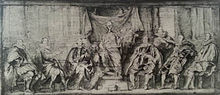
The Christie's catalogue speculates that the newly found study relates to Van Dyck's grisaille in the Ecole Nationale Supérieure des Beaux-Arts in Paris (above), which is all that survives of the artist's commission to paint the Brussels magistracy. In the grisaille, 7 sitters are seen. But we are fast running out of candidates for the head studies to relate to, for the new Christie's study and the Ashmolean heads could be said to candidates for the figures with their heads turned to the right.
However, most people forget that there was another, far larger Brussels magistrates group portrait painted by Van Dyck, for which we have not even a grisaille or drawing to give us an idea what it looked like. Both the large magistrates group and the smaller group related to the grisaille were destroyed in 1695 when French forces bombarded Brussels. The larger portrait had about two dozen sitters. So in fact the surviving studies could relate to either picture.
I'm fairly sure we can add to the five studies above heads such as this example in the Royal Collection. A series of similarly composed heads were worked up into more finished pictures with the addition of painted ovals, probably some time after Van Dyck's death. Some of them feature known magistrates such as Antonio de Tassis, but the majority are of unknown sitters.
