


Anne Boleyn-ollocks
February 16 2015

Picture: via Flickr
The Anne Boleyn story doing the rounds today highlights everything that is wrong with art research and art reporting at the moment. It is head-bangingly frustrating.
First, the story, as reported in The Telegraph:
Two of the most well known portraits of Anne Boleyn, which are on display at the National Portrait Gallery, may not be her, scientists have concluded.
Facial recognition experts have created a computer algorithm which maps the faces from portraits to find a match with other paintings.
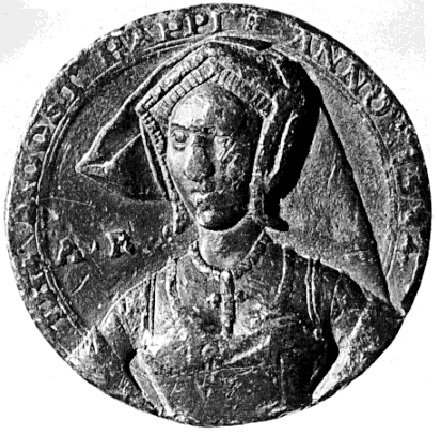
They used a contemporaneous miniature of Boleyn from the British Museum as a reference, as it is the only undisputed likeness of Henry VIII’s second wife.
After running the software, the experts said they could not be sure that the ‘Anna Bolina’ portrait, a late 16th century copy of a painting from 1533, which hangs in London’s National Portrait Gallery, was the queen. [...]
Professor Amit Roy-Chowdhury, of the University of California, created the algorithm after being approached by a history student who was keen to see if facial recognition technology could be applied to art history.
The technology also appears to have cleared up the mystery of the Nidd Hall portrait [above], a painting labelled as Anne Boleyn, but which many historians believed actually depicted Jane Seymour, Henry’s third wife. The image shows a young woman in a gable hood, wearing a brooch bearing the initials ‘AB’ which was known to belong to Boleyn.
The portrait was labelled as “The Most Excellent Princesse Anne Boleyn” but many historians claimed it was based a painting of Seymour by Holbein. [...]
Well, where to begin? The 'miniature' referred to in this piece is in fact a medal (below) in the British Museum, which is dated 1534. While it certainly does show Anne, the main problem is that it has become so damaged over time that it gives few reliable clues as to what she really looked like. The nose has been flattened, and one side of the face has been rubbed clear of any defining features. She looks like a drunken boxer. Can there really be anything reliable here for a computer programme to register? No.
Next, the National Portrait Gallery portrait and Hever Castle portrait (below). For me, the Hever Castle type is the best of a number of versions of this image, all of which date from the late 16th Century. That is, they are not contemporaneous. They are consciously historical portraits, pianted to fit the political and artistic tastes of the time. While some believe that they copy an earlier portrait, there is no firm evidence that they do. In fact, as actual likenesses, they may not be very reliable at all, and could be said to reflect, in the pale complexion, black hair and black dress, the view of her projected by those who resented her role in the break with Rome - that she was some sort of witch who cast a spell over Henry, and thus set the nation on its fateful path away from Catholicism. For example, in 1586, Nicholas Sanders wrote, 'Anne Boleyn was rather tall of stature, with black hair, and an oval face of a sallow complexion, as if troubled with jaundice. She had a projecting tooth under the upper lip, and on her right hand six fingers. There was a large wen under her chin, and therefore to hide its ugliness she wore a high dress covering her throat.' By this account, it's hard to imagine what Henry VIII saw in her.

The Nidd Hall portrait [illustrated at the top] 'proved' by Prof. Roy-Chowdhury has never struck me as a particularly convincing candidate as a contemporary portrait, although I must stress that I haven't seen it. As far as I know, there is no firm evidence that it is a contemporary image. But I certainly don't think it's right to say that 'many historians' have said it was Jane Seymour. The enormous 'AB' pendant is a bit of a giveaway as to who the portrait was meant to represent. Still, that hasn't stopped the newspapers getting into a terrible muddle. On the website of The Australian, they showed Holbein's portrait of Jane Seymour - over which there is no doubt whatsoever - to illustrate the Nidd Hall image.
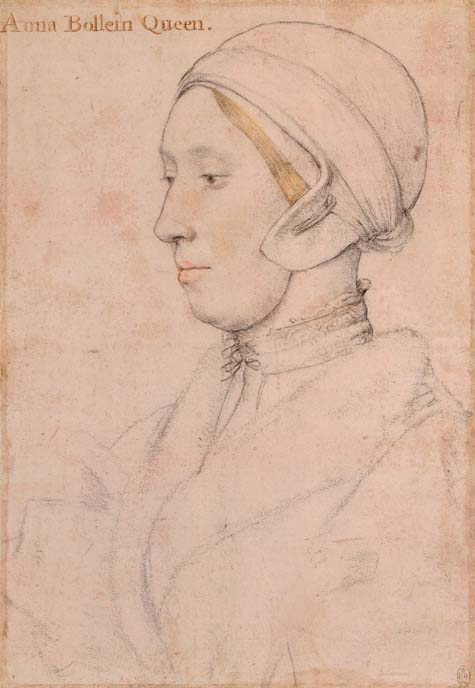
Finally, Prof Roy-Chowdhury evidently did not place much faith in our best contemporary portrait of Anne Boleyn; that by Holbein in the Royal Collection (above). It is true that for much of the latter half of the 20th Century, this drawing was doubted - but mainly because it didn't fit in with the NPG and Hever portrait type of Anne, which many people then thought were contemporary images. Now, however, the Royal Collection describes their fine drawing as showing Anne. Regular readers may recall that I had a role in this. For more details see earlier AHN here.
The idea of using facial recognition technology to identify sitters in portraits has been around for years. But I'm afraid I've never been persuaded by it. Prof Roy-Chowdhury says, according to The Telegraph that:
The programme is so advanced that it even takes into account how individual painters like Holbein and Clouet represented certain facial characteristics, making allowances for artists’ style.
Whilst there can be no doubt that such technology can be used for scanning the faces of real people in, say, CCTV footage or Facebook, there are just too many hurdles to overcome in art.
First, in historical portraits we have no control model to use as a true foundation for a face. All the actual sitters are dead. So while it may be possible to make a computer programme make allowances for an artist's style (and personally I doubt it can) we can never know how an artist translated a real human face onto canvas in the first place.
Then there is the question of wider artistic styles - a Mannerist face will look quite different from a Counter-Reformation face. And finally, there is the question of artistic ability - your average jobbing 16th Century English portrait artists, such as the fellow who made the Hever Castle portrait, would have been simply unable to capture all the intricacies of a face, and could only ever present the very basic elements of a likeness. And sometimes not even that.
Which is why it pains me to have to conclude that another of Prof Roy-Chowdhury's findings can also not be relied upon; that the 'Cobbe Portrait' doesn't show William Shakespeare. As The Telegraph says:
But while the software has cleared up one mystery, it may have opened the doors to several others.
It revealed that two pictures of William Shakespeare are also unlikely to be the bard. The Cobbe portrait which dates from around 1610 is probably not the playwright. Historians have long speculated the painting may be poet Thomas Overbury. The Hampton Court Palace painting is also unlikely to be Shakespeare.
Regular readers will know that I'm not a fan of the Cobbe portrait, and (like the National Portrait Gallery) have never believed that the sitter shows Shakespeare.
You can read more coverage of Prof. Roy-Chowdhury's findings here in The Independent, and here in The Guardian.
For an interesting take on what the British Museum medal might have looked like before it was damaged, see Lucy Churchill's website here.
Update - it's been interesting to see the media response to this story unfold. The presentation of the new research has been uniformly presented as 'experts say'. Despite the fact that Prof. Roy-Chowdhury, while of course an expert in his own field, can hardly be considered 'expert' in Tudor portraits. Would it be too much to ask that news organisations first ask real experts, before presenting stories of this kind as de facto revelations, rather than just speculation?
Update II - a reader tweets:
Count to 1510, Bendor.
Yes, I'm aware I get a bit ranty about this sort of thing. But it bothers me that so many people may be misled by badly presented research.
A sculptor writes:
No facial recognition software is needed to confirm that the portrait of Anne Boleyn in a gable hood (Is it the Nidd Hall portrait?) probably shows the same person as the squashed lead portrait medal of 1534. The curious piece of cloth on the top of the head in both portraits (as well as the gable hood), is the same shape in both, which can't be pure chance. This has often been pointed out before. One only needs a good pair of eyes.
The gable hood moreover (without the piece of cloth on top) is very similar to that in a portrait miniature of a woman by Lucas Horenbolte which Sir Roy Strong believes is a portrait of Anne Boleyn, because of its undoubted similarity to the woman represented in the two Holbein drawings, supposedly of her.
I think it reasonable to suggest that both Nidd Hall portrait and the medal derive ultimately from the Hornebolte, and are vastly inferior versions of the likeness.
On a technical note, I would suggest that the manufacturing method of the medal relates to contemporary and earlier lead alloy ' pilgrim badges' in technique.
A fine grain Silnhofen limestone ( imported from Bavaria), was engraved to form a mould. Into this an alloy of tin and lead (similar to type metal) was poured to make one or many casts.(A similar profile portrait medal in lead alloy of Elizabeth 1 by Steven van Herwijck was cast in 1565).
The image had to be engraved in reverse in the mould for Anne to face in the same direction as the portrait it copied. I think this more likely than that the painted portraits face in the same direction as the medal because they were based on it as exemplar.
To confuse things, in a similarly poor NPG portrait, Catherine of Aragon wears an almost identical hood to the portrait of Anne Boleyn we are discussing.
Quite how poor home grown portraiture seems to have been at the time is clear when we compare these paintings with the marvellous portrait of Catherine of Aragon C. 1502 by Michael Sittow, the Holbein drawings of Anne and Horenbolte's miniature.
The other potential likeness perhaps worth mentioning is the tiny enamel portrait in Elizabeth 1's ring at Hever Castle.
I don't personally subscribed to the theory that the image in the ring referred to here is Anne Boleyn. The evidence to suggest that it is is meagre. I suspect it may just as well be a young Elizabeth I, and that the ring is a private demonstration of 'look how far I've come'; from the 'bastard' daughter of Henry VIII to Queen of England.
Another reader writes:
Having done some work on facial sculpture, I know that computers can reconstruct one side of a face based on the other, barring unknown scars or deformities.
I think the point here, with relation to the British Museum medal, is that there isn't much face to begin with, even on the good side.
Another reader adds, pertinently:
Now Anne Boleyn can join others including Moses and Jesus of whom we have portraits that don't depict their actual likeness.
Another reader refers us to the other Holbein drawing that was for many years claimed to be Anne Boleyn. There is no evidence that the sitter is Anne, and it can be easily ruled out.
Update III - another reader adds:
In my experience, the best software development and application is directed by subject matter experts.
Spot on.
