


Category: Auctions
Lost Rossetti to be sold
April 10 2012

Picture: Telegraph/Christie's
From Colin Gleadell at The Telegraph:
A portrait redolent of one of the most famous romances of the Victorian era has surfaced for sale from a private collection in Scotland where it has been, unrecorded and unknown to scholars, for over a hundred years.
Painted in 1869 by the pre-Raphaelite artist Dante Gabriel Rossetti, it represents his muse, Jane Morris, who was married to Rossetti’s business partner, the artist and designer William Morris.
Artist and sitter first met and were attracted to each other in 1857, but as Rossetti was already engaged to Elizabeth Siddall, she married Morris instead. However, after Siddall tragically took her life in 1862, and the Morris marriage appeared to flounder, the relationship was rekindled.
The year 1869 is generally thought to be when Rossetti reconciled his grief for Siddall with his love for Jane Morris. Though gossip levels ran high, lack of documentary evidence has left historians guessing at the degree of intimacy achieved between them.
Each destroyed the correspondence with the other during those crucial years. The title of the painting, ‘The Salutation of Beatrice’, associates Jane with Dante’s Beatrice, the incarnation of beatific love and the object of Dante’s courtly love. A sonnet by Dante pinned to the wall extols the virtues of courtly love: ‘My lady looks so gentle and so pure…’
The highest price for Rossetti is the £2.6 million paid by Australian collector, John Schaeffer, in 2000 for a pastel drawing of Jane Morris entitled ‘Pandora’, also dated 1869. He subsequently re-sold it in 2004 for £1.7 million. The rediscovery, which is a rare oil painting, is estimated to fetch between £1 million and £1.5 million at Christie’s next month.
The catalogue is not online yet - I'll link to it when it is, and put up a better photo.
'It's a very, very serious painting'
April 5 2012
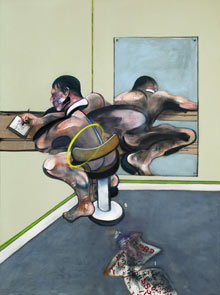
Picture: Sotheby's
So say Sotheby's of this Bacon, Figure Writing Reflected in a Mirror, to be sold at auction in May with a very serious estimate of $30-40m.
The one that got away
April 4 2012

Picture: Christie's
Remember this? Last year, it was in a minor sale as 'follower of Saenredam' with an estimate of £3-5,000. At the last minute the picture was withdrawn. Then, Saenredam scholar Gary Schwartz saw the picture on this blog, and published a fascinating analysis showing how the picture was not only by Saenredam, but showed his house in Assendelft. And now it is to appear at Christie's in the summer, fully catalogued, and with an estimate of £400,000-£600,000. I wonder if AHN will get a credit!
History strikes back
April 3 2012

Picture: Christie's
The sale of the Raglan collection at Christie's has been halted by a last minute injunction. I viewed the sale on Friday, but by Saturday the shutters had come down, and the catalogue taken off the website. The sale was to include an impressive array of items from the 1st Lord Raglan (above), who fought at Waterloo and later commanded British forces in the Crimea. From the Independent:
An 11th-hour injunction has brought a dramatic halt to an auction by Christie's in London of a treasure trove of hundreds of artefacts relating to Waterloo, Wellington and the Crimea.
Heirs of the 1st Lord Raglan, who commanded troops at the Charge of the Light Brigade, are embroiled in a bitter battle over the ownership of military memorabilia. Legal action by one member of the family has cancelled plans by another to sell more than 300 objects, including arms and armour, furniture and works of art, tomorrow.
The treasures, which had been estimated to fetch £750,000, were to have been sold on behalf of the executors of Fitzroy John Somerset, 5th Lord Raglan, great-great-grandson of the 1st Baron (1788-1855), whose military career was at the right hand of Britain's greatest soldier, the first Duke of Wellington, for almost 40 years, during the Peninsular War, at Waterloo, and as private secretary, through to his command of British forces in the Crimean War.
I can't help thinking that the sale's cancellation is a Good Thing. The disputed will also covers the family seat, Cefntilla Court, which was donated to the first Lord Raglan and his heirs by public subscription as a gesture of thanks for his military service. So, on many levels, both collection and house should remain intact. And I'm enough of a romantic to want to see the Raglan family carry on living there (death tax allowing). Personally, I can't quite believe that the late Lord Raglan would not have wished it so.
Although the Christie's sale had some interesting things, it was quite obvious at the viewing that there were few really stellar items. After all, the sale was to be held at the South Kensington saleroom, and not King Street. There were lots of copies, oddities and items of sentimental value. It seemed clear to me that the value of the collection as a whole, both financial and historical, far outweighed that of the individual items.
There is, seperately from the family dispute, a campaign to save the collection. Knight Frank, who were marketing the house, have now removed it from their website.
ps - news of the injunction was revealed by me on Saturday over on Twitter. If you would like to know the latest art history titbits as they happen, you can sign up here.
That forgetful auctioneer
April 2 2012
Following my tale of frustration last week, a reader writes:
I think you should name and shame!
While another writes:
I do tho sometimes feel sorry for auctioneers and think I could well do the same in their place.
Annoying things that happen to an art dealer no.27
March 29 2012

Spotting a sleeper at a regional auction house (in this case a 'Harlequin' portrait of Bonnie Prince Charlie catalogued as 'Portrait of a Scottish Nobleman'), booking a phone line, and then the auctioneer not calling you. Particularly annoying if, like me, you're slightly obsessed with the Jacobites.
Update:
A reader writes:
I tried to book a telephone bid [...] too, and they didnt reply to me either. They sometimes do reply, and sometimes sell things reasonably. But isnt it a copy after a print in the National Gallery of Scotland, so maybe not a bargain?
Those Chinese non-paying bidders
March 27 2012

Picture: The Saleroom
It seems one English auction house, Nicholsons, house has had enough of the non-payers. Bidders in their forthcoming sale must be vetted before they go over £5k.
More on the Coleridge collar
March 23 2012

Picture: Christie's
A reader alerts me to this good write up in The Economist of the sad story of the Coleridge collar I mentioned earlier this week. It reveals that Lord Coleridge will now have to pay costs of about £1m:
...because he lost the case, Lord Coleridge has to pay 90% of most of its costs, estimated at £1m. Hearing the verdict was like listening to a morality tale. There was much to learn from it.
Essentially, if a work of art or an antique is of personal or financial importance, it pays to get a second opinion if you don't much care for the first one. The job of an expert is to use acquired skills and natural gifts to narrow the gap between opinion and fact. The better the expert, the more narrow the gap—but it never disappears entirely. Experience teaches collectors, dealers and art historians that mistakes are unavoidable. Learning from them is often more beneficial and less expensive than going to court.
As it happens, the chain was bought at Christie's in 2008 by Christopher Moran, who has built on enormous Tudor-style house alongside the Thames. Perhaps he will not mind having a collar that now is widely considered to be Tudor style, rather than the real thing.
I don't know what Christopher Moran thinks of his chain now, but I do know that he was very well advised at the time he bought it. And if I were in Moran's place, I would have no doubt at all about my purchase.
There was one other aspect of the case which has slightly troubled me. A point made by Lord Coleridge's barrister was that Sotheby's should have made more effort to establish the value of the chain, even if it was 17th Century. The only comparable 17th Century collar had been sold for £300,000 by the London dealers S J Philips some years earlier - ten times what Sotheby's said Lord Coleridge's collar was worth as a 17th Century item. But, according to the Antiques Trade Gazette:
...Judge Pelling rejected the idea that S.J. Phillips would have revealed the price to Sotheby's, whom they would consider rivals in the market. He went on to conclude that, in general terms, contacting retail dealers with regard to value was unrealistic.
As a dealer, I'm not sure this is entirely right.
Update:
A reader involved in Sotheby's defence writes:
I have just seen your piece on the Coleridge Collar. SJP did not sell the collar to Arthur Gilbert for £300,000. The figure given in court by Lord Coleridge's expert witness was inaccurate. The precise figure of 300,300 was taken from an inventory in the V & A which should never have been made public. In any case the figure is a US dollar conversion of the price paid by Sir Arthur at the prevailing exchange rate. The price paid to the Richards's family solicitors, from whom the Gilbert collar originally came, was considerably less, though not paid by SJP, and very close to Sotheby's estimate of the less good Coleridge Collar.
If I understand this correctly, the relevant figure is what Sir Arthur Gilbert paid for his chain, not what its original vendors sold it for. Something is worth what someone is prepared to pay for it. And it seems from this that Sir Arthur Gilbert paid considerably more than the Coleridge collar was valued at by Sotheby's.
A Murillo discovery at Maastricht
March 23 2012

Picture: BG
A picture I liked yesterday at Maastricht was this small oil by Murillo of The Vision of Saint Anthony of Padua. It was with the Madrid gallery, Caylus, and had been plucked from under everyone's noses (including mine!) at an Old Master auction in London, where it had been catalogued at Christie's as 'Studio of Murillo'. It sold for just £10,000. The picture is a little gem, and since the vetting at Maastricht is fairly tough, there can't be much doubt about the elevation from Studio to autograph. Caylus have also established some solid provenance for the painting, going back to Marechal Soult, Napoleon's famous general.
On the subject of vetting, I heard yesterday of a picture previously offered by an auctioneer for many millions which was vetted off by the committee at Maastricht. Ouch. I'd love to tell you about it, but am sworn to secrecy. (Oh alright then, it was from Sotheby's).
More fakes at auction?
March 21 2012

Picture: TAN
This time, Greek ones (allegedly). A leading Greek collector is suing Sotheby's over two alleged fakes. According to Riah Pryor in The Art Newspaper:
The collector Diamantis Diamantides, who owns the shipping firm, Marmaras Navigation, is one of the biggest buyers of Greek art. He bought Still Life Before the Acropolis [by Constantin Parthenis] from Sotheby’s, London, in 2006 and set a record price for the artist when he paid £670,100 for The Virgin and Child in the same saleroom in 2007. Both works are believed to have been consigned by the same two people, although Sotheby’s declined to disclose who they were.
Doubts were soon raised over the authenticity of the works. Diamantides eventually lodged a complaint against the auction house and Constantine Frangos, the London-based senior director of Greek art at Sotheby’s, in February 2010, saying that they fraudulently induced him to buy forgeries. A spokesman for Sotheby’s denies this vigorously, saying: “It stands to reason that an auction house that sells billions of dollars of art a year, and relies on its reputation to secure consignments and purchasers, would not put its business at risk by knowingly selling forged works.” The spokesman adds: “We are reviewing further evidence that has been submitted concerning the authenticity of the works.” A decision on the case is expected shortly.
That Sotheby's statement was looking really convincing until the word 'knowingly' creapt in there. I doubt anyone really thinks a major auction house like Sotheby's knowingly sells fakes. The question is, how rigorously are works checked before sale? As we know from the Beltracchi case, the answer is, sometimes, not very.
The illustration above is of one of the earliest suspected recent Greek fakes, Lady in White, meant to be by Dimitrios Galanis. From TAN:
Rumours of widespread forgery began in 2008 when Bonhams rejected a work, Lady in White, by Dimitrios Galanis (1880-1966) and said “further research” on the work was needed. The sheer volume of works coming on to the market also raised suspicions, especially as the country has relatively few well known modern artists.
A sharp-eyed reader has been in touch to say that it is a copy of a well known painting by Meredith Frampton in the Tate. He says:
One wonders at Bonhams having to do further research on the piece!
That, I suppose, is because the picture wasn't 'rejected' by Bonhams quite as The Art Newspaper suggests - it had in fact been included in a sale, with an estimate of £50-70,000, and had to be withdrawn. Whoops! Here's the original catalogue entry for the picture, which, in retrospect, is hilarious, and a contender for 'Guffwatch of the Decade':
Discovered in Germany by its present owner, this stunning portrait sheds new light on Galanis’ scarcely recorded German period, making it a rare piece, extremely valuable to scholarly research. In his seminal account on the painter - the first Greek to be accepted among the European avant-garde, art historian M. Mavrommatis holds that “we might never be able to reconstruct this period in his career, unless new evidence comes to light." [...]
A startling example of fine portraiture, the painting on offer is a penetrating study in formal balance, eventually unfolding into abstract rhythmic designs in which contours and colour harmonies are mutually interdependent. The pleated curtain on the upper left is ingeniously echoed in the lower right, its greenness repeated in the tablecloth and leafage, its columnar verticality surviving in the stripes of the vase and its sculptural presence resounding in the art-deco solidity of the flower motifs. Likewise, the warm red of the wall is picked up in the sitter’s shoes and lips, while the round form of the side table is supported by a series of curvilinear themes in both the sofa and the sitter’s body. These magnificent and well-thought harmonies provide the solid framework on which Galanis would mount the focal point of his composition: the striking antithesis of brooding black and brilliant white in the centre of the painting.
The effect of the picture is heightened immeasurably by the sitter’s commanding presence, confident stare and aristocratic posture. Devoid of any jewellery and wearing a simple, virginal dress, the sitter becomes a symbol of nobility without the glitter of high society. In this picture Galanis’ achievement is one of utter elegance and majesty, phrased by an almost musically articulate series of formal elements that weld the image and its attendant attributes into a compelling entity of idealised, eternal beauty.
What is 'columnar verticality', by the way?
'The Painter's Indiscretion'
March 20 2012

Picture: Bonhams
I bet Van Dyck did this. Augustus John certainly did (and worse). 'The Painter's Indiscretion' is by the Polish artist Ladislaus Bakalowicz (1833-1904), and is coming up for sale in New York at Bonhams, estimated at $6-8,000.
Why you should always get two auction estimates
March 19 2012

Picture: Christie's
There is a very sad tale in this week's Antiques Trade Gazette, which, however you look at it, reflects badly on the antiques world. In 2006, Lord Coleridge, needing to raise some funds, asked Sotheby's to look at his heirloom, 'the Coleridge Collar' (above). The Chain was said to have been worn by every Chief Justice of the Common Pleas between 1551-1873. But Sotheby's said it was late 17th Century, not a Tudor original, and valued it at £35,000. Seeing that the Chain was worth less than he had hoped to raise, Lord Coleridge made what he described as the 'traumatic' decision to sell his Devon home, Chanter's House, where his family had lived since the 18th Century. He also included the Chain in the sale to the new owners.
But then, two years later, the new owners sold the Chain, as a Tudor original, at Christie's for £313,250 (inc. premium). Lord Coleridge, understandably miffed, decided to sue Sotheby's. But last week he effectively lost the case, and now has to pay costs of many hundreds of thousands of pounds. From the ATG:
Essentially Lord Coleridge's case was that Sotheby's had taken too little time and care in researching the chain. His legal team set out to prove this with recourse to scientific testing, analysis of manufacturing techniques and prolonged and vigorous cross-examination of witnesses. But the judge's verdict was that all this effectively added nothing to the conclusion reached by Sotheby's expert Elizabeth Mitchell during what he acknowledged was a hurried visit to the Coleridge family home to inspect the collar: namely that there was no record of the chain prior to 1714 and that there was nothing to prove that it was not of post-Restoration manufacture.
This ultimately means that a court has decided the Chain is not certainly Tudor, so where that leaves the new owners, and Christie's, I don't really know. I'm no specialist in this field, but I saw it at the 2008 sale and it seemed to me entirely genuine, and of Tudor origin.
Auction houses selling ever more by private treaty
March 19 2012
There's an interesting snippet in the Antiques Trade Gazette showing how auction houses are conducting more and more private treaty sales. Last year, Sotheby's sold a total $4.9bn of works privately, up 7% from last year. That's 16.5% of their total sales.
The flipside of this, of course, is that an increasing number of works which appear at auction are not as 'fresh' as they might appear - freshness to market being a key driver of desirability at auction. In fact, such works are only in the auction because they have failed to sell when offered directly to clients as private treaty sales. I know of one major old master sold at auction in New York recently for $17 million (there's a clue), which had been touted around at prices of up to $50m before the sale. Not surprisingly, it generated only a single bid when it finally had its day at auction.
Getty acquires new Watteau discovery
March 16 2012

Picture: Getty Museum
Exciting news from Los Angeles, where the Getty has acquired the above picture by Watteau, The Italian Comedians. There is, however, a twist. Not everyone agrees it is by Watteau. From the LA Times:
Depending on which expert you ask, it is either a rare large canvas by one of France's greatest artists, Jean-Antoine Watteau, or the work of somebody else.
Scott Schaefer, the Getty's senior curator of paintings, said that before deciding about a month ago to buy the oil painting from a London art dealer, museum leaders sought opinions from "almost all major Watteau scholars in the world," each of whom had seen the painting in person.
The vote was 7-3 in favor of it being either solely by Watteau, who was 36 when he died in 1721, or a canvas the master had left unfinished, to be completed by another hand — possibly his student, Jean-Baptiste Pater, to whom the painting was sometimes attributed during the 20th century.
"It's so emotionally engaging that, for us, it can only be by Watteau," Schaefer said from Maastricht, the Netherlands, where he was attending the annual European Fine Art Fair.
The doubters, he said, did not say who they believed had painted the piece, which is 3 feet wide and slightly more than 4 feet tall. "But everyone, including the naysayers, thought it was a magnificent picture."
As revealed on AHN here at the time, the picture came up at auction last year in France, where it was catalogued as 'Circle of Watteau', and with an estimate of EUR40-60,000. The picture was enticingly catalogued, with plenty of supporting evidence to suggest the picture was by Watteau, such as preparatory drawings by him. I remember thinking it looked like a very fine picture, but that other specialist dealers who knew more than I do about French painting were sure to bid on it. And lo, it made a hammer price of EUR 1 million. You can watch a video of it selling here. Although I haven't seen the picture in the flesh, I don't doubt that the Getty wouldn't have bought it unless they and others were absolutely sure it was by Watteau. So many congratulations to them, and to the London dealer who bought it. It's always good to see the art trade contributing to art history with important discoveries like this.
More details on the Getty site here.
Caveat Emptor
March 12 2012

Picture: BG
Intrigued by the above advert in the London Evening Standard, I went along to what seemed like the auction of a lifetime in London yesterday. A Van Gogh for sale at 'total inventory clearance' prices? Too good to miss, I hear you say.
Too good to be true, of course. It was a motley selection of prints, some 'signed', and sold in the strangest 'auction' I think I've ever seen. The lots were put up randomly, with each one preceded by a little speech on how valuable it was. Sometimes (with a Dali for example) the auctioneer made reference to a 'price guide' he had, saying the print was worth £4500, but then starting the 'bidding' at a bargain £1500. And still nobody bought it.
Anyone attending the one hour viewing (that tells you something), was first given a lengthy and seemingly inane document detailing the history of printing, which, at the very end, set out the difference between a 'Fine Art Print' and 'a poster' (answer, not very much). I guess this was to avoid any difficulties on the legal front. The auction itself started with a tale of how all this fine art was being sold so cheaply: because a US art gallery had hoped to establish a large gallery in London, and had shipped all this investment quality art to the UK - but, at the last minute, 'the real estate deal fell through', and so the stock had to be sold off. What a curious way of doing business! (I presume the same tale was given at the previous weekend's auction in Birmingham.) As they used to say in the News of the World, 'I made my excuses and left'.
New discovery heralds 'Zoffany' at the RA
March 7 2012

Picture: BG
Well, where to begin? The classy layout? The excellent catalogue? The varied and invigorating selection of works? The virtuoso display of the dying art of curation? For me, there aren't superlatives enough to describe the new Zoffany exhibition at the RA. Yes, Zoffany may never be in the top rank of artists from his ultra-talented generation. But there are few artists who tell us more about painting and painters in the 18th Century.
Born in Germany, studied in Italy, celebrated in England, and, at the end, almost abandoned in India, this perpetually peripatetic artist and his unprecedentedly varied network of patrons from German kings to Indian maharajahs gives us an unparalleled view into how art was valued and commissioned in the 18th Century. We can see in Zoffany the desire for large formal portraits, for conversation pieces, for subject pictures, for landscapes, for still lifes, for historical pictures, and even religious ones. He could paint the lot. True, the studied control of his paintings may bely a lack of fluency, and even genius in handling oil paint. But he was still capable of producing great paintings, such as the Tribuna [Royal Collection]. What he may have lacked in talent, he made up for in labour.
And in this exhibition, excellently curated by Martin Postle, we can see the whole range of Zoffany's work. Proof of how varied he could be in his approach comes in an exciting new discovery of the above landscape The South Gate of Lal Bagh, Dhaka, dated 1787. This picture was at auction in Sotheby's only last December, where it was catalogued as by Robert Home. I remember standing in front of it and being sure it wasn't by Home (on whom I'm something of an anorak), but I never made the connection to Zoffany. The figures are so unlike his usual figures, more sketch-like and elegant. But there, hanging next this landscape at the RA is another very similar scene by Zoffany which confirms the attribution beyond doubt. The picture was estimated at £60-80,000 at Sotheby's, and seemingly didn't sell (I'd value it at about £250,000 now). It's a great coup for the exhibition, and an important discovery, being one of only three surviving landscapes from Zoffany's time in India.
But perhaps the most pleasing thing about the show is that it is happening at all. This kind of single artist, scholarly exhibition is seen, at least amongst those who now control many of our exhibition spaces in the UK, as unfashionable. Now, funders and marketing people want 'thematic displays', onto which you can tag on topics of (dread phrase) 'contemporary resonance'. It should forever be to Tate's shame that they cancelled this exhibition ('too idiosyncratic' apparently), not least when we see the piss-poor effort - 'Migrations' - they have put on in its place. And it should be to the Royal Academy's perpetual credit that they have stepped in and rescued it. I suspect that most of all, however, we have to thank the Yale Center for British Art, who first sponsored the exhibition. Ultimately, of course, we must be grateful to the late Paul Mellon, whose largesse is now almost single-handedly keeping good old-fashioned art historical research in the UK going, not least through the Paul Mellon Centre in London. If it wasn't for his money, these kind of exhibitions, with their spin-offs of new research and discoveries, would most likely not take place any more. So please support the exhibition by going to see it. I promise you won't be disappointed.
£8m-£12m Rembrandt at Christie's
March 5 2012

Picture: Christie's/Bloomberg
Christie's have released a sneak preview of their July sale, and will include the above Rembrandt Bust of a Man in a Gorget and Cap at £8m-£12m. The picture is on panel, and dated to 1626-9. Interestingly, according to Bloomberg:
Christie’s plans to stimulate fresh interest in historic paintings by taking the single-owner collection on a promotional tour to Doha, Moscow, New York, Hong Kong and Amsterdam before its sale.
A Lely in Louisiana?
March 5 2012

This came up for sale over the weekend in the US, and made a strong price. Catalogued as 'Follower of Van Dyck', the picture looked to us like a portrait by Sir Peter Lely, from early in his career. The sitter was identified as Lady Newburgh.
Exclusive - the next mega acquisition?
March 2 2012

Picture: Tate
Hot on the heels of the £45m Titian purchase, a reader has alerted me to this, which has quietly appeared on the Arts Council's website, under 'Notices of Intention of Sale':
Arts Council England has received notifications of sale for the following items which have previously been exempted from capital taxation. Please note that the price given is intended as a rough guide only, and does not constitute an offer to sell at this price. The practice of the auction houses is usually to pitch this at their high auction estimate or, sometimes*, even higher.
Pablo Ruiz Picasso (1881-1973)
Child with a Dove, 1901, oil on canvas, 73cm by 54cm
Guide price: £50,000,000
It would be helpful to know if the £50m includes the tax liability, and the extent of it (in the event of a UK museum purchase, the tax due would be written off by the Treasury). No UK museum could afford the full £50m (unless the Heritage Lottery Fund has a miraculous change of heart on acquisitions). The picture used to belong to Samuel Courtauld, and has passed down from him by descent. It has been on long-term loan to the Courtauld Institute, and is now on display at Tate Britain as part of the Picasso and Modern British Art exhibition. (Normally, the Tate has strict rules about this sort of thing - but I suppose these days it's enough to know they won't chuck it out by mistake).
If you're interested in the picture, but haven't got £50m, you can buy a poster of it for £25 at the Tate shop.
* for which read 'invariably'.
Guffwatch
March 2 2012

Picture: Christie's
Just as I was thinking 'I haven't done a Guffwatch for a while', along comes Christie's New York with some glorious candidates from their forthcoming ''First Open' Post-War Contemporary Art Sale'.
Here's the introduction to Wade Guyton's Untitled (above, inkjet printed on linen, executed 2006), estimated at $200,000 - $300,000:
A candid example from the artist's ongoing series of "printer drawings," Untitled poses a poignant double query of form and function. By folding the primed linen in half and repetitively feeding it through a large-format inkjet printer, Guyton performs an obsessive ritual that can only be realized by modern means of photographic reproduction. And all the while, the artist is also paying a personal tribute to form by referencing modernism and conceptualism.
Phoney words for a phoney picture. Think of it this way, if Nick Penny wrote verbiage like that to describe Titian's Diana and Callisto, we'd laugh at him.
Still, proof that even those skilled in art guff can sometimes struggle to produce anything meaningful may be found in Christie's catalogue entry for the top lot in their sale, a Hirst spot painting estimated at $600-800,000. The entry is simply a lame and seemingly random excerpt from a 1996 interview with Hirst. Here's a snippet:
Damien Hirst: Imagine a world of spots. Every time I do a painting a square is cut out. They regenerate. They're all connected.
Stuart Morgan: Why are you cutting out squares? Is this a cipher for infinity?
DH: It's an idea of painting and I've always wanted to paint but this is more sculpture than painting. I guess it's infinity.
SM: And in front much smaller versions of infinity, like people dying. [...] How do you feel about nature?
DH: I've seen better (laughs). There isn't anything else.
In case you were wondering:
First Open is the perfect opportunity for new and established collectors who are eager to discover emerging artists and ready to explore lesser-known works by famous artists.
In other words, the not so good stuff (laughs).
