


Category: Auctions
Why you shouldn't trust an auction house condition report
October 21 2011
This was the condition report on a head and shoulders portrait of a gentleman, which we recently bought from a prominent regional UK auctioneer:
Fine craqueleure in areas, several deep scratches to lower half that require retouching, some old restoration, would benefit from a clean.
You wouldn't guess from this that the scratches (actually rips in the canvas) were in the face, the most important part of any portrait. And not least because the face was in the top half of the painting!
Artist exposes fake at auction in China
October 20 2011

Picture: China Daily
One of China's hottest contemporary artists, Zhang Xiaogang, has exposed a fake of his work that was about to be sold at auction. From China Daily:
The portrait of a young girl was among the modern and contemporary artworks that Beijing Tranthy International Auction Co Ltd had gathered for its autumn auction.
On Tuesday, a Sina micro blogger asked Zhang to authenticate the painting. He replied on the website: "It's a bad fake at first sight. Poorly done. How dare someone put it up for auction." [...]
Tranthy Auction has withdrawn the piece Zhang identified as fake from the auction and apologized to him. A source with Tranthy who refused to be named said that on June 2 the painting sold for 1.8 million yuan (then almost $278,000) at Beijing Yinqianshan International Auction House.
I suspect this happens all the time. I'm often told that one of the reasons people prefer to buy contemporay art instead of old masters is that they can be certain about the attribution. But these days that just isn't the case. There are fakes everywhere (and of course, some might say that many of these contemporary works aren't hard to fake). The added problem in China is that the country's auction houses are exempted, by law, from giving any guarantee or authentification of the works they sell.
Finally, I love the defence put up by one of the auctioneers:
He went on to challenge the painter: "Does Zhang remember clearly how many paintings he has done through his life?"
Feast your eyes on...
October 19 2011

Picture: Christie's
...this, at $25-35m, a cast of Petite danseuse de quatorze ans by Degas in the 1st Nov Impressionist sale in New York. From Christie's catalogue:
Petite danseuse de quatorze ans is widely regarded as one of the most innovative and important sculptures of the modern era. A candid depiction of a young dancer at two-thirds life-size, the Petite danseuse is the largest, most technically ambitious, and most iconographically complex of Degas's sculptures, and the only one that he ever exhibited during his lifetime. It therefore stands apart from the remainder of Degas's sculptural output, which numbered more than a hundred and fifty extant figures or fragments at his death, and represents the pinnacle of his achievement in this medium, to which he devoted a great deal of time and energy over the course of his career.
This is one of 38 casts. The ex-Sir John Madejski cast sold at Sotheby's in 2009 for £13.25m.
Pietro Psaier - new evidence?
October 17 2011

Picture: pietropsaierartist.com
This is meant to be a photo of Pietro Psaeir, an artist who was friends with Warhol and whose works fetch thousands at auction. The problem is, nobody really knows if he existed. The regional English auctioneer John Nicholson has held a number of sales of his (frankly, very poor) paintings, chiefly collages, along with occasional sales by the likes of Sotheby's and Christie's. But there have been perpetual reports that the whole Psaier industry is a scam.
Psaier's advocates have a website which claims to have proof of his existence and work, including the above photo. But there is hardly any evidence to go on, not least because Psaeir was apparently killed in the 2004 Tsunami, and both his beach house and body were never found.
Now, writing in the Guardian, Tim Williams has published some further evidence to claim that the whole Psaier industry is nothing more than a cynical fraud. And I think I believe him.
Guardi blocked for export - but for how long?
October 17 2011

Picture: Sotheby's
The vain attempt to stop some of the greatest paintings in England being exported continued today when Francesco Guardi's epic View of the Rialto Bridge was deferred for six months. A UK museum now has six months to try and raise the £26.7m needed to match the price paid for it at auction earlier this year.
A quick look at the value of paintings temporarily refused export shows that the more expensive the picture, the more likely it is to end up being exported (usually to a US museum). The plain fact is that due to the slashing of acquisition funds over the last fifteen years or so, no British museum can afford to compete with international institutions. And, because the recession is creating more selling pressures for the owners of these great works, we have a 'perfect storm' situation for the UK to lose forever some of its greatest treasures.
There is of course one quick and simple way this situation could be avoided - and that is the restoration of a proper acquisition fund. When I was helping to write Conservative arts and heritage policy before the 2005 election (with Hugo Swire MP and John Whittingdale MP) we suggested the creation of a National Acquisition Fund, to be supported by funding from the National Lottery.
David Cameron, who was then in charge of policy and with whom I drafted the arts and heritage manifesto, thought it was a good idea. But so far we've not seen anything similar under the present administration. But the Lottery, or specifically the Heritage Lottery Fund is the one funding stream which has had an increase in revenue, thanks to the Conservative policy (copyright, Whittingdale, Swire & Grosvenor) to increase its share of the Lottery pie. The only problem is, the HLF does not like to fund the acquisition of paintings. It would, via a statutory instrument, be the work of a moment for the government to overturn the HLF's reluctance - so what are we waiting for?
Christie's Contemporary sale lifts the gloom
October 15 2011
Picture: Christie's
Christie's comprehensively beat Sotheby's this week in the battle of the contemporary art sales. Where Sotheby's totalled only a below estimate £17.8m, Christie's came in with an above estimate £38m.
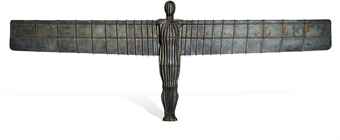
One of the star performers was a maquette by Anthony Gormley of The Angel of the North (above), which sold for £3.4m (inc. premium) against an estimate of £1.5m-£2m. As a guide to how fast the contemporary market can move, it was only in 2008 that Philip Mould's valuation of another Gormley maquette of The Angel made headlines as the first Antiques Roadshow item to beat £1m.
'The mood has changed'
October 14 2011
So says London-based art dealer Edmondo di Robilant, discussing last night's weak contemporary art auction at Sotheby's. A number of high-profile lots failed to sell, and although the Sotheby's press release talks boldly about records being broken, a closer look at the numbers reveals a different story.
The Contemporary Art Evening Sale, Sotheby's major event of this important contemporary art week (alongside Freize) raised a total of £17.8m. This figure includes buyer's premium, whereas the the pre-sale estimate of £19-26m does not. So knock off a couple of million for premiums, and you get a total hammer price some way below even the lower pre-sale estimate. That's not good, however you spin it.
From Bloomberg:
Some paintings went unsold, such as Peter Doig’s “Bellevarde,” valued at as much as 2 million pounds.
“That would have sold a year ago,” the London-based dealer Edmondo di Robilant said. “The mood has changed. Auction houses entice things with high estimates and in the past they’ve been able to sell them. That wasn’t always the case tonight. A number of lots that sold were knocked down against lowered reserves.”
Dealers said economic worries were weighing on some buyers. Even headline-grabbing pieces such as Marc Quinn’s 18-carat gold sculpture of Kate Moss in a yoga pose attracted just one bid. The 2008 “Microcosmos (SIREN)” was knocked down to a bidder represented by Patti Wong of Sotheby’s Asia for 577,250 pounds.
There was also just one telephone bid for the 1952 close-up portrait “Boy’s Head” by Freud, who died in July, aged 88. It was valued at 3 million pounds and fetched 3.2 million pounds.
The word is that Frieze this year hasn't exactly been stellar. So - what's going on? Is it the economy? Has the price-it-high and sell-it-low game played by the auctioneers finally been rumbled? Or, is the excesseive hype around contemporary art beginning to fade. Probably a combination of all three.
Which one is by the Orangutan?
October 14 2011
Picture: Sotheby's/Hogle Zoo
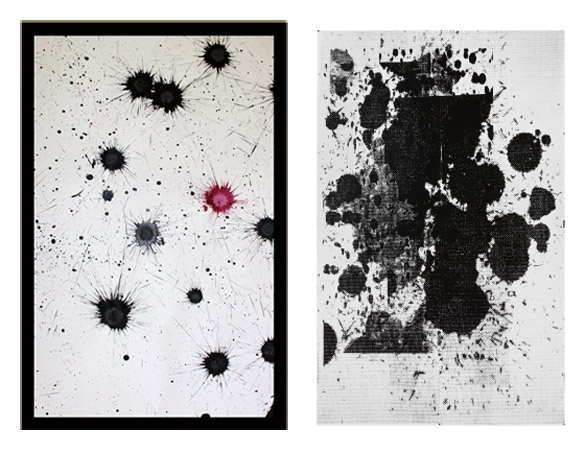
Which one of these sold last night at Sotheby's for £421,250 and which one was painted by an orangutan? I bet quite a few of you get the answer wrong.
Ok, I know it's a tired old cliché. But you've got to admit that this particular Orangutan, Acara (b.2005), is pretty talented...
Here's the catalogue note for Untitled by Christopher Wool:
Wool's attitude towards the role of images in our culture today, one which he shares with contemporaries such as Prince, Oehlen, Cady Noland and Kippenberger, has become increasingly important to a younger generation of image makers, including New York artists Wade Guyton, Josh Smith and Kelley Walker.
And here's the note for Untitled by Acara;
Born here at Utah's Hogle Zoo in 2005 to Elijah and Eve, Acara inherited some of her talent for art from her parents. She has been the most consistent and reliable orangutan in her desire to paint when asked to, and rarely turns down an opportunity to create a masterpiece. Still learning her craft, she has been an intent observer of the techniques our human guest artists have used, and has then used these techniques in her own work. She seems to be the most versatile in using different materials as well as different styles and can be counted on to deliver a finished piece in mere moments.
If you like Acara's work, then why not buy some here to help protect orangutans' native forests around the world.
The Madoff Curse
October 12 2011
Picture: Christie's
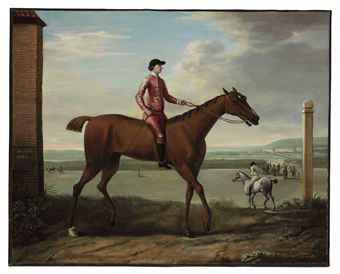
That Wootton once owned by Bernie Madoff failed to sell again today at $70-100k. An after-sale offer of $30k would probably do it. A better investment than any fund of Madoff's...
The price of bad provenance
October 11 2011

Picture: Christie's
A picture from Bernie Madoff's collection will be sold at Christie's in New York tomorrow. Brocklesby Betty, 1718, by John Wootton has an estimate of $70,000-100,000. In the first Madoff sale in June this year it had an estimate of $140,000-169,000. Strangely, this time it is being offered in a 19th Century European Paintings sale, which is hardly the right auction.
Being an auctioneer
October 11 2011

Picture: Sotheby's
Here's an enlightening video from Sotheby's about being an auctioneer. It's a touch laudatory, but includes interesting snippets from Henry Wyndham (above), who's the best in the business.
Money for old rope (with a dead child on it)
October 10 2011
Picture: BG
Viewing the London contemporary art auctions is one of the highlights of my art market year, as the auction houses transform their sale rooms with dramatic lighting and enormous estimates. Where an old master sale is crammed with pictures, people and conversation, contemporary sales are hushed, reverential affairs where no expense is spared. Every piece of art is treated as if it were a priceless masterpiece, its virtues extolled to gullible collectors by trendy specialists in look-at-me glasses. Even the labels are larger than usual, to cope with all those extra zeros. It's worth going just to marvel at the sheer decadence of it all.
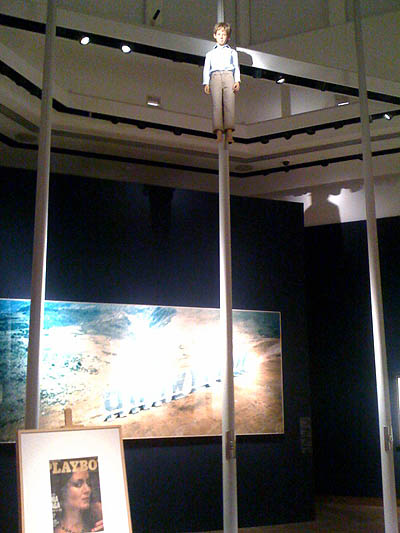
The above caught my eye at Christie's. Maurizio Cattelan's Untitled consists of three flagpoles. At the top of one hangs a life-like dummy of a child on a rope. It is the centrepiece of this week's Contemporary Art evening auction on 14th October. At the entrance to the room in which Untitled is displayed is a sign saying:
Please note an artwork in this room is of a challenging nature. Please ask a member of staff if you require any further guidance.
Powerful, or revolting? You decide. But at £900,000-£1,200,000 it provides a telling narrative of the time we live in.
Restitution - a case study
October 10 2011

Picture: Philip Mould Ltd
This is worth going to: Dr Clarence Epstein of the Max Stern Art Restitution Project will be in London on 20th October to give a talk on tracking down Nazi-looted art. Max Stern was a Jewish art dealer forced to dissolve his business, with his pictures sold at knock-down prices. The lecture is at 8pm at Goodenough College, Mecklenburgh Square London (near Russell Sq.). Call 020 7520 1535 for seats.
We recently gave the above Flemish picture back to the Stern collection. It had originally been sold from Stern's collection at Lempertz auction house in Germany. And guess where we bought it, unknowingly, some 70 years later? Lempertz. And would they give us a refund? Nein...
Elizabeth Taylor - up a Hals, down a Modigliani?
October 5 2011
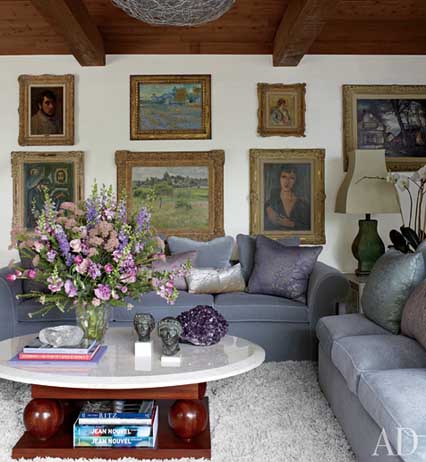
Picture: Architectural Digest
Yesterday saw the news that Elizabeth Taylor had a previously unknown Hals portrait in her collection. But today we find that her Modigliani (lower right, above) is in doubt. Is part of the problem the seemingly vice-like grip over Modigliani 'expertise' by our old friends the Wildensteins? From the LA Times:
When asked about the painting... Christie's Americas head Marc Porter said it was not appearing in a Christie's sale.
"There is a great controversy in the Modigliani authentication world because Restellini and Wildenstein are supposed to be producing new catalogue raisonné."
"So many collectors of her generation have bought Modiglianis that in this time period can't be authenticated," he added. "There are dozens of Modiglianis waiting to be established."
Elizabeth Taylor: Actress, Star, Connoisseur?
October 4 2011

Picture: LA Times
A portrait from Elizabeth Taylor's collection has been identified as a Frans Hals by Christie's. Previously, the picture was considered to be an imitation of Hals' work. From the LA Times:
The painting, "Portrait of a Man, Half-Length," was for decades thought to be by an imitator or student of Frans Hals, the great Dutch painter often compared to Rembrandt for his vigorous, sometimes humorous depictions of the growing merchant class. Now Ben Hall, the head of Christie's Old Masters department in New York, is making the case that Taylor's painting was the handiwork of Hals himself. An expert in Hals' work agrees.
With the change in attribution comes a change in projected value: a canvas that would have likely brought less than $100,000 could now bring $1 million in an Old Masters auction in January.
The re-attribution is an example of the importance of seeing a painting, long known through reproduction, in the flesh. In the 1970s, the painting appeared in scholar Seymour Slive's catalogue raisonné on Hals — the industry standard for what is and is not authentic — as "doubtful and wrongly attributed." But Slive only saw the work in a black-and-white reproduction.
Hall, on the other hand, saw the painting in person in July, when it arrived at Christie's Rockefeller Center warehouse with other material from Taylor's estate. He said it "packed a real punch — making a tremendous impact from even 20 feet away."
Exclusive - Nazi loot extortion attempt foiled?
October 3 2011

Picture: The Art Newspaper
The Art Newspaper recently reported on an attempt to sell a painting by Jan van Huysum stolen from the Palazzo Pitti in 1943/4. The picture had been evacuated from Florence in 1943, but was 'acquired' by a German soldier in Italy in 1944 'in exchange for food'.
Now, the soldier's grandson wants a EUR2m 'finder's reward' for returning the picture. He is threatening to sell the painting if he doesn't get the money. The demand has come through Edgar Liebrucks, the German lawyer who represented those who handled the Tate's two stolen Turners in 2002-4, for which the museum paid a ransom fee for information of £3.5m.
Liebrucks has proposed that if the picture is worth EUR 10-12m, then it should be sold at auction with 80% of the proceeds going to the museum, and the balance to his client. Liebrucks says:
My client needs the money, and it is feared that he will sell the painting elsewhere. I hope this will never happen.
Well, Edgar, I hope it doesn't happen either. After The Art Newspaper reported the story, I contacted The Art Loss Register. Surely, if the picture was not lawfully disposed by the Palazzo Pitti, it cannot legally be sold now? And sure enough, it can't. The picture is now listed on the Art Loss Register's database, ruling out the auction option at least. So if Mr Liebrucks and his client still want to squeeze money out this shoddy deal, they'll have to think of a plan B.
Guffwatch: Koons special (Vol.III)
September 29 2011

Picture: Sotheby's
Sotheby's has put together an entertaining film called 'The Artist'. The premise is, what inspires great artists to make their great works? As Sotheby's auctioneer Tobias Meyer asks in the introduction:
How could Michelangelo paint the Sistine Chapel, how did he come up with all these compositions? How did he do it? It's a miracle.
Cut to Jeff Koons (sitting, I presume, in his studio with four assistants making his works behind him) - so, how do you do it, Jeff?
My father was an interior decorator, and from a young age I would see all the samples for carpet and wallpaper and I was also around a lot of objects. I really learnt about how colours and textures really can effect emotionally how you feel about things. My grandfather used to have an ashtray, it was of a woman lying down on a couch, with her legs in the air and if you put a cigarette here the heat from the cigarette would make the legs go back and forth... I was so fascinated by that, so it had a big influence on me... [etc., etc.]
Can't you just imagine Michelangelo saying something similar? Still, the film is worth watching for the views of some other, more enlightening artists.
Lost Sassoferrato found in US?
September 27 2011

Picture: Fairfield Auction
A painting thought to be by Sassoferrato has been discovered in a small auction house in New England. Catalogued as 'Italian Old Master', and with an estimate of just $5-7,000, the picture sold for $184,000 including premium. More images here (scroll down to Lot 108).
New Fitzwilliam acquisition
September 27 2011

Picture: Tribune De L'Art
The Fitzwilliam has bought the above Lamentation of Christ supported by the Virgin Mary and Mary Magdalene by Marcantonio Bassetti (1586-1630). The picture is painted in oil on slate, and measures 15 x 11 3/8 inches. Apparently it was acquired from the sculpture dealer Danny Katz, who bought it at Christie's in New York in 2003 for $273,500.
It says something of the Fitzwilliam's determined introspection (check out their non existent labels next time you go) that the news comes in French via the site Tribune de L'Art, with, at the time of writing, not a whisper on the museum's own website.
