


Category: Research
Searching the Google Art Project
April 10 2012

Picture: Google/Gemaldegalerie
While we all love the Google Art Project's high-resolution images, there's no doubting the site could do with the input of a few art historians. A reader writes:
What is disconcerting about GoogleArtProject is that they list artists alphabetically under their first name. So if one cannot immediately recall Le Brun's first name as he is not listed under L or B but under C for Charles, one is left guessing and sorely searching...
Update:
While it is indeed odd that artists are listed under their first name in the main index, 3PP points out that the search box works fine:

The one that got away
April 4 2012

Picture: Christie's
Remember this? Last year, it was in a minor sale as 'follower of Saenredam' with an estimate of £3-5,000. At the last minute the picture was withdrawn. Then, Saenredam scholar Gary Schwartz saw the picture on this blog, and published a fascinating analysis showing how the picture was not only by Saenredam, but showed his house in Assendelft. And now it is to appear at Christie's in the summer, fully catalogued, and with an estimate of £400,000-£600,000. I wonder if AHN will get a credit!
Google Art Project expands
April 3 2012
Picture: Gemaldegalerie Berlin
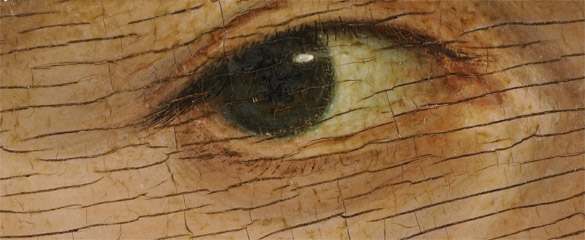
When Google first launched its Art Project, I expressed the hope that other UK galleries would quickly join up. Today, ten have done just that, including Dulwich, the Royal Collection, the V&A, and the National Galleries of Scotland. Splendid. More here.
Connoisseurs will note that the attributions are a little off in some cases. It seems that there is no room for riders such as 'Circle of' or 'After', and so everything gets a full attribution. Like this 'Van Dyck'.
Important new conference for UK collections
April 2 2012

Picture: Philip Mould
Regular readers will know that I occasionally bang on about the need to establish a panel of experts to advise regional galleries on their art collections. This is particularly necessary now that deaccessioning is increasingly taking place in the UK, for we must avoid the situation in the US, where good pictures are sometimes deaccessioned by mistake (as copies for example, like the above Romney). As a dealer, I've profited from such mistakes - but I don't want to see the same happen here. So I've been making the case for a panel of experts for some time, not only on the site here, but also at a conference last year on deaccessioning at the National Gallery, in The Art Newspaper, and in a chapter in the new Museums Etc book, Museums and the Disposals Debate, edited by Peter Davies.
So I'm delighted to report that this is actually going to happen, and all thanks to the Public Catalogue Foundation. The PCF is perfectly placed to be the lead body on this, not least because they have put together the invaluable photographic database of every publicly owned oil painting in the UK. On 25th April, the PCF is organising a conference at the National Gallery to look into the various issues. The project is to be called OPEN - the Oil Painting Expert Network. Here's what the PCF says:
Over the last nine years the PCF’s team of researchers has had unparalleled access to the nation’s oil painting collection. This has provided valuable insights into the state of painting catalogue records and the guardianship of these paintings. Unsurprisingly, it has found that the state of records varies greatly between collections and that there are significant gaps in knowledge about paintings’ artists, subjects and execution dates.
There are a few reasons for this. Only a fraction of the participating collections have staff with fine art expertise or other relevant knowledge. This is because many of the institutions involved in the project are small museums with limited resources or non-art specialisms and others are not museums at all. Furthermore, many of the museums – both large and small – have lost fine art expertise due to financial cutbacks.
The PCF has also found that those collections without expertise often do not know where to turn for help.
There will be a number of speakers, including Peter Funnell of the National Portrait Gallery, Nigel Llewellyn of Tate, Francis Russell of Christie's, Matthew Hargreaves from the Yale Center for British Art, Val Boa of the McLean Museum, and, er, me. If you would like to attend the conference, or would like to contribute to OPEN in any way, please contact the PCF: open[at]thepcf.org.uk. And if you know of anyone else who may be interested, or whom OPEN could do with hearing from, please spread the word.
'Nipples at the Met'
March 21 2012

Picture: Nipples at the Met
This is what happens when art historians have too much time on their hands.
Anyone fancy a round of 'Test your Connoisseurship'?
Science 1 - Connoisseurship 0
March 20 2012

Picture: Independent
A still life dismissed by experts as not being by Van Gogh has now been re-attributed thanks to an x-ray analysis of the picture beneath. Van Gogh re-used a canvas on which he had painted a scene of two wrestlers, and now, for the first time, the wrestlers have been found. From The Independent:
The wrestlers’ existence was known only from a reference in one of the Dutch master’s letters, written aged 33, just four years before his tragic death. On 22 January 1886, he wrote: “This week I painted a large thing with two nude torsos – two wrestlers.”
There is no other painting of wrestlers. It is this painting that now confirms the still life’s authenticity. They are both on the same canvas. Van Gogh painted the still life over his wrestlers which could not be seen until now.
The still life was acquired in 1974 by the Kröller-Müller Museum in Otterlo, Holland, which boasts one of the world’s largest Van Gogh collections. But the painting’s link to Van Gogh had been repeatedly dismissed over the years because it was thought to be “uncharacteristically exuberant”.
In 2003, it was finally “deattributed” on stylistic grounds and unceremoniously relegated to a back room out of public view, listed merely as “artist: anonymous”.
US National Gallery joins the free image revolution
March 16 2012

Picture: NGA
Rejoice! From the US National Gallery:
The National Gallery of Art announces the launch today of NGA Images, a new online resource that revolutionizes the way the public may interact with its world-class collection at http://images.nga.gov. This repository of digital images documenting the National Gallery of Art collection allows users to search, browse, share, and download images believed to be in the public domain, underscoring the Gallery's mission and national role in making its collection images and information available to scholars, educators, and the general public.
Designed by Gallery experts to facilitate learning, enrichment, enjoyment, and exploration, NGA Images features more than 20,000 open access digital images, up to 3,000 pixels each, available free of charge for download and use.
With the launch of NGA Images, the National Gallery of Art implements an open access policy for digital images of works of art that the Gallery believes to be in the public domain (those not subject to copyright protection). Under the open access policy, users may download any of these images free of charge and without seeking authorization from the Gallery for any use, commercial or non-commercial.
Says the reader who alerted me to this good news:
Meanwhile, the Tate and NPG have their fingers in the dyke...
"Prado copy proves Mona Lisa was painted later"
March 15 2012

Picture: Museo Prado/Royal Collection
The latest theory spinning off from the Prado's much-hyped copy of the Mona Lisa is that it proves Leonardo finished the original much later than thought, possibly up to 1519. He began it in 1503. This is because, say specialists at the Prado, infra-red images of a part of the background in the copy relate to a drawing of rocks by Leonardo in the Royal Collection, which is dated on stylistic grounds to 1510-15. From The Art Newspaper:
When the Prado copy was being studied, infrared images revealed that a section of the original design for the rocks beneath the paint surface had been based on a drawing now in the Royal Collection. Martin Clayton, the senior curator at the Windsor print room, dates the drawing to 1510-15 on stylistic grounds.
The Prado copy of the Mona Lisa was worked on side by side with the Louvre painting, so this connection has important implications for the dating of Leonardo’s original.
Louvre specialists went back to photographs taken of the original Mona Lisa in 2004. They realised that the design for part of the rocks on the right side in the Prado copy also appears in the underdrawing of the original, in a blurred form. This can just be made out in an emissiograph, an image made using an x-ray technique.
I must say, I don't like conclusions based on images that 'can just be made out' in x-rays. Anyway, have a look for yourself at the images, and see if you can spot the compelling similarities between the rocks in the Royal Collection drawing, and the rocks in the under-drawing in the Prado copy. No - I can't either. They look vaguely similar, that's all.
So it seems we're back to over-interpretation of the infra-red images again. Incidentally, if the Mona Lisa really was painted over a much longer period than previously believed, doesn't that make it less likely that the Prado's copy was painted alongside it? I can't quite get my head round the concept of Leonardo beginning a painting in 1503, and then having some student sit alongside him, in different countries, following him slavishly till as late as 1519. It doesn't make any sense. And who was this long-suffering student of whom we have never heard?
A rare Tudor survival
March 15 2012

Picture: Philip Mould Ltd
Last night at the gallery we hosted the launch of Tudor historian Suzannah Lipscomb's new book, the enjoyable and thoroughly useful Visitor's Companion to Tudor England. In her speech, Suzannah mentioned some of the only remains of Henry VIII's magnificent Nonsuch Palace, a series of painted canvas panels at Loseley Park in Surrey generally accepted to have been commissioned for Nonsuch. This reminded me that some years ago we handled two of the panels (above), showing Juno and Neptune. And since they haven't been widely published, I thought I would post them here, for any Tudor art lovers among you.
The two panels had left the Loseley Collection when they were given to John Paul Getty in the 1980s. We bought them after Getty's death, when they were sold by his estate through a London auction house. The auctioneers hadn't really grasped the importance of what they had, and we were lucky enough to acquire them. Like the rest of the set at Loseley, the panels were covered in literally centuries of over-paint and dirt. We were able to remove this, so in these two panels at least, we can see them more or less as Henry VIII would have seen them all those years ago. What surprised us most about what emerged was the overall quality. The detail and colouring is quite sophisticated, especially for English 16th Century decorative painting.
Here is my research note on the panels. It looks at the probable artist, Antonio Toto del Nunziato (1499-1554), one of many Italian itinerant painters working at the Tudor court.
ATTRIBUTED TO ANTONIO TOTO DEL NUNZIATO (1499-1554)
The Nonsuch Panels’
Oil on Canvas; 50 by 17 ¾ inches, 127 x 45 cm
Provenance
Commissioned for Henry VIII; In the possession of Sir Thomas Cawarden (c.1514–1559); His executor Sir William More (1520–1600); By descent at Loseley Park Surrey to Mr & Mrs James More-Molyneux; Until gifted to John Paul Getty c.1980, at Sutton Place, Surrey.
Literature
Decorative Painting in England 1537-1837, Edward Croft-Murray, London 1962, Vol. I p.18, Vol II p.313. Marcus Binney, ‘Loseley Park’, Country Life, October 9th 1969.
These paintings are known by tradition as the ‘Nonsuch Panels’, due to their apparent origin at Nonsuch Palace, the greatest of Henry VIII’s Tudor palaces. They can be attributed with some certainty to Henry VIII’s Sergent Painter, Antonio del Nunziato, or, as he was known in England, Anthony Toto, and are part of a series of his only attributable works. They were painted c.1543-4, probably for an important royal celebration or Henry’s final wedding to Katherine Parr, and represent a rare and highly important survival of decorative art from the Tudor court.
The present panels are two of a larger surviving set of at least a dozen others at Loseley Park in Sussex, home of the More-Molyneux family for over four hundred years. The panels came to Loseley through Henry VIII’s Keeper of the Tents and Master of the Revels [1], Sir Thomas Cawarden, and there remained until the 1980s, when the present paintings were given to John Paul Getty. All scenes in the series depict classical figures, and are of varying condition. The present pair have been the subject of recent renovation, during which numerous layers of later overpaint have been removed.
The panels were first attributed to Anthony Toto by Edward Croft-Murray in his 1962 survey Decorative Painting in England 1537-1837, on the basis of a listed receipt in Toto’s hand and signed by him “for painting of hatchements, arms and badges of the King’s to be set upon his Highness’s tents and pavilions” in the Loseley archives dated May 31st 1544 [Loseley MS 1893]. This view was reaffirmed by Marcus Binney in a 1969 article for Country Life. The present works would have been typical of the temporary ‘hatchements’ painted for the interior of a royal ‘tent’, or pavilion.
Further research by the present author has unearthed an additional, more comprehensive, description of the work carried out by Toto for Carwarden. The document, in Toto’s own hand, not only helps confirm the attribution of the present pictures, but sheds important light onto the activities of an artist in the Tudor court. It is undated, but was drawn up between 1544-47. The list of work carried out begins, “Things made and paynted for the kings Majestie by Antony Totto Serjeant Paynter [for] Sir Thomas Cardew Knyght” and goes onto detail a mass of heraldic hatchements “of the Kings Armes wt the beasts around the garter, and the Kings words [ie, motto]”, and large number of smaller “pensills paynted upon Burkeram wt the Kings badge” [Loseley MSS 1891/2]. There are also a number of painted earthenware pots listed, apparently for use in stables, suggesting that the riot of colour and decoration seen in the present paintings was employed in even the most mundane corners of the court.
If on the home page, click 'Read on' for more.
More data online at York
March 12 2012

Picture: University of York
I've mentioned before the excellent project run by York University's art history department, which puts primary material online relating to the late 17th and early 18th Centuries. Well, now it has got even better, with a cache of new sales and inventories uploaded. Click here for full details.
Drilling for Leonardo
March 12 2012
'Lost', 'hidden', 'Leonardo'; three words guaranteed to deliver a cascade of press interest. The quest to find Leonardo's lost painting The Battle of Anghiari in Florence's Palazzo Vecchio, which some say was covered up by Vasari's later murals, has uncovered... some old flakes of paint. From The Guardian:
Researchers in Florence say they are one step closer to proving a lost masterpiece by Leonardo da Vinci, The Battle of Anghiari, is painted on a hidden wall in a cavity in Florence's town hall, where it has remained unseen for five centuries.
After drilling tiny holes in a fresco painted on a wall which hides the cavity, the researchers inserted a 4mm wide probe and took samples of paint, which they say is similar to that used by Leonardo when he painted the Mona Lisa. [...]
The research team's probe confirmed the existence of an air gap, originally identified through radar scans conducted of the hall, between the brick wall on which Vasari painted his mural and the wall located behind it. "No other gaps exist behind the other five massive Vasari frescoes in the high-ceilinged hall," the team said.
A sample of black material removed from the back wall was analysed with a scanning electron microscope using energy dispersive X-ray spectroscopy to identify its chemical makeup.
The chemical composition "was similar to black pigment found in brown glazes on Leonardo's Mona Lisa and St John the Baptist, identified in a recently published scientific paper by the Louvre, which analysed all the Da Vinci paintings in its collection", the team said.
"Note that Leonardo painted the Mona Lisa in Florence at the same time," said Seracini, who was featured in Dan Brown's Da Vinci Code.
Flakes of red material were also found. "Analysis of these samples seems to identify them as organic material, which could be associated with red lacquer. This type of material is unlikely to be present in an ordinary plastered wall," the team said.
And on the BBC, a note of dissent:
Tomaso Montanari, an art historian who has led the opposition to the research said that he did not "consider the source of these findings credible."
He added: "What do they mean by saying the findings are compatible with Leonardo? Any painting from the Renaissance would be. Anything from that era could be painted on that wall."
Whether this was worth all the effort remains to be seen. If the Battle of Anghiari has miraculously survived, and if it is anything like Leonardo's other famousy fragile frescoe, The Last Supper, there won't be much left to see. One could reasonably believe that if it was covered up by Vasari, it must have been done so for a good reason - that is, it had perished beyond use. We know Leonardo took great risks with his murals, and was constantly experimenting. After all, what are the chances that Vasari, the first great art historian and Leonardo's biographer, deliberately covered up a viewable Leonardo?
Renaissance portrait symposium in London
March 8 2012

Picture: Courtauld
This looks interesting, a symposium at the Courtauld on Saturday 28th April 'Beyond the Frame: Portraits and Personal Experience in Renaissance Europe'. There's an illustrious selection of speakers, admission is free, and you don't need to book.
As is increasingly the case these days, the art historical blurb needs reading twice if you're not fluent in the lingo:
In Renaissance art historical scholarship, the category of the portrait has provided a key framework for thinking about and discussing representations of the individual, an emphasis that has been echoed in a range of recent exhibitions celebrating Renaissance ‘faces’.
The inaugural Renaissance postgraduate symposium invites new scholars to explore the limits of this framework. It aims to encourage students of the Renaissance, in its broadest definition, to consider the domestic, devotional and urban environments of portraits. Contributors are invited to consider how the experience of viewing, commissioning and living with portraits affects our understanding of their meaning and function, situating the images within their historical contexts rather than within the museum’s exhibition space. Likewise, we invite participants to challenge the terminology of portraiture and to consider objects and images which do not fit into the conventional category of the ‘portrait’ but which nevertheless ‘portray’ individuals.
Mona Lisa copy - it was painted by Leonardo's lover??
March 1 2012

Picture: Prado
The speculation on this is just going to run and run. Here's the latest headline from The Art Newspaper:
"Leonardo’s lover probably painted the Prado’s Mona Lisa"
How do we get to this news-tastic conclusion on the basis of hard-to-interpret infra-red imagery - and no other evidence whatsoever?
Here's the reasoning:
In attempting to identify the copyist, curators at the Prado began by eliminating pupils and associates such as Boltraffio, Marco d’Oggiono and Ambrogio de Predis—since they each have their own individual styles. They also eliminated two Spanish followers of Leonardo, Fernando Yáñez and Fernando de Llanos, whose work is distinctively Valencian.
Miguel Falomir, the head of Italian paintings at the Prado, now believes that the copy of the Mona Lisa “can be stylistically located in a Milanese context close to Salaì or possibly Francesco Melzi”. Melzi was an assistant who joined Leonardo’s studio in around 1507, but the Prado’s copy may well have been started earlier. Of the two, Salaì now seems the most likely.
So it's by a process of elimination. Boltraffio, d'Oggiono and da Predis must be ruled out because they are far superior painters than the hand responsible for the Prado's copy. Presumably the same goes for Yáñez and Llanos. Melzi only joins Leonardo after he began the Mona Lisa, so that's him out. And we're left with Salai, for whom, perhaps conveniently, we have very few firmly attributable works for comparison. I'm not sure about this...
On connoisseurship
February 29 2012

Picture: Philip Mould Ltd. Fig.1: Attributed to John Greenhill (c. 1644-1676, 'Portrait of John Locke', c.1672-6, Graphite on vellum, 5 1/4 in. high (oval) Private collection, U.S.A.
I recently wrote an article on connoisseurship in the US-based magazine, Fine Art Connoisseur. It's been a while since the issue was out, so here, with editor Peter Trippi's permission, is the full article for any readers who may be interested.
On the Importance of Connoisseurship
When the celebrated English philosopher John Locke sat to Godfrey Kneller for his portrait in 1704, he made a special request. He asked “Sir Godfrey to write on the backside of mine, John Locke 1704 ... this is necessary to be done,” he continued, “as else the pictures of private persons are lost in two or three generations and so the picture loses of its value, it being not known whom it was made to represent.’” 1
Sadly for Locke, not everyone has followed his advice. About a year ago, Philip Mould and I found a fine portrait drawing of him (Fig. 1) in a sale at Christie’s secondary saleroom in London. It was catalogued as Portrait of a Gentleman, and, proving that Locke was right to worry about his portrait’s future value, was bought for just £386 — a fraction of its true worth. It relates to a painting by John Greenhill in the National Portrait Gallery, London (Fig. 2).

Picture: National Portrait Gallery. Fig. 2, John Greenhill (c. 1644-1676), 'Portrait of John Locke', c.1672-76, Oil on canvas, 22 1/8 in. high (oval)
More on the Tate archive debacle
February 28 2012

Picture: KHI
Dr Costanza Caraffa, the director of the Photo Library at the Kunsthistorisches Institut in Florenz (founded in 1897, one of oldest research institutions on art and architecture in Italy) has been in touch about the Tate's disposal of their photographic archive. She writes:
As director of the Photo Library of an art historical research institute (a German institution with seat in Florence) working also theoretically on photo archives, I would like to draw your attention to the "Florence Declaration - Recommendations for the Preservation of Analogue Photo Archives".
To the many reasons that were mentioned in the article and in your blog, why throwing away such photographic holdings is an unforgivable crime against the scientific community and the entire society, I would like to add some new research perspectives on photographs and photo archives as material objects that cannot be substituted by digital surrogates. These new studies go beyond the disciplinary borders of art history and see photographs and archives as research objects on their on.
The "Florence Declaration" aims at an integration between the analogue format and the digital format, which only can guarantee the correct conservation of the photographic heritage for future studies and at the same time the implementation of digital instruments.
Quite. Indeed, these points were considered so important that there was a conference on them in 2009 attended by, amongst others, the Courtauld, the Getty, and Holland's RKD, all of which have large photographic archives. Their premise was that:
[Photographic] archives are valuable both as active research tools and as historical entities. They contain images that are records within the history of art, but are in themselves objects of study as historical photographs (for example as parts of bequests by major art historians, collectors, or photographers) and also as documents of art historical practices over time.
Photographic archives not only support but they generate research. Each archive has its historical and conceptual logic, which often raises as well as resolve research questions.
Additionally the mounts hold information about the photographs and the objects they represent.
There, in a nutshell, are several valid reasons as to why the Tate should not have disposed of their photographic archive. The mystery to me is this; if institutions such as the RKD and the Getty thought keeping the actual photos was so important, why didn't the Tate?
And here is the preamble from the Florence Declaration, which goes into more detail on why simply keeping a digital record of the photos is not the same as keeping the photos themselves:
The main role of photo archives, like that of every archive, is to guarantee the conservation and future accessibility of documents from the past for their possible future use for research purposes.
The introduction of digital technologies has made new, powerful tools available for conservation and access requirements. Almost all photo archives are currently involved in electronic cataloguing and photographic print and negative digitization projects and new methods of online consultation have been developed. The digital technologies applied to the archive have thus undisputed advantages.
However, for this very reason, there is a tendency to consider the consequences of these processes too superficially. In particular, the debates on digitalization imply that once digitally reproduced, the original artefacts can be removed from consultation or even dispensed with altogether. The Kunsthistorisches Institut in Florenz – Max-Planck-Institut on the other hand, supported by the other subscribers to these recommendations, believes that it is essential for the future of studies in historic, human and social sciences to generate a greater understanding of the inescapable value of photographs and analogue archives.
The conviction that it is useful and necessary to preserve the analogue photo archives is based on two simple considerations:
- the technologies not only condition the methods of transmission, conservation and enjoyment of the documents, but they also shape its content;
- the photographs are not simply images independent from their mount, but rather objects endowed with materiality that exist in time and space.
Van Eyck in ultra-high resolution
February 27 2012

Picture: Universum Digitalis
A reader has alerted me to this excellent site on Van Eyck's Ghent Altarpiece. You can even zoom in on the infra-red images.
This is a joke, right?
February 24 2012
A reader has alerted me to a seemingly quite staggering story about the Tate and the V&A throwing out their photographic archive. In fact, it's so bonkers, I can't believe it. From The Guardian:
Art historians have been disturbed by allegations that the Tate was about to dump its invaluable photographic archive in a skip when another institution realised its importance and rescued it, and that the Victoria & Albert Museum has already destroyed its own thematic archive. Curators, who consider such resources vital, were not consulted.
The archives were full of photographs of artworks from their collections and beyond – crucial visual histories, invaluable for comparative research and for studying any deterioration as a result of time or restoration.
Brian Allen, director of the Paul Mellon Centre for Studies in British Art, a UK educational charity with links to Yale University, expressed disbelief that the Tate, as the holder of a national collection of British art from the Tudors onwards, did not treasure its archive.
Allen says he received a call out of the blue from a "low-ranking" Tate employee, who told him: "Someone said … you might like the curatorial photo archive because we're about to throw it on to a skip."
Fortunately, Brian Allen sent some vans round to the Tate's skip, and rescued the archive. It is now safely stored at the Paul Mellon Centre. But alas, nobody was able to rescue the V&A's archive, which has been lost:
The V&A admitted dumping archival material using "a secure data disposal service". A spokeswoman denied the decision was a mistake, explaining that in removing the picture archive in 2007 to make way for new gallery space, it believed that a thematic archive "wasn't a method of classification that was really necessary any longer", as it had duplicates of photographs and digital files.
In case you were the ****** ***** *** plonker at the Tate who decided to chuck the archive out, here's why old fashioned photographs of paintings are of invaluable help to art historians.
1 - pictures change over the years, sometimes quite radically, and mainly as a result of restoration. A careful comparison between, say, a photograph of painting taken in 1935 at an auction, and the same picture today can be revealing. Sometimes, pictures lose their recent provenance, and are mistaken for copies, when in fact they are the same painting that was just over-painted years earlier.
2 - old photos often have seemingly trivial but highly useful notes on the back. This might be, for example, the view of a former curator on attribution, or a piece of provenance.
3 - digital archives are fine if you know roughly what you are looking for. But nothing beats going through the actual photographs.
Prado reveals evidence behind 'earliest Mona Lisa copy' claim
February 22 2012

Picture: Museo Prado
A few weeks ago the Prado unveiled a newly-cleaned copy of the Mona Lisa, and claimed that not only was it the earliest known copy of the original, but that it was made in Leonardo's studio alongside the master by one of his pupils. And today they released an excellent series of images and videos setting out the evidence behind the claim, in a first-class presentation that should be the model for all future museum discoveries.
The main evidence behind the claim is the infra-red imagery. Briefly, the Prado say that the infra-red image of their picture matches the infra-red image of the original, including in areas where Leonardo subsequently changed his mind. So, for example, in the infra-red images of both the original and the Prado copy we can see a line of under-drawing to the right of the Mona Lisa's veil at about the level of her neck. But in both the finished original and the copy this change is not visible on the final painted surface. This must mean, say the Prado, that the copy was drawn alongside the original, and when Leonardo made a change, so did the copyist. There is other quite convincing evidence to put the picture in Leonardo's studio, such as the walnut panel, and the type of ground layer used.
[more below]
Dating 'The Field of the Cloth of Gold'
February 13 2012

Picture: Royal Collection
One of the most iconic Tudor paintings in the Royal Collection is the The Field of the Cloth of Gold, which celebrates Henry VIII's meeting with Francis II outside Calais in 1520. But there has always been doubt as to when exactly it was painted. Now, new research has suggested an earlier dating for the picture, and answers to the mystery of why Henry VIII's head was cut out and replaced at a later date. More details here.
The need for catalogue raisonnes*
February 13 2012
Writing in The Art Newspaper, the art market commentator Marion Maneker says that catalogue raisonnes are the best way to protect against the growing problem of fake art:
The other key pillar of the self-regulating market is the scholarship that produces reliable catalogues raisonnés. But, the field appears increasingly under threat. The troubling retreat of scholars in the case of a group of Francis Bacon drawings (The Art Newspaper, December 2011, pp1, 8) indicated that experts, fearful of costly lawsuits, are shying away from taking a public stance on what is, or is not, a legitimate work. [...]
Ultimately, the best way to protect the art market—and address the issue of regulation—is to safeguard scholarship: this underpins an artists’ value, provides proof of provenance and lubricates an expanding market. As the art business continues to globalise, its growth depends upon making scholarship reliable and accessible. Because, in the end, the experts are the only candidates who can provide the adult supervision the market desperately craves.
Though she** is primarily concerned with modern and contemporary art, the same could probably be said for the whole art market, including Old Masters, where the issue is not one of fakes, but of correct attributions. But the problem is, not enough art historians these days are interested in publishing catalogue raisonnes. Devoting years of study to one artist is unpopular, and seen as too like the old-fashiond approach to art history of 'who painted what when'. This is sad, but a fact.
* A reader has suggested this should be 'catalogues raisonne'.
** Another reader writes:
As always, enjoyed logging on to Art History News but I think Marion Maneker, whose article I also read with much interest – valuation and attributions being such vexed subjects – is male not female. Maybe Marian/Marianne = female!
And to be completely pedantic, it should be catalogues raisonnés (old French grad here).
Whoops - Marion, Sorry!
