


Previous Posts: February 2012
The need for catalogue raisonnes*
February 13 2012
Writing in The Art Newspaper, the art market commentator Marion Maneker says that catalogue raisonnes are the best way to protect against the growing problem of fake art:
The other key pillar of the self-regulating market is the scholarship that produces reliable catalogues raisonnés. But, the field appears increasingly under threat. The troubling retreat of scholars in the case of a group of Francis Bacon drawings (The Art Newspaper, December 2011, pp1, 8) indicated that experts, fearful of costly lawsuits, are shying away from taking a public stance on what is, or is not, a legitimate work. [...]
Ultimately, the best way to protect the art market—and address the issue of regulation—is to safeguard scholarship: this underpins an artists’ value, provides proof of provenance and lubricates an expanding market. As the art business continues to globalise, its growth depends upon making scholarship reliable and accessible. Because, in the end, the experts are the only candidates who can provide the adult supervision the market desperately craves.
Though she** is primarily concerned with modern and contemporary art, the same could probably be said for the whole art market, including Old Masters, where the issue is not one of fakes, but of correct attributions. But the problem is, not enough art historians these days are interested in publishing catalogue raisonnes. Devoting years of study to one artist is unpopular, and seen as too like the old-fashiond approach to art history of 'who painted what when'. This is sad, but a fact.
* A reader has suggested this should be 'catalogues raisonne'.
** Another reader writes:
As always, enjoyed logging on to Art History News but I think Marion Maneker, whose article I also read with much interest – valuation and attributions being such vexed subjects – is male not female. Maybe Marian/Marianne = female!
And to be completely pedantic, it should be catalogues raisonnés (old French grad here).
Whoops - Marion, Sorry!
Be a Tate Curator. But not if you specialise in the 1840s.
February 13 2012
Picture: Tate
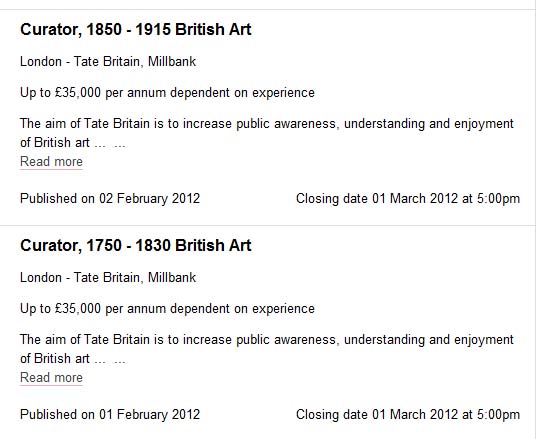
A reader has alerted me to two current vacancies at Tate Britain, for curatorships covering British art from 1750 to 1915. But as she points out, and as you can see from the descriptions above, there seems to be a slight gap.
If you want to apply, you have until 1st March to do so.
Introducing Major Edward Borrow
February 12 2012
Picture: Durham.gov.uk
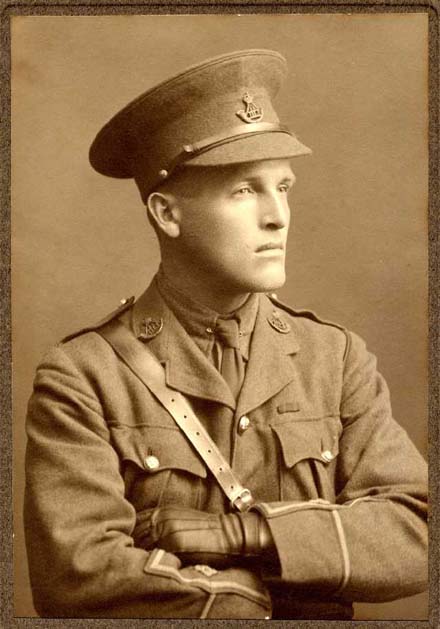
[Warning: this is a nothing-to-do-with-art-history post] Some years ago I bought two tin trunks full of letters written during the First World War. They are between Edward Borrow, an officer in the Durham Light Infantry, and his wife, Alys. The letters are rare in that they reveal two sides of the war; a soldier from the front to his wife at home, and vice-versa.
I can't think why I bought them - I was a student at the time and could hardly spare the cash. The correspondence is often moving, and at times intimate, but could not be called great literature. In a sense, that is why the letters are so interesting; their very ordinariness, even cheerfulness, shows a side of the war often forgotten amidst the War Horse-style emotive gloom of retrospective histories (or worse, historical fiction). And, after I came across the letters by chance at a country auction, unloved and randomly wedged into old cigar boxes, I thought that if nobody else was going to look after them, then I must. So I bid over six months rent, and began to organise and transcribe them.
Anyway, the point of this post is to say that today, in a moment of idle Google-ing, I found out for the first time what Edward Borrow looked like. Above is his photo from the museum of the Durham Light Infantry. Seeing it is oddly moving; here is a soldier to whom I have no connection whatsoever, and yet of whom, for at least a part of his life, I know the most private and banal details. Anyone who has written a biography or a thesis on a single subject will know the peculiar feeling of disjointed affection one can feel towards your subject. (I knew I'd spent too long researching for my PhD when I started dreaming about Disraeli.) So here, with a curious feeling of pride, I publish for the first time a few extract's from Major Borrow's letters to his wife, together with his portrait: [click Read on for more]
In praise of...
February 10 2012
Picture: Credit Suisse
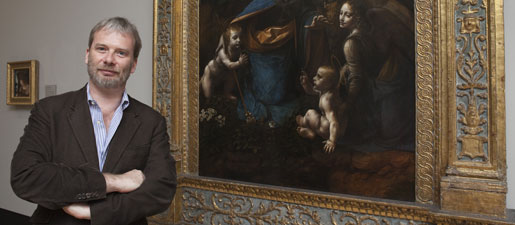
...Luke Syson [above], the National Gallery curator of the Leonardo exhibition. Jonathan Jones, in The Guardian, rightly lays on the acclaim:
Syson has proved that courage and passion are the true virtues of a great curator. His exhibition has gone but it will never be forgotten. He too is leaving the National Gallery to work at the Metropolitan Museum in New York. But he has left an amazing legacy in London: an exhibition that should change the way exhibitions are thought about from now on. I hope we see many more such intimate and soulful revelations of what knowledgeable curators love about their artists.
To see why we don't have a comments section here at AHN, check out some of the bitter bile beneath Jones' article. And those are the moderated ones...
John House 1945-2012
February 10 2012
Video: Courtauld
It is with great sadness that I report the news of Professor John House's sudden death. He was Emeritus Professor of The Courtauld Institute in London, and one of the most noted art historians of his generation. He specialised in 19th Century French art, and published on books on Monet, Manet, Degas and Renoir.
Not only was he a great scholar, he was also a thoroughly nice man; perpetually cheerful, always happy to help, and blessed with a communicative ease most academics can only dream of. Viewers of Fake or Fortune? will remember him from our programme on Monet, in which he had to return to London from Paris with news of the Wildenstein Institute's rejection of David Joel's painting. In the above clip he can be seen talking with characteristic fluency on Renoir's La Loge.
The Director of the Courtauld, Deborah Swallow, has made this statement:
One of the pre-eminent scholars of nineteenth-century French art of his generation, John served The Courtauld with great distinction from his appointment in 1980 up until his retirement as the Walter H. Annenberg Professor in 2010; I cannot think of anyone with a deeper attachment to all aspects of our community, with which his close and richly productive involvement has now been cruelly cut short.
John was a much loved and greatly respected teacher and colleague. His scholarship reached well beyond the world of academe through the many wonderful exhibitions he curated both here at The Courtauld, at the Royal Academy and throughout the world. It is almost impossible to imagine The Courtauld without his strong yet benign presence near at hand.
The Duchess and the photographers
February 9 2012
Video: Disney
Following my post below, on the Duchess of Cambridge's trip to the NPG, a reader writes:
Wonder if I'm the only one who found similarities between the press shouting 'Ma'am' at the Duchess of Cambridge last night and with the seagulls shouting 'mine' in Finding Nemo [above]. Take a listen (really is uncanny!)
The best art charity you've never heard of?
February 9 2012

Picture: Shakespeare's Birthplace Trust/Public Catalogue Foundation
A giant round of applause please for the Woodmansterne Art Conservation Awards, an independent fund that supports the restoration of oil paintings in British public collections. The award is operated by Woodmansterne greetings cards, which have long printed cards with fine art reproductions. Since 1995, 60 paintings have been conserved at a total cost of £357,000. Last year, Woodmansterne funded the restoration of the above portrait by Pickenoy at the Shakespeare Birthplace Trust.
If you work in a museum which has a painting which needs restoring, then you have until 21st February to apply for this year's award.
Duchess of Cambridge at the NPG
February 9 2012
Video: Telegraph
Last night, the Duchess of Cambridge made her first solo royal engagement at the National Portrait Gallery, where she saw a private view of the Lucien Freud exhibition. That the Duchess should choose to support the NPG at this moment is excellent news not just for that gallery, but for the arts in Britain in general.
The above flash-filled video gives an idea of just how much press interest the Duchess has to deal with, even when she goes to a museum. I like the way the photographers first try to get her attention by shouting 'Catherine', then, not having much luck, with a politer 'Ma'am'.
Meanwhile, the exhibition has gone down well with the critics. Here is Brian Sewell's conclusion:
I am told that Freud loved to hate me. I did not hate him; nor do I hate his paintings - it is only that I share neither his lust for ugliness nor his taste for furfuraceous paint, and wish that he had found a different escape from the trap of beautiful Neo-Romanticism. I wish that he had always painted sheets and wiping rags in the white paint in which he clad his mother in 1982-4, when Sargent and Pontormo seem to have held his hand, and given us more such exquisite details as the rat in the hand of a naked man and the fringed blanket in Flora with Blue Toenails of 2000-1, the hand of the octogenarian not trembling. When all is said and done, for all his perversity, Freud was perhaps as great a figurative painter as is now possible, and he is well-served by this exhibition.
Christie's edge Sotheby's in Impressionist & Modern
February 9 2012
Picture: Sotheby's/Art Daily
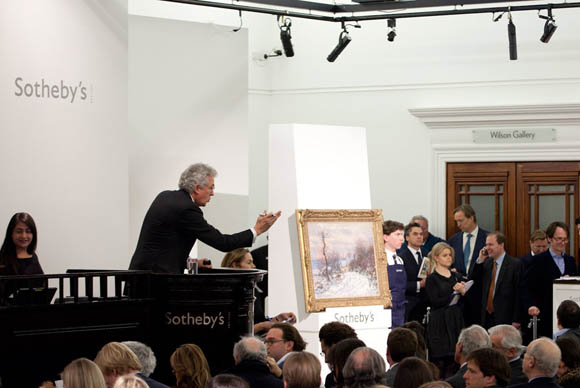
In the Impressionist & Modern evening sales this week in London, Sotheby's sold £78.9m, but Christie's came out on top with £97.8m. Sotheby's top price was £8.2m for a snowy landscape by Monet of 1885, L'Entree de Giverny en Hiver [being sold by Henry Wyndham above]. Sotheby's 'forgotten' Klimt did not sell in the room when estimated at £6-8m, but sold soon afterwards for £5.6m. Over at Christie's, the top seller was the £19m Henry Moore mentioned below.
Early Titian comes to London
February 9 2012
Picture: Hermitage
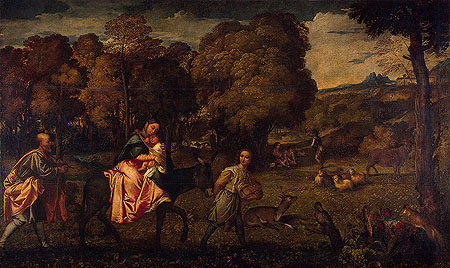
The Hermitage Museum is lending one of Titian's earliest great works, The Flight into Egypt, to the National Gallery in London from 4th April to 2nd September. More details here, and on the Hermitage's website there is some interesting information about the picture's recent restoration.
More 'Liberate Tate' daftness
February 9 2012
Floe Piece - Liberate Tate from You and I Films on Vimeo.
Are Liberate Tate learning from their mistakes? Instead of chucking gallons of 'oil' on the floor at Tate Britain (and then running away, leaving someone else to clear up the mess), this time Liberate have left a block of ice from the Arctic to melt in the Turbine Hall at Tate Modern. They still ran away, but at least water is easier to mop up than molasses.
And Liberate have also figured out that arriving at a protest in a gas-guzzling taxi doesn't look good, for, as you can see above, the protesters piously carried the block of ice by foot from St Paul's Cathedral. But they don't mention the carbon cost of hauling a lump of sea ice all the way back from the Arctic, which is presumably quite high.
I have to say, though, that as a form of artistic protest, the illuminated ice looks rather clever. And yet, Liberate Tate just can't stop shooting themselves in the foot. Earlier this week, they put up a post on their site, called "Who has been a speaker at Tate on a BP sponsored platform?" This 'named and shamed' artists as eminent as Peter Doig, and Peter Blake. This silly post (not least because Liberate is an anonymous organisation, and its protestors wear veils) prompted much outrage on Twitter, and cries of McCarthyism. And so Liberate took the post down, leaving the page blank save for the ironic message: 'This is somewhat embarrassing, isn't it? It seems we can't find what you're looking for'. You can still see the original page on Google cache, here.
Thanks...
February 9 2012
...to my colleague Lawrence Hendra for looking after the site so well while I was away.
Moore makes £19m
February 8 2012
Pic: Christies
By LH
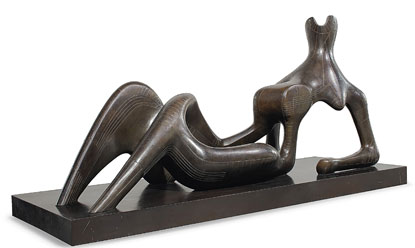
Last night at Christies Henry Moore's 'Reclining Figure: Festival' made a staggering £19m. The estimate was only £3.5m-£5.5m, beating by some way their previous record for the artist.
The sculpture was created by Moore for the Festival of Britain on the invitation of the Arts Council in 1949. The catalogue says:
"The importance of Reclining Figure: Festival lies not only in the significance of the commission itself but also because it functions, as Moore recognized, as a 'key' to this period of his work. It represents the culmination of ideas Moore had developed on the theme of the reclining figure in the previous decades, whilst concomitantly inaugurating a new working method and ushering in stylistic innovations. This new working method, one which would henceforth shape Moore's approach to sculpture, involved the progression from maquette, to working model and subsequently to the large scale work; the stylistic innovations explored in Reclining Figure: Festival were a new equivalence of form and space and the introduction of raised tracery-like lines upon the surface of the sculpture."
A quick look on Artnet suggests that this quadrupled the previous auction record for Moore. The most amazing thing is that it's not even a one-off - there are another four from the same edition plus one artist proof out there somewhere...
Getty on Acquisition Rampage
February 8 2012
Picture: Getty Museum
By LH
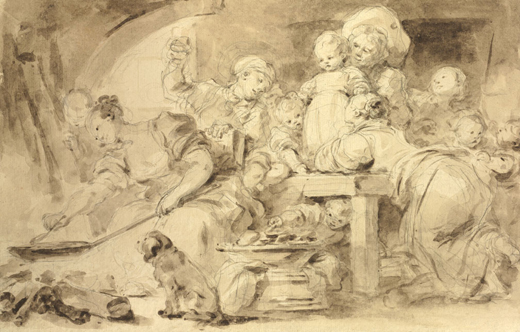
The Getty have acquired two more works for their ever-expanding collection; 'The Pancake Maker' by Fragonard and a panel by Peter Hemmel.
Collections director Thomas Kren:
"These two acquisitions, which are so unlike one another in style and medium, reflect the Museum’s desire to see that each acquisition lifts up the collection as a whole and enhances our visitors’ experience of European art.”
Good effort, considering they bought this only a few weeks ago.
Taylor Collection
February 8 2012
By LH
A few choice works from the collection of the late Elizabeth Taylor fetched almost £14m at auction in London last night.
All eyes were on Van Gogh's 'Vue de l'asile et de la Chapelle de Saint-Rémy' which soared above the £5m-£7m estimate, selling for over£10m. Not bad considering it cost her dad £92k back in 1963. Other interesting works included a self-portrait by Degas which made £713k, and a nice Pissarro for £2.9m. More details here.
The sales continue today, and if you want a piece of the action there are still some interesting works by top artists up for grabs, such as this head sketch by Augustus John of the 'Bright Young Thing' Mabel Wright.
"Wanted: Your Artists" - Stuart, C. 1632.
February 7 2012
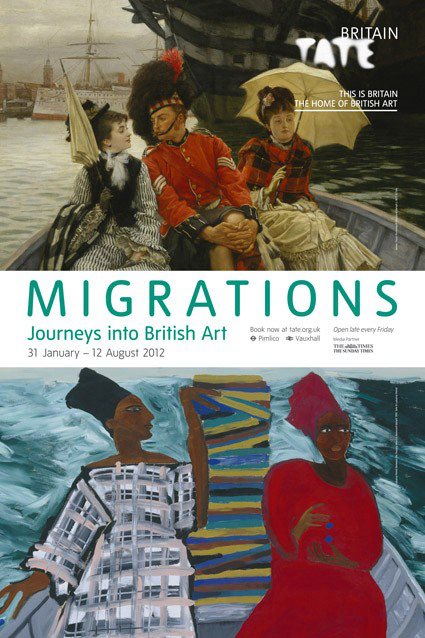
Picture: Tate Britain
By LH.
A new exhibition 'Migrations' has just opened at the Tate Britain, exploring (among other things) how foreign artists have helped shape our artistic heritage.
If there was one thing us Brits were good at (most notably under the Stuart reign) it was persuading foreign artists to move over here. On Van Dyck's arrival for example, Charles I knighted him, awarded him a huge income (more than double that of his predecessor Daniel Mytens) and gave him expensive bling.
I will refrain from going into too much detail here, as i am sure Bendor will do it better justice on his return, but here are the exhibition details in the meantime.
'Leonardo Live' in U.S.A
February 7 2012
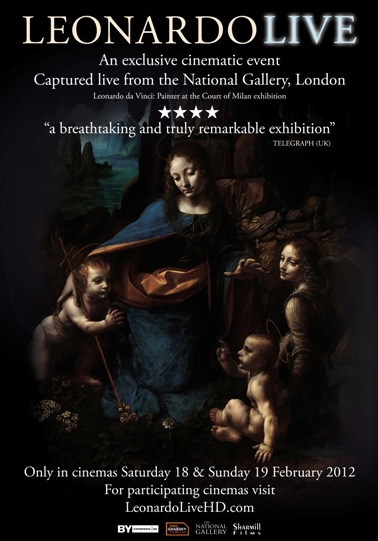
Picture: National Gallery
By LH.
For all you American readers:
A number of theatres across the U.S.A are to screen a 'ground breaking' film discussing the highlights of the recently closed Leonardo exhibition at the National Gallery, London. The show will be in high-definition and even features commentaries from a famous actress...
The director says:
TV is one thing, but in the cinema it plays on a big screen in high-definition, no interruptions, great audio, like-minded folk around you, nice cup of coffee and a slice of cake, and a stunning look at the works and life of one of the most creative genius's ever to walk the planet.
I eat coffee and cake in front of my TV all the time. (Silly) comments aside, that's definitely the kind of geeky thing I would go to. A more condensed version of this film was screened over here in the UK last November, alas i never saw it.
Details here.
Kate Commissions a Portrait
February 6 2012
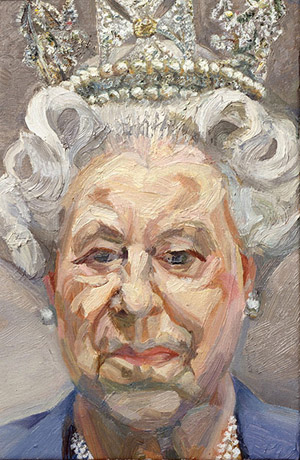
Picture: Queen Elizabeth by Lucian Freud
By LH.
A Clarence House spokesman has announced that Kate Middleton will be commissioning a portrait through the NPG in celebration of her 30th birthday.
It was announced at the beginning of January that the Duchess would become one of the institution's official patrons, but the big question is: 'who will be asked to paint her?'
Royal portraits can define an era and project an image which will last for centuries, so Kate, if you're reading this, see below for some inspiration...
In-your-face-majestic? OR Modest and reserved?

Miro in Yorkshire
February 6 2012

Picture: 'Lunar Bird' 1945 - Hirshhorn Museum and Sculpture Garden, Washington.
By LH.
Yorkshire Sculpture Park is to host an important exhibition of sculpture by Joan Miro (1893-1983).
Miro, who is perhaps best known for his surrealist, two-dimensional paintings, experimented with sculpture from the 1930's onwards, his most prolific period being between 1960-1983 where he produced some 800 sculpture and ceramics.
Miro considered his sculpture work to be of equal importance to his painting, and this will be the first time an exhibition of his sculpture on this scale has been held in the UK.
Details here.
