


National Gallery acquires Signorelli
April 13 2016

Picture: National Gallery
The National Gallery in London has acquired a new picture by Luca Signorelli through the Acceptance in Lieu scheme. Man on a Ladder, painted between 1504-5, was (says the NG website):
Originally part of a vast altarpiece depicting the 'Lamentation at the Foot of the Cross' commissioned in 1504 for the church of Sant’Agostino in Matelica, a town in central Italy, the large panel was subsequently cut into separate pieces for sale to different purchasers. 'Man on a Ladder' is one of six known fragments of this altarpiece. The others are currently housed in museums and collections around the world, including the Museo Civico, Bologna, the National Gallery of Art, Washington DC, and private collections in Genoa, Rome and England. 'Man on a Ladder' is the only fragment that can be seen in a UK public collection.
Apologies...
April 12 2016
... For the lack of blogging lately. I'm afraid I'm little unwell again. Hopefully back tomorrow.
Raising 'The Raising the Lazarus'
April 8 2016
Video: National Gallery, London
These National Gallery videos are getting better and better. In the video above, National Gallery restorer Jill Dunkerton (who, I must say, has great TV presence and authority) talks about restoring Joachim Wtewael's Raising of Lazarus. Longstanding readers might remember that this picture was a discovery from back in 2014, when it was spotted by a Bonhams specialist in Wycombe Museum. It had previously had no attribution at all, and was covered in many layers of dirt and old varnish.
For more NG videos, see here.
'Panama Papers' & the art world
April 8 2016

Picture: Christie's
The 'Panama Papers' leak has prompted a fascinating piece in The Guardian about the famous Ganz sale of modern art at Christie's in 1997. The sale was seen as a beginning of the boom in modern art prices. It appears that the Ganz sale was effectively guaranteed by the auction house, although no mention of the guarantee was made in the catalogue. The Ganz collection was bought before the sale by Christie's then largest shareholder, Joe Lewis. Says The Guardian:
In a secret deal six months earlier, an offshore company whose bank account was controlled by the secretive billionaire currency trader Joe Lewis had bought all of the most valuable works. On the same day, it had contracted to auction them at Christie’s, to be marketed as the Ganz collection.
The Met's new David drawing
April 6 2016
Video: The Met
The Met has bought a drawing by Jacques Louis David, which according to the video above is one of the artist's first explorations of The Death of Socrates, a painting the Met owns. The drawing apparently surfaced on the art market last year. The new addition means that the Met has recently bought two preparatory drawings by David for The Death of Socrates, for in 2013 (regular readers may remember) they bought another, a 'sleeper' in a New York auction, for just $800. The video doesn't say how the two drawings are related.
Update - a reader points me to the latest drawing's sale at Christie's for $593,000. That's a quite a spread for David drawings of the same subject.
'The Next Rembrandt'?
April 6 2016
Video: nextrembrandt.com
There's been widespread news coverage for a Dutch project to create a 'new Rembrandt' painting. The picture, below, was made by scanning in over 50 Rembrandt portraits, and a computer programme made up a 'new' Rembrandt-like face. The result was then printed on a 3D printer.
The finished result was hailed by its creators thus:
347 years after his death the next Rembrandt is unveiled.
But actually it looks like someone who's been to a fancy dress photography shop.
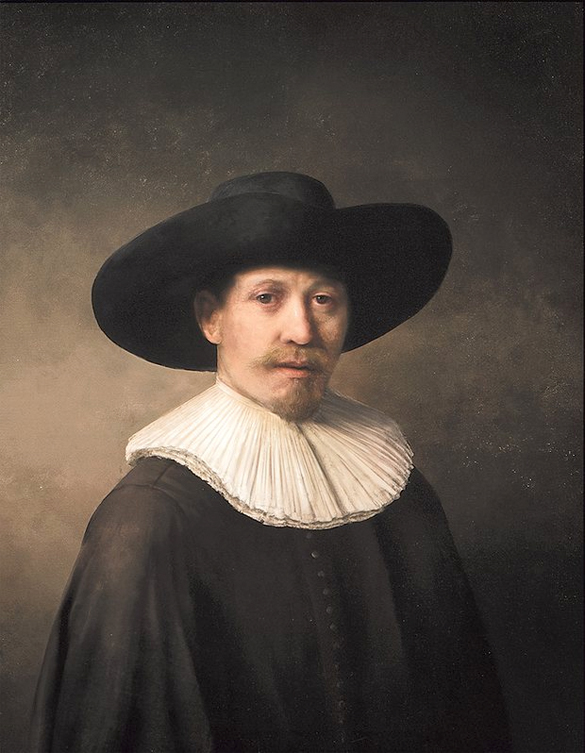
The main pitch of the project, according to sponsors ING, was to 'see where innovation can take us'. What it really shows is that even with the might of modern technology we cannot make portraits as beautiful as those made by an eccentric Dutchman four hundred years ago using nothing more than paint and genius. What we have gained in technology, we have long lost in artistry.
Update - a reader writes:
How absurd? Contrary to the claims in the film, the algorithm hasn't succeeded in making a 'typical' Rembrandt eye (or nose, or mouth) because their eye doesn't belong to anyone. So they've only succeeded in making a pastiche of a Rembrandt eye and a pastiche of a Rembrandt face. The man doesn't exist. He has more in common with a modern photofit than anyone Rembrandt might have known.
The technology would be more impressive if it could transform the image of a real sitter into a convincing Rembrandt portrait. But we have no photos of Rembrandt's sitters, so nobody could devise an algorithm to account for the deviations from photoreality which make a painting recognisably by Rembrandt.
Even if it were possible, what would be the point? The great thing, the magical thing about portraits is that, at some point, some human beings realised that they could stoop down to the ground, take a handful of earth and rock, mix it with the oil from the pressed seeds of a common plant, and somehow transform those base ingredients into what, for who knows how many millennia, had only existed as a reflection on the surface of still water.
We don't need machines that can squirt out pastiches of Rembrandt. We need painters like Rembrandt, who can show us how to make magic from dust and seeds.
Penrhyn Rembrandt goes on public display
April 5 2016

Picture: TAN/Media Wales
Rembrandt's portrait of Catrina Hoogshaet has gone on display at the National Museum of Wales in Cardiff. We must hope the superhumanly strong curator charged with holding the picture up is given the odd day off.
The £35m picture was recently caught up on a hoo ha over the UK's export licensing rules, after the new owner withdrew an export application. The Art Fund had declared that it would try and buy the picture (at a tax reduced price of £22.5m), and the new owner decided they'd rather keep it. The picture must now stay in the UK for at least ten years before a new application can be made, so it's good to see it going on public display. The National Museum of Wales has a free Rembrandt, at least for the time being.
Martin Bailey in The Art Newspaper highlights the fact that in 2025 the picture might be more expensive should a new attempt be made to acquire the picture for the nation, not least because the tax advantages would not apply. He also adds:
The loan of the painting to an important museum could also add to its financial value.
I don't think that's true, however. We're not dealing here with a newly discovered Rembrandt of questionable status, which might benefit from a period of institutional endorsement in the eyes of future buyers. This is a well known painting, which has already been on public display for many years (albeit in a National Trust house). The idea of museums adding value to pictures is widespread, but (at least in the Old Master sector) it's a chicken and egg question: is a picture chosen for display by a museum because it is already museum quality, or does museum display make it museum quality? Almost all of the time, curators and museum directors chose pictures for display because they deem them to be museum quality.
Anyway, I recently wrote a piece for Apollo Magazine on whether the UK's export licensing rules need changing. I argued 'no' and Prof. Christopher Brown, former director of the Ashmolean Museum, argued 'yes'. Though I was amused to see that in the end we largely agree with each other.
Update - the Rembrandt news is not featured on the National Museum of Wales' website. The press release is included (unillistrated) on the Museum's press page. But it's amazing how often museums can't get their press office and website people to work together. Surely the site should have the Rembrandt news on the front page, with details about the painting and how anyone who has read the news story can now come and see the painting themselves.
Update II - a reader writes:
Your highlighting the abject failure of National Museum Wales to promote adequately the new display of Rembrandt’s Catrina Hooghsaet at the museum is sadly charateristic of a general failing of most art museums in Britain other than the London nationals, the Ashmolean, the Fitzwilliam and a handful of others. Indeed the appalling quality of most regional museums’ websites is a disgrace. At a time when they are desperate for more funds and more visitors it is surely inexcusable for so many of them to ignore the power of the internet to advertise their collections. Just two examples (but it’s not difficult to find others) - the Higgins in Bedford and Nottingham Museum at Nottingham Castle say nothing on their websites – not a single word – about their collections, and yet they both have some wonderful works of art. Amazingly, the Museums Association, which is so keen on ‘access’ seems to have no interest in this issue at all.
Another reader adds:
Perhaps the NMGW website (never much good at the best of times) failed to be updated due to the recent strike action??
Update III - a curator writes:
The Rembrandt from Penrhyn was on loan to the Ashmolean Museum from January 2014 until it was transferred to the National Gallery for their exhibition 'Rembrandt: The Late Works' in autumn that year. It had previously been on loan to the National Museum of Wales in 2009-10. So, it is certainly not unknown to the general public. Unfortunately, this does not make it a better picture - the current valuation is grotesque, and it is difficult to understand why, apart from sentimentality, it can be considered part of our national heritage. There are much more important paintings by Rembrandt in private collections in the UK.
'Visitors shouldn't feel stupid'
April 5 2016
Picture: FT
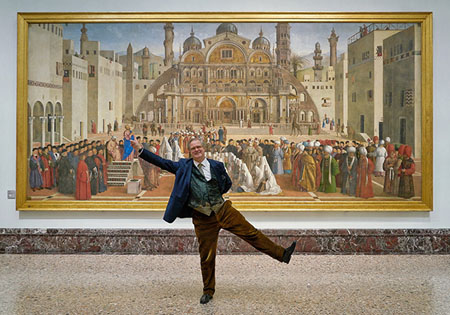
There's a good interview in the FT with James Bradburne, the new director of the Pinacoteca di Brera in Milan. He was appointed as part of a (much needed) government policy to shake up Italy's museums. Among the bold and revolutionary ideas Bradburne wants to introduce to the Brera are... decent lighting and picture labels. He says:
“When I got here I was shocked by the dull, flat approach to lighting, which strove to recreate the sort of northern light the artist would have worked in,” he says. (Painters’ studios have historically tended to face north because light from that orientation produces the least shadow.) “That is an old orthodoxy; the prevailing fashion today is to put things in the spotlight. We speak with light and colour now.”
Most importantly, each work is labelled. “There are curators who believe the works should speak for themselves,” he tells me over breakfast at the Mandarin Oriental, the city’s newest hotel, close to the Brera. “But unless you’ve been reading Ovid [specifically Book VII of his Metamorphoses], you probably don’t know why a child is being born out of a tree,” as you wonder at the frescoes in the museum’s first gallery. For the moment there’s no clue even as to who the artist was (Bernardino Luini). “Curators have forgotten what it’s like not to know stuff. A visitor should not leave feeling stupid.”
Update - a reader writes:
You might want to tell James Bradburne though, that artists favoured northern light not because it cast the least shadow(?), but because it maintains a more constant colour and intensity throughout the day. Any photographer will tell you that light from the morning sun tends to be significantly bluer than light in the afternoon, which is much yellower.
The variation plays havoc with the choice and mixture of paint on your palette, especially when it comes to skin tones (which can look too 'wet' and yellow in the morning and then too 'biscuit-dry' and red in the afternoon). Luckily, working exclusively with northern light evens out these light temperature fluctuations, giving a skin tone which is usually just what the artist wanted, in all conditions.
Also, if the weather changes much through the day, northern light evens out the worst of the contrast fluctuations.
What's going on at Sotheby's?
April 5 2016

Picture: Sotheby's
Well, it depends who you read. The broad media narrative is of an 'art market in decline', and Sotheby's, who reported a recent fourth quarter loss last year of $11.2m, are apparently suffering as a result. But look more closely at the numbers, and not everything seems as dire. Nevertheless, the stock price is bumping along at around $26 a share, some way of its highs of $46 in the summer. Earlier this year it fell as low as $19 a share.
Much of the media focus has been on Sotheby's new CEO, Tad Smith, who used to run Madison Square Gardens in New York (and very successfully). As a publicly listed company, Sotheby's comes under a lot more scrutiny than Christie's. So I always read the travails of whoever is CEO with some sympathy. I have never met Mr. Smith, but I was pleasantly surprised to see him wandering around the salerooms when I was last at Sotheby's in January, for the Old Master sales. It’s always good to see management ‘on the shop floor’.
But Mr Smith has had an uneasy inheritance. Over the last couple of years we had the former CEO Bill Ruprecht, and indeed the whole of Sotheby's, being bashed repeatedly and publicly by activist investor Daniel Loeb. Loeb’s hedge fund, Third Point, owns around 10% of Sotheby’s, and is the company’s largest single shareholde. You might have thought he’d be more diplomatic, but he seemed to delight in branding the company 'dysfunctional' and like 'an old painting in desperate need of restoration’. The attack was was unnecessary, and really Mr Loeb should have known better. In the art world, and especially in a duopoly, reputations and sentiment matter, and Loeb's message stuck. But in the short term he got what he wanted, for in 2014 he secured a number of seats on Sotheby’s board, and Ruprecht resigned in November that year. Tad Smith was, it seems safe to say, largely Mr Loeb’s appointment.
There's not been a great deal of good news for Sotheby's to celebrate since. The acknowledgement by the company that they will lose money on the Taubman sales got widespread coverage. Strong competition from Christie's for the chance to sell the collection of the late Sotheby's owner, Alfred Taubman, prompted Sotheby's to offer a guarantee of $515m to Taubman's heirs. Personally, I couldn't see the wisdom of Sotheby's taking such a huge punt on the collection of their jailed former owner - it hardly offered the sort of freshness and provenance collectors like to get excited about. That said, the final stand-alone Taubman sale, of his Old Masters, went better than expected, and Sotheby's cash loss on the whole deal will be slight, about $9m ($3m on the sales themselves, and $6m in marketing).
Another recent Sotheby's announcement has led to further head scratching in some quarters; the acquisition of an an art advisory firm, Art Agency Partners, for $50m in cash (and up to $85m in options if all goes well). The first question many asked was; why buy a business whose pitch is seemingly to provide 'independent' art advice to buyers, and then shackle it to Sotheby's? Won't that risk losing that firm's clients? And how could an agency business be so valuable? Evidently, Sotheby's believed that it was hiring the best art sellers in the business, and Amy Cappellazzo and Allan Schwartzman will now effectively head a new department selling everything from impressionist to contemporary. There has been talk of Sotheby's getting more involved in the financing end of the market, especially in private equity.
However, the acquisition of Art Agency Partners has led to a number of high profile departures from the company, the most recent being Alex Rotter and David Norman, two long-standing members of the contemporary and impressionist departments respectively, and just last week Cheyenne Westphal, the ‘Global’ head of contemporary art. Such departures come on top of Sotheby's programme to seek a 5% reduction in head count through a voluntary redundancy programme, which may or may not be connected with the departure of their (and the market’s) best auctioneer, Henry Wyndham.
Why does all this matter? At the top end of the market, both securing high value consignments and engineering sales depends a great deal on longstanding personal relationships. So when you lose a large number of experienced staff in one go you inevitably lose a lot of client relationships too. And worse, who can doubt that many of those who have left the company will soon either set up on their own, or go and join the competition. People don't forget what, and who, they know.
Still, I must confess to speaking from a point of ignorance on how the modern and contemporary market works. It amazes me that the super rich need so many people to help them buy art (many of whom, of course, are on a commission). In the modern and contemporary field it seems a given that you don't just pitch up and buy what takes your fancy.
Anyway, where is Sotheby's going? The worrying thing is that many of those in the company I speak to don’t entirely know. Sotheby's is clearly undergoing some significant changes, at Tad Smith's behest, and it's too early to judge whether they'll work. Time will tell whether the Art Agency acquisition pays off. Historically, Sotheby's has had a tendency to make bold buys like this, and they haven't always worked. There was the acquisition of Butterfields in 1990 for $260m, which was soon offloaded to Bonhams in 2002 for a fraction of that price. The first tie-in with Ebay back in 2002 was a costly disaster (and I'm still not sure how the latest one is going to work). And the purchase of the Noortman Old Master business back in 2006 was always a curious thing; that business is also now closed.
But what would concern me most, were I Sotheby’s shareholder, is the talk from Sotheby's of ‘new metrics’ by which to measure the performance of staff in the future. The problem is, measuring individual performance in the rarefied world of selling art is difficult to do. It’s not like Sotheby’s makes a product that its salesmen then go out sell, all reporting back with measurable performance. Auction houses rely instead on specialist knowledge.
But how do you measure the value of that knowledge? Let’s say that X specialist secures the consignment of an Old Master picture, but it is their colleague Y who actually knows that it’s not a humdrum ‘Spanish School’ picture but an El Greco. The picture may then be sold to a client by colleague Z. The performance of the people doing the consigning and selling could be ‘measured’, but actually it’s Y who has added value, and who is the most important part of the whole business. All of which makes people like me wonder whether Wall Street types ever realise that the art business is very different from most other businesses.
Evidently, both Sotheby's and Christie's are going to have a difficult time adjusting to the end of the cash cow of a ballooning modern and contemporary sector. Despite the media reports, Sotheby's recent quarterly filings painted a somewhat more healthy picture of the business. Overall sales in 2015 were similar to those in 2014. The recent losses are mainly due to one-off transactions. Overall performance seems to be strong enough. That's hardly evidence of a market slump, although Tad Smith did recently describe the market as ‘flagging'. But the good news is that Sotheby’s sells more than just modern art. I'd be fascinated to know how profitable their Old Master department is; I suspect it performs consistently well. Sotheby's might yet find that concentrating on what they've always done, selling stuff (as opposed to financing it) pays off in the end.
Quite how all this ends up for Dan Loeb’s hedge fund I’m not sure. As far as I can make out, Third Point bought a 5.7% share in Sotheby’s in August 2013, when the share price was around the $45 mark. Later, in October 2013 he upped his stake to 9.3%, and at this stage the share price was nearing $50. If those figures are anything like correct, Loeb is currently nursing a 50% loss on his initial investment. And much of it is self-inflicted.
A new Caravaggio discovery?
April 4 2016

Picture: La Tribune de l'Art/Didier Rykner
Didier Rykner at La Tribune de l'Art reports that the French government has declared a 'national treasure' (and thus carrying certain export constraints) a possible new discovery of a work by Caravaggio. There is alas no photo available, but it is said to be Caravaggio's original version of Judith and Holofernes, which composition has been known until now through a copy by Louis Finson (above). Caravaggio's original is recorded as being in Finson's studio in 1607. The discovery has been hailed by Dr Mina Gregori. Let's hope some images are available soon.
US National Gallery 'online editions'
April 4 2016

Picture: NGA.gov
The National Gallery of Art in Washington DC has put a second volume on its excellent 'online editions' site. First we had Dutch Paintings of the Seventeenth Century, and now we have 'Italian Paintings of the Thirteenth and Fourteenth Centuries'.
Dusting the Mona Lisa
April 4 2016

Picture: AHN reader
AHN has often wondered why they never dust pictures at the Louvre. Now, a sharp-eyed reader has sent in this screen grab of a cobweb on the Mona Lisa (seen in Waldemar's Renaissance Unchained series).
Release the art! (ctd.)
April 4 2016
Picture: Tate
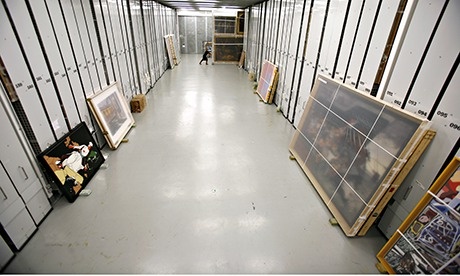
Regular readers will know that one of AHN's hobby horses is the question of art locked away in storage (see earlier AHN here and here, and also my piece in the FT here). In the UK, about 80% of our public collection of oil paintings is in storage at any one time. For some of our major museums, such as Tate in London, an extraordinary amount of great masterpieces lie languishing in storage, unseen for years. We're not just talking about lesser works, but pictures by major names such as Van Dyck, Constable and Gainsborough.
So hurrah then for the Culture Minister, Ed Vaizey, who is determined to do something about it. Here's a snippet in the Mail on Sunday:
An unseen treasure trove of the nation’s most valuable paintings could soon be on display in local art galleries and community centres across the country if radical new plans proposed by Culture Minister Ed Vaizey get the green light from Downing Street and the Treasury.
Vaizey is said to have been stunned by the size of the collections languishing in the storage vaults of London’s major galleries – ‘like something from Raiders Of The Lost Ark’ he reportedly told friends – and is lobbying for funding to put them on display in the regions.
The problem of art in storage is a feature of the government's new 'White Paper' on culture, the first for 50 years, and which you can download here. It features many sensible things.
Museum attendance - London leads the way
April 1 2016

Picture: TAN
Us Brits can be proud of the fact of three of the ten most visited museums in the world last year are in London. As ever, the Art Newspaper's annual visitor survey makes for interesting reading, and to navigate it best you need to get the paper edition. While the biggest draws were the likes of Ai Wei Wei (372k visitors in London) and Jeff Koons (650k in Paris), I'm happy to report, of course, that Old Master exhibitions are still popular: 'Late Rembrandt' had 520k visitors in Amsterdam, and 264k in London; Vleazquez had 478k in Paris and 336k in Vienna; Goya in Madrid had 535k (figures for London seem not be listed); 'Late Turner' had 267k visitors at Tate Britain.
All of the above pale in comparison to the exhibitions held at the National Palace Museum in Taipei, however: there 8 exhibitions drew in over 1m visitors last year, with 5.3m going to see 'The Enchanting Splendor of Vases & Planters'.
This is not Shakespeare (ctd.)
April 1 2016

Picture: BBC History Magazine
It's the 400th anniversary of Shakespeare's death, so we're seeing him featured in all sorts of magazines, books and TV programmes. We're also seeing repeated use of the Cobbe portrait, which regular readers will know that AHN (and many others, including the National Portrait Gallery) do not think is actually Shakespeare.
The latest offender is BBC History Magazine (above), which really ought to know better. A version of the Cobbe portrait is also shown as Shakespeare on the front cover of the Museums Association magazine, but then we expect the MA to be wrong about most things. Meanwhile, the Chandos portrait, which really does show Shakespeare, is off on loan to Russia, to the Tretyakov Gallery (till July 24th).
The suprassing of the Chandos portrait by the Cobbe portrait tells us more about us than Shakespeare - whatever he looked like - for we are determined to imagine him as more handsome and flamboyant than he really was. He was a celebrity, we say, therefore he must look like our conception of one. Of course, this is not a new process, for in the 19th Century the Chandos portrait was retouched to make Shakespeare look more like a romantic playwright, with the addition of longer hair. It's one thing to alter an existing image of the Bard, but quite another to invent a wholly new one.
'Classic Art Week' at Christie's New York
April 1 2016
Video: Christie's
Here's a trailer for Christie's new 'Classic Art Week' in New York, 12th -15th April, which features all manner of things from clocks to Brueghels. The tag line at the end - 'Prices from $3,000' - suggests Christie's are aiming the sale at new buyers, which is good. I hope it does well. Happily, for old stick-in-the-muds like me, the Old Master paintings are still called 'Old Masters'.
Late Renaissance marble discovery
April 1 2016
Video: Christie's
Here's a nice video from Christie's, in which sculptor specialist William Russell describes discovering a long lost marble figure of Andromeda by Pietro Paolo Olivieri. It's coming up for sale on 13th April in New York at $500k-$800k. The catalogue note is here.
Fakes, fakes everywhere? (ctd.)
April 1 2016

Picture: Loovre
A source at the Louvre has sent me the first results from their analysis of the Cranach seized by a French court. The picture, which was bought recently by the Prince of Liechtenstein for €7m, has been beset by allegations of forgery, and had been sent to the Louvre by a judge for scientific testing. My source says:
We took a new multi-spectral x-ray with our patented Lumiere-o-scope, and the results are quite remarkable. They prove for the first time that Cranach had a sense of humour.
Bof.
New Rubens discovery in New York
April 1 2016

Picture: Christie's
I was glad to see the above picture in Christie's forthcoming New York catalogue, correctly described as by Rubens. It had previously been in a Christie's South Kensington sale as 'Flemish School', and though I was disappointed to see it withdrawn shortly before the sale, the sleuther's loss is the consignor's gain.
The estimate of $120,000-$180,000 seems quite reasonable. The sale is on 14th April. Other highlights include a fine, small El Greco of The Entombment at $4m-$6m, and an important newly discovered Virgin and Child by Joos van Cleve $600k-$800k.
Optimism
March 31 2016

Picture: Liveauctioneers.com/Miami Auction Gallery
I wonder who would consider paying $100,000-$200,000 for this portrait, attributed to Andreas Riehl the Younger (but not by him, or anyone close). Caveat Emptor...
