


Sotheby's Old Master catalogue
November 6 2014

Picture: Sotheby's
The catalogue for Sotheby's London evening Old Master sale has gone online. Highlights include a £5m-£7m Canaletto, and the above Turner being sold by the Earl of Rosebery with an estimate of £15m-£20m (that's more, by the way, than the entire budget for the new film 'Mr Turner'). For the latter, there's an excellent catalogue note by Sotheby's specialist Julian Gascoigne.
In 2010, the Getty bought the last major Turner of Rome on the market, also sold by Lord Rosebery at Sotheby's, for £29.7m. Will they buy this one too?
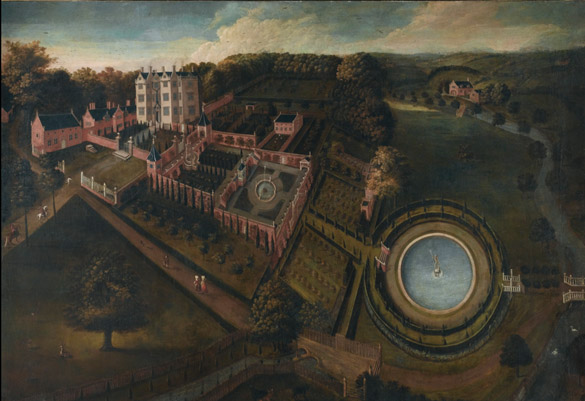
Also interesting is the below c.1662 depiction of Llanerch Park in Denbighshire which, say Sotheby's, is likely to be 'the earliest topographical birds-eye view of a British estate'. The estimate is £400,000-£600,000.
Making 'Mr Turner'
November 6 2014
Video: FT
Here's a nice video from the Financial Times' arts editor Jan Dalley about Mike Leigh's new film 'Mr Turner', looking at how it was made, and how Timothy Spall learnt to paint for the role. Leigh gives a touching insight into how hard Spall tried to emulate the great artist.
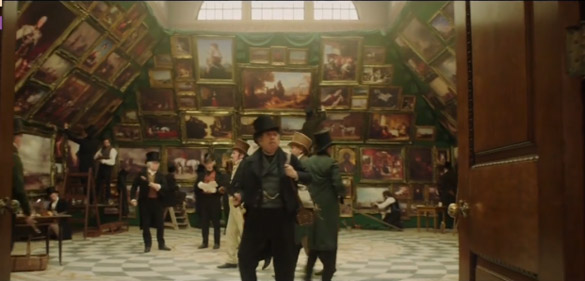
Also, following my recent rants here and in the FT on how art galleries don't display enough of their collections, check out the below shot of gallery hanging, 19th Century style.
Important Van Dyck in Christie's December Old Master sale
November 4 2014

Picture: Christie's
It's now getting to that time of year when people like me begin to obsessively check the websites of Christie's and Sotheby's, to see if their London Old Master sale catalogues are online. Refresh, refresh, refresh...
They're not yet online, but I can tell you that Christie's have secured the above impressive portrait by Van Dyck of the musician Hendrick Liberti, which will carry an estimate of £2.5m to £3.5m. Painted in Antwerp in about 1628, it used to form part of the collection of Charles I, where it was described as 'ye singing man', and hung in the Bear Gallery at Whitehall Palace alongside Van Dyck's similarly dated portrait of Nicholas Lanier, the musician and courtier. It was Lanier's portrait which, in its brilliance, helped make Charles I so determined to secure Van Dyck's services as court painter from 1632 onwards.
New Moroni discovery at the RA
November 4 2014

Picture: Camilla McCulloch
The new Moroni exhibition at the Royal Academy in London is winning praise from the critics: here's Richard Dorment in The Telegraph giving it 4 stars out of 5; and here's Jonathan Jones in The Guardian doing likewise.
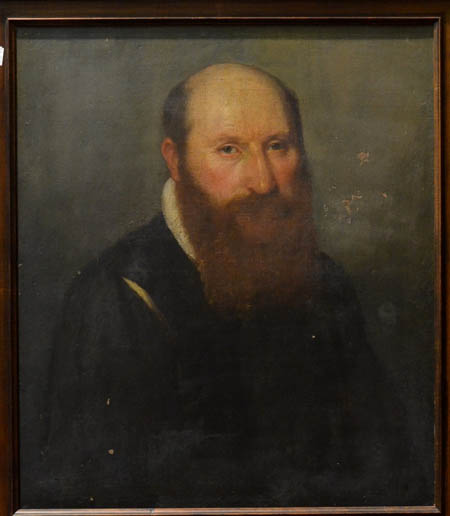
Meanwhile, sleuthing art dealer Rohan McCulloch alerts me to the fact that the above exhibit is a new Moroni discovery, having surfaced in a regional English auction last year as 'Italian School'. Rohan underbid it. I missed it completely. So congratulations to the buyer; going from sleeper to major museum exhibition in one year is an impressive feat.
Update - another sleuthing reader also spotted the picture, and sends this photo of it at the sale:
I seem to be the only person who didn't see it!
Contemporary Art Fail
November 3 2014

Picture: via dezeen.com
A zippy new 'contemporary art space' which opened in Colchester in 2011, funded by taxpayers (via the Arts Council) at a cost of £28m, seems to be heading for disaster. FirstSite's café, a hoped for money spinner, has closed, there are no exhibitions planned for the new year, and after renting itself out for 'Christmas-themed events', the whole place will shut down for a couple of months while they figure out what the hell to do with the place.
For more on what appears to be another disastrous attempt to impose contemporary art spaces on the masses see here and here.
FirstSite isn't a patch on the £60m flushed down the toilet by the Arts Council on The Public in West Bromwich. It's a mystery to me that the culturati assume that if you spend millions on a contemporary art gallery, but have no idea of what's going to go in it, that somehow it'll all work out, and that people will come and visit.
Shouldn't we use such funds instead on helping to show the thousands of masterpieces hiding in museum storage? And help support excellent ideas like Mr Ruffer's? I suspect the people of Colchester would rather see a few of Tate's stored Constables (43 out of 50 at the last count) in FirstSite than a few neon light installations by an artist they've never heard of.
Italian Museums (ctd.)
November 3 2014
In the middle of railing against the latest film of the Vatican's art treasures, Jonathan Jones has this entirely typical account of dealing with Italian art galleries:
All this reminds me of the time I needed to see a Michelangelo drawing in the Department of Prints and Drawings in the Uffizi in Florence. Despite bringing the required references, I was repeatedly fobbed off with reproductions, until I made it clear I would not leave without being shown the real, actual, wondrous thing.
Centuries of tourism have, I think, bred a particular snobbishness in Italy about the nation’s cultural heritage. There is, perhaps, a level of art historical insiderdom where you would be able to see the special stuff and would not be treated like an idiot – though I’ve no idea how you convince Italy’s art institutions you are seriously interested, rather than just gawping.
The Uffizi still has no online collection of any kind.
Dictator Art Week
November 3 2014
Video: Telegraph
It's Asian Art Week in London, and, reports the Telegraph, there's even an exhibition of works by North Korean artists in the DPRK embassy in Ealing.
There's a limerick in there somewhere...
Update - a reader has had a go:
A painter who lived in Pyongyang
Was at home when the shit hit the fan
Which bounced off the ceiling
And landed in Ealing
What an unfortunate North Korean.
Happy Halloween!
October 31 2014

Picture: via @hclaytonwright
Remember 'Fresco Jesus'? Seems he's back, as a Halloween mask...
'Show us what you've got' - the scandal of great art in store
October 31 2014

Picture: montel.com
My latest piece for the Financial Times, which you can listen to as a podcast here and read here, looks at the sometimes staggering amount of good paintings our leading museums keep in storage. Would you believe that out of Tate's 50 oil paintings by John Constable, just three are on show at Tate?
And by chance Jonathan Jones has also touched on the same question over in The Guardian. He went to Tate Britain recently to see some of their William Hogarths:
So I got to Tate Britain and headed for its 18th-century gallery. But where was Hogarth’s self-portrait? Where were Tate’s other terrific examples of his art? Nowhere. I hate to moan (no really, I do) but I have to ask why the man who invented British art is so glaringly absent from Tate Britain’s “Walk Through British Art”.
Actually, I think this is a subject well worth moaning about.
Finally, over on Tribune de l'Art, Didier Ryckner reports that the Louvre's plans to build a new €60m storage depot 200km outside Paris have caused uproar amongst the Louvre's curators. They fear, quite rightly I'd have thought, that once so many pictures are so far away, there won't be much rotation of art works at the Louvre itself. That said, at the moment, even with the storage in the Louvre's basements (where there is a risk of flooding of course, being next to the Seine), one regularly sees long-standing gaps on the walls when pictures are taken off on loan or for conservation.
Update - a reader writes to point out that Jones just missed out on a cache of Hogarths because of Tate's new 'spotlight' exhibition on Hogarth portraits, which opened on 27th October. In my experience, such a turn of events is, however, very much the exception. And it still seems to me a shame that as great an artist as Hogarth has to wait for his turn in the spotlight. He should be permanently in the limelight.
I remember looking at the number of Hogarths Tate's website said was on display some months ago (I've had this article in mind for some time), and I recall it was something very low like two or three.
Update II - another reader writes:
The National Gallery used to boast that all its paintings were on display, but this was in the halcyon days of Neil MacGregor's directorship (before you were born); and meant that the zweite garnitur was hung hugger-mugger, cheek by jowl, in the lower ground floor. Successive trustees and directors of the National Gallery have steadily weakened their commitment to ensuring that everything is on display, to the extent that the reopening of the lower ground floor this (?last) year, with only a small percentage of the lesser pictures, was hailed as a major advance. The Tate, on the other hand, has never been embarrassed about the huge extent of the iceberg below display. What is needed is a clear commitment to the permanent collections, even if this comes at the (literal) expense of exhibitions; but it would need trustees much more courageous than any appointed in recent years to acknowledge that the public has a right to see what it owns, immediately, and not by appointment or in an exhibition several years hence.
Which is why I should immediately be made a trustee of everything.
Update III - another reader writes, from the US, with this sad note:
Some storage items are never seen as they may be stored from the day they are donated to the day they are sold, as happened to my mother's gift.
Update IV - another US reader writes:
Hang paintings in the nineteenth century manner as at the Barnes Foundatoin [below] and you can show the entire collection.
Indeed. The Wallace Collection is another example of this hanging style, and I've always thought it works well.

Update V - a reader writes:
Worth adding that four of the Tate's Constables are on display at the Victoria and Albert Museum in their Constable exhibition?
Even if all four of these go back on display at Tate, that still leaves 43 in storage...
Update VI - a reader who has held senior curatorial positions in both regional and London galleries writes:
Many, perhaps most regional galleries, have large numbers of pictures in store (as BBC Your Paintings shows). There are wonderful exceptions but, sadly, many can't cope with their existing collections. It's a matter of staffing and resources. There is no point in redistributing art unless the resources go with the redistribution. But I agree about being more relaxed about lending and moving.
Which is true, though I would add that to resources we might, in some cases need to add gumption. Some regional curators and directors are much more active and enthusiastic than others when it comes to acquiring, displaying and borrowing. The late Brian Stewart, for example, ran Falmouth Art Gallery on a shoestring, but managed to put on the most extraordinary displays.
Also, it's undeniably the case that many of the pictures in regional museum's stores are hardly top line. My main point is that some London galleries have pictures which they might not feel are quite good enough for permanent display in a limited hanging space; but for smaller galleries they would be handsome additions to any hang.
Update VII - a reader makes this perceptive point:
With regards to Tate Britain, I wish the director or curators could have the imagination to stage a grand rehang in classical style for the vast Duveen Halls, along the lines of the Koch gallery at the Museum of Fine Arts Boston. That would be splendid way to showcase some of the grand 18th and 19th Century paintings, and maximize the wallspace of this much under-used central space.
I've mentioned this before, in relation to the fine hang in a similar space at the Museum of Fine Arts in Boston.
Update VIII - a reader recently tried to borrow one of the stored Constables; 'we're too busy', was Tate's response. Tate also require, I'm told, nine months notice for a loan request. Most galleries are happy with six, though since museum world bureacracy moves at a famously glacial pace, it's obviously better to get your request in long before that.
Richard Wilson catalogue raisonné online
October 31 2014

Picture: PMC
The new catalogue raisonné of Richard Wilson's paintings has gone online.
Just marvel, AHN-ers, at the rarity of such a sentence. How often do we get to see the words 'new', 'catalogue raisonné' and 'online' all together? So all hail please the great endeavours of Dr Paul Spencer-Longhurst, who has compiled the catalogue, and the Paul Mellon Centre in London for supporting it. It looks like a fine model for all such future ventures.
Sleeper alert?
October 30 2014

Picture: Christie's
The above 'Circle of Rubens' made £128,500 today at Christie's mid-season Old Master sale in London, against an estimate of £20,000-£30,000. It's a copy (at least, so we presume) of a picture in the Rothschild collection at Waddesdon, which you can see here. The Waddesdon picture is called 'After Rubens', but I remember when I saw it a long time ago that I thought it was pretty good. The Rubens scholar Peter C. Sutton apparently thinks the Waddesdon picture is by Rubens. You can see an undoubted version by Rubens of the subject, the Garden of Love, in the Prado here.
Update - I think we can safely say this is a case of 'optimism alert'.
The new Picasso Museum
October 30 2014

Picture: NYTimes
In the Sunday Times, Waldemar loved it. He says that following the recent sacking of the museum's director, Anne Baldassari, he was:
[...] expecting to encounter an unhinged institution trapped in a cycle of recrimination and chaos. Instead, I found a gloriously rethought Picasso experience in which his story is excitingly and inventively told, and his artistic genius forensically clear. The old Musée Picasso was a marvellous place to visit. This one is better.
Apparently, Baldassari was let back in to complete the opening hang. This, then, is her handiwork. Mercifully, and unexpectedly, the journey she has created for us is essentially chronological. As the inventors of the circuitous theme hang, French curators have much to answer for in modern museum history, but here we start at the beginning and end at the end, with just a handful of enlargements along the way. [...]
With so much that is new on show, the enlarged and reimagined spaces have gained an archival air that appears initially to dispel some of the raw power of Picasso’s art. The old museum was a mess, but the disorder seemed to suit it. Everything now is white and pristine, carefully considered and positioned. However, once some of this glaring new whiteness has faded, the power will surely loom again.
And you can certainly see where the money went — on achieving perfection. I imagine that is where the time went, as well. It is no more than Picasso deserves. All in all, a magnificent achievement. Instead of sacking Baldassari, they should have given her the Légion d’Honneur.
But in the New York Times, Holland Cotter was less convinced about some aspects:
Given such richly personal material, it’s too bad the new presentation at the Picasso Museum — officially the Musée Picasso Paris — isn’t telling that story more persuasively. Architecture is part of the problem. The museum’s 17th-century home, the Hôtel Salé, in the historic Marais district, with its garden, courtyard and two-story, sculpture-encrusted entrance hall, has never been ideal for showing art.
The interior is choppy, with smallish spaces, dead ends, and illogical connections. The original 1980s renovation laid a white-walled Corbusian gloss over this without achieving a sense of unity. The new design, by the architect Jean-François Bodin, is basically a magnified version of the old plan. There’s more space — four floors of galleries, including a vaulted basement and loftlike attic with exposed beams and views of surrounding rooftops — but their order is still hard to navigate.
An impression of discontinuity is compounded by the idiosyncratic arrangement of art devised by Ms. Baldassari, who stayed on the job just long enough to organize the inaugural show. The main installation, on the first and second floors, begins with a few paintings by the adolescent Picasso in Spain, where he was born in 1881, and others from his first stay in Paris when he was barely out of his teens. The shift is dramatic: Murillo-style realism one year, the equivalent of psychedelia the next.
'Inside Picasso's Camera'
October 30 2014
Video: New York Times
The above video shows Sir John Richardson, Picasso's biographer (he knew the artist well) talking about Picasso's love of photography. You can read more about Sir John's new exhibition on Picasso's photos here.
Marvel, though, at the extraordinary fact that Sir John's grandfather was born in 1817, when King George III was on the throne. I love it when history is so tangibly close to us.
Moving Leonardo's 'Self-Portrait' drawing
October 30 2014
Video: Euronews
The abovenews clip is narrated by a (spookily good) automated English voice, but it's worth watching to see the zippy new case built for Leonadro's (alleged) self-portrait drawing, which is going on display in Turin for the first time in many years. Despite all the protective gizmos, however, they seem not to be too concerned about the light levels...
For more on the exhibition, and the latest views on whether the drawing is or is not by and of Leonardo, see this piece here on the BBC.
Turin Shroud debunked (again)
October 30 2014

Picture: Antonio Calanni/AP
British scholar Charles Freeman has written perhaps the most comprehensive debunking of the Turin Shroud legend in the latest History Today. It's well worth reading the article in full, but here, from the Guardian, is his case in a nutshell:
Freeman, the author of Holy Bones, Holy Dust: How Relics Shaped the History of Medieval Europe, studied early descriptions and illustrations of the shroud. None predates 1355, the year of its first documented appearance in a chapel in Lirey near Troyes in France, before it was acquired by the House of Savoy in 1453 and “converted into a high-prestige relic” to shore up the power base of the insecure Alpine dukedom.
In particular, he turned up a little-known engraving by Antonio Tempesta, an artist attached to the Savoyard court, who made a meticulously detailed image of one of the ceremonial displays of the cloth to pilgrims in 1613.
“Astonishingly,” he writes, “few researchers appear to have grasped that the shroud looked very different in the 16th and 17th centuries from the object we see today.”
The Tempesta engraving, as well as a number of 15th- and 16th-century first-hand descriptions, emphasise a feature that is much less obvious now – that the figure was covered in blood and scourge marks, relating to Christ’s flagellation. These extensive markings can be explicitly related, argues Freeman, to a focus on blood in depictions of the crucifixion that emerged in the 14th century – a “dramatic” change in iconography that sharply differentiates depictions of the crucified Christ from those of earlier centuries, and which reflects revelations of a bloody, wounded Christ reported by mystics such as Julian of Norwich in the 14th century.
The original purpose of the shroud, argues Freeman, is likely to have been as a prop in a kind of medieval, theatrical ceremony that took place at Easter – the Quem quaeritis? or “whom do you seek?”
“On Easter morning the gospel accounts of the resurrection would be re-enacted with ‘disciples’ acting out a presentation in which they would enter a makeshift tomb and bring out the grave clothes to show that Christ had indeed risen,” he said.
Freeman’s idea was shored up by his study of the earliest illustration of the shroud – on a pilgrim badge of the 1350s found in the Seine in 1855. On it, two clerics hold up the shroud, and beneath is an empty tomb.
For an example of the tenacity of the Shroud's supporters, see this rebuttal in The Catholic Herald.
New LED lighting for the Sistine Chapel
October 30 2014
Video: BBC
Blingier than ever. More details here.
Andrew Wilton on 'Mr Turner'
October 30 2014

Picture: Film4
Andrew Wilton is one of the leading Turner scholars, and has written this interesting take on the new 'Mr Turner' film.
Dobson's self portrait at Osterley Park
October 30 2014
Video: ZCZ films
The Great Waldemar has made a short film about the return of William Dobson's self-portrait to Osterley Park, where it used to hang (when that house belonged to the Earls of Jersey) alongside Van Dyck's late English self-portrait now in the National Portrait Gallery.
The Dobson still belongs to the present Lord Jersey, who has generously lent the Dobson to Osterley (now a National Trust house) for ten years. You can see from the close-ups in this film just how much of a homage Dobson was paying to Van Dyck in the painting, not only in the composition but also in terms of the technique; it's about as Van Dyck-ian as Dobson gets.
The film also reminds me that the Dobson is in better condition than the Van Dyck, possibly on account of Dobson's slightly thicker painting style. Some of the glazes in the Van Dyck have become a little abraded, and the background has become substantially darker over time; its original colour is quite a bit lighter.
Waldemar is also as obessed with Dobson as I am about Van Dyck. I'm hoping that's him singing at the beginning. But I doubt it.
Apologies...
October 29 2014
I'm writing my article for the FT, so not much blogging today I'm afraid...
New Constable for the Ashmolean
October 28 2014

Picture: Ashmolean
The above painting by John Constable, Willy Lott's House from the Stour, has been acquired by the Ashmolean Museum through the UK government's Acceptance in Lieu scheme. Surprisingly, it's the Ashmolean's first finished Constable. And equally surprisingly it was once (it is thought) the first Constable to ever enter a US collection - it was later sold by the New York Public Library, and returned to the UK in 1956. More details here.
Update - the below photo on the Ashmolean's website is a classic of one of our favourite genres here on AHN; The Spurious White Glove Shot. Here, we name and shame Senior Curator of European Art, Colin Harrison (on the right), for 'holding' a painting that is already firmly attached to the wall. But top marks to the Ashmolean for not falling for the other photo-op beloved of the press; The Long-Legged Woman Walking Blurrily In Front of the Paintings Shot (for a previous example see here).
Update II - I'm told the picture had been hanging in that spot for 18 months!

Update III - a reader would like to point out:
Besides the acquisition of a John Constable painting the Ashmolean Museum has recently announced the donation by Elizabeth and Micheál Fellers of the 61 items of historical needlework recently on show in their "Eye of the Needle" exhibition. The pieces are seventeenth-century embroideries which include dramatic pictorial panels, samplers, domestic items and costume pieces. The donation is being made to the Museum in honour of Professor Christopher Brown CBE who retired as Director of the Ashmolean on 30 September.
Professor Brown says: I am profoundly grateful to Micheál and Elizabeth Feller for this gift. The collection has been built, over many years, through Micheál and Elizabeth’s passion and dedication; and the gift to the Museum, where the embroideries can be enjoyed by thousands of visitors, is an act of enormous generosity.
I hope this is worthy of at least a mention on your Art History News website. Textile artists are interested in what is happening in the painting and sculpture world even though those worlds do not seem very interested in textiles alas.
