


How to be an art critic
February 4 2014
Waldemar, one of the greatest , tells us how he did it.
Update - a reader writes:
Waldemar's story is as inspiring as the art that inspired him, and must make us appreciative at having overcome more privileged upbringings to also become diligent and productive. The talents of many artists arose from cauldrons like the one he experienced.
Paid internship at the NPG
February 4 2014
One day left to apply for a paid internship at the NPG in London. More here. Good luck!
The blockbuster effect
February 4 2014

Picture: The New Yorker
Interesting piece in the New Yorker on how the Frick coped with the crowds for their recent Mauritshuis exhibition.
Guffwatch
February 4 2014

Picture: The Art Fund
A reader alerts me to this gem, which was enough to persuade the Art Fund to part with some cash* to help the Guildhall Art Gallery buy Mark Titchner's sculpture, Plenty and Progress:
At first glance, Plenty and Progress seems to embody the affluence evoked by its title: Titchner's sculpture is spectacularly glossy, bursting with a vibrant red reflected within its own mirrored surfaces. Yet a close inspection reveals that the apparent plenty is only surface deep. The sculpture isn't precious metal but stainless steel, a material of austerity, while the circularity of the work seemingly resists any notion of linear progress. The work invites the viewer to consider the issues raised, without providing any conclusions of its own.
What utter b*llocks.
My reader adds:
I wonder if Michelangelo and Raphael's tondi also resist any notion of linear progress. The last sentence is a classic of the genre.
* We're not told how much.
Update - a reader writes:
I wonder what the Guildhall Art Gallery paid for the Mark Titchner 'sculpture' - it's ironic that you should blog it on the very day you also report the export ban on the Benjamin West from St Stephen's Walbrook - which should surely go to the Guildhall if it isn't going back into the church.
Another adds:
On another topic, with respect to contemporary art such as Peace and Prosperity I prefer the old maxim "res ipsa loquitur" to the Guff that critics compose from their basket of jargon blocks.
Sotheby's NY Old Master sales
February 4 2014

Picture: Sotheby's
Sotheby's total haul for the Old Master week was $76.2m, so some way ahead of Christie's at $64.2m (all prices inc. buyer's premium). The top lot was Honthorst's fine and newly discovered musical scene, above, which made $7.5m, against a $2m-$3m estimate. Other notable prices included $2.4m for Jan Miense Molenaer's Self-Portrait with his Wife, Judith Leyster (Frans Hals' daughter), $4.4m for a Jacob Ochtervelt genre scene, and $5.8m for a curious early work by El Greco, which was based on a lost Titian. Notable casualties included a 'playful' nude scene by Fragonard, which bought in at $6m-$8m. Yesterday's taste...
I may be wrong, but it seems to me that Sotheby's in New York usually has a better haul of pictures than Christie's. Maybe I'm swayed by the presentation - Sotheby's NY headquarters is infinitely nicer than Christie's, and the pictures are showed to much better effect.
Incidentally, this last comment doesn't apply to Sotheby's new website, which is woeful.

Authenticating Modigliani
February 4 2014

Picture: NYT
If you thought authenticating Chagalls was frought with difficulty, spare a thought for Modigliani - as Patricia Cohen in the New York Times reports, the artist's ouevre is now beset by fakes and controversy:
Three daunting facts confront anyone interested in buying one of Amedeo Modigliani’s distinctive elongated portraits. They tend to have multimillion price tags; they are a favorite of forgers; and despite an abundance of experts, no inventory of his works is considered both trustworthy and complete.
Christian Parisot, for instance, the author of one catalog and the president of the Modigliani Institute in Rome, is due in court this week in Rome on charges that he knowingly authenticated fake works.
Marc Restellini, a French scholar compiling another survey of Modigliani’s work, jettisoned part of his project years ago after receiving death threats.
And even those who swear by a listing of 337 works created by the appraiser and critic Ambrogio Ceroni acknowledge it has significant gaps. The effort to establish an authoritative record of Modigliani’s work “resembles nothing so much as a soap opera,” Peter Kraus, an antiquarian book dealer, wrote in an essay published a decade ago.
Mon Dieu - le feu! (ctd.)
February 4 2014

Picture: BG
Martin Lang, the owner of the Chagall fake we featured on 'Fake or Fortune?' last week, has served an injunction on the Chagall Committee, to try and stop them burning his picture. So far, the Committee has remained silent...
In the Telegraph, attention has turned to the crazy French system of authenticating pictures:
As in the latest case, the decision often rests with an artist’s descendants, who are indefinitely allowed to exercise the “moral rights” of their forebears under French law. Similar committees decide whether works apparently by Edgar Degas, Pablo Picasso and Man Ray are genuine. Yet, as Valentin puts it, “The children, grand-children or great-grandchildren of an artist are not necessarily the best experts.”
Mould argues that the system ought to be reformed. “The son of a brain surgeon is not someone you would trust to work on your brain,” he says. “After all, they hold a very powerful right: they can turn something bought for £5 in a flea market to £1 million. Conversely, as in Martin’s case, they can turn £100,000 to nothing.”
Update - it hasn't been burnt yet. Hope builds...
'Fake or Fortune?' makes into 'Thought for the Day'
February 4 2014
Audio: BBC
'Thought for the Day' is the holy slot on BBC Radio 4's Today programme, and is heard every day (save Sundays) at 7.50am. If I hear it, it normally means I've woken up too early. This morning, however, I was startled to hear the Bishop of Norwich discussing the fake Chagall we had on 'Fake of Fortune?' last week, and somehow linking it to Jesus. Still, top marks for watching the programme Bish!
Another sleuthing vicar
February 4 2014

Picture: TAN
Hot on the heels of the English vicar who found a Van Dyck recently, Father Joaquin Caler in Spain believes he has found a Murillo (above). However, there's disagreement amongst Murillo scholars. More in The Art Newspaper here.
Another chance to buy Coello's portrait of Don Diego
February 4 2014

Picture: DCMS
A portrait by Coello of Philip II's son, Don Diego, has been temporarily barred from export from the UK. The matching price to raise, should a UK buyer be interested, is £4.25m. The picture belongs to the Prince of Liechtenstein, and the last time he tried to export it there was a tremendous hoo ha, leading in part to the cancellation of a Liechtenstein collection show at the Royal Academy. It is thought that the National Gallery may be interested in the picture. More here.
Update - A reader writes:
Why do the committee not let this one go? I cannot think of it's relevance to British history or find it to be an exciting example of portraiture to make it's mark in a UK national collection. The public lost out by by the cancellation of the Lichtenstein show.
West altarpiece barred from export
February 4 2014

Picture: DCMS
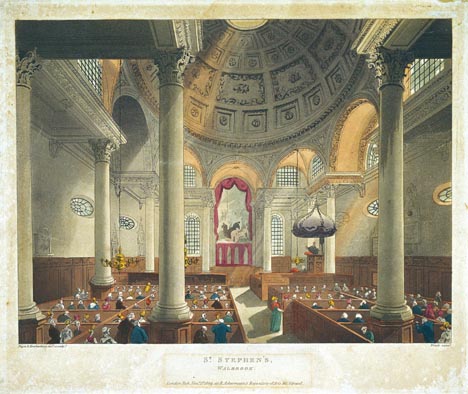
A large and lovely altarpiece by Benjamin West being scandalously sold by the Church of England to a US museum has been temporarily barred from export. The picture, Devout Men Taking the Body of St Stephen, used to hang in St Stephen's Walbrook in London, as shown below. But after a frankly bizarre judgement in the CofE's Consistory Court last year the picture was sold to the Boston Museum of Fine Arts, for £1.75m. A UK institution, if any is interested (which I doubt) will have to raise that sum to keep the painting in Britain. More details on the export bar here.
Mon Dieu - le feu!
February 3 2014

Picture: BG*
I'm a little busy today, so not much posting till later on I'm afraid. We're mounting a last ditch attempt to stop the short-sighted** Chagall Committee in Paris from burning the picture we featured on yesterday's 'Fake or Fortune?'.
* Marvel at my Photoshopping skills.
** That's the kindest way I can think of describing them at the moment.
Update - here's Philip in The Telegraph on why you should never burn even a fake:
Fakes are nasty things but they do have educational benefits. As murky artefacts they testify to society’s heroes and its villains. But we are hardly going to destroy all those fake medieval splinters of the True Cross, or bin all those phony metatarsals of St Barnabas because they confuse our understanding of Christianity.
It is also important to know thine enemy. Identifying fakers requires knowing their traits and identifying a corpus of works of reference, like the fascinating oeuvre of Van Meegeren the Vermeer faker in wartime Amsterdam – another artist we outed in a former programme - whom we can now with retrospect see added a touch of early Hollywood to his 17th century religious personages.
And what will this do to those who may well have works by Chagall which, for whatever reason, have failed to make the art history books to date? If I owned a would-be Chagall I would now not think twice, but three times or more before sending it to Paris. Ugly acts like the one proposed by the Committee can have the effect of damaging the progress of art history.
Update II - thanks for your kind emails on the programme. A reader writes:
It might be said that the right of an artist's descendants to destroy a work that they consider to be a fake is closely related to their right to enjoy an income from the sale of genuine works for 70 years after their ancestor's death - the so-called Droit de Suite, which the EU has now forced the United Kingdom to adopt as Artist's Resale Right. Do you see where this is leading....?
Another reader adds:
Presumably only the signature makes the painting a fake. Maybe that could be taken off?
Indeed. Another reader says similarly:
I totally agree with your discussion on destruction of fakes. In order to avoid further circulation of the work would not be sufficient for the committee to publish online a catalogue of ascertained “fake” pictures, and maybe put a big “fake” rubber stamp on the back of the work?
One reader recalls a very similar tale:
Circa 1989 a friend/acquaintance was working in a London gallery and someone walked in and offered her a Chagall picture. She bought it for about £1000 and discovered that the only way to verify it was to send a photo to an expert in Paris, France. The expert contacted her and requested that she should bring it to him for further verification etc. In due course she and her husband went to Paris, whereupon the Gendarmerie appeared and explained that the artwork was fake and that it would be destroyed.
It would be interesting to know just how many works the Chagall Committee has torched over the years.
A reader adds that some fakes can even become valuable:
Indeed, when is a painting a fake and when is it in the style of an artist or a copy. Our museums are replete with paintings described as "school of" or "after". Should all student and studio copies be burned as well. A fake Vermeer could be an original Van Meegeren, who was an accomplished artist whose Vermeer style paintings enjoy a good market now.
One reader did a little research into the picture themselves:
I watched last night’s program with interest. I have a book on Chagall and out of interest I turned to the index to see if the dancer’s name Kawarska appeared. It was not there but I immediately saw the name Karsavina, Tamara. I turned to the page and was surprised to see that indeed she was a ballet dancer (in fact I have since learnt that she was extremely famous, the original firebird). Now I also saw that Chagall was in St Petersburg studying under Leon Bakst in 1908-1909 or thereabouts and that therefore it is very likely that Chagall had contact with Karsavina. So could it be that the name Kawarska is just a garbled version of Karsavina?
Another point is to do with the phthalocyanine question. It was brought into commercial use in the 1930’s but again I was interested to learn from the internet that it was discovered in 1907. It would be worth researching into whether it could have been available to Chagall as early as 1909-1910.
Sadly, the picture really is a fake. But the point remains, particularly on the science front, that our knowledge of pigments is continually evolving. A yellow pigment (I forget which) which paint analysis used to say definitively could not have been used before such and such a date, has recently been found to be in use in artist's palettes for much longer than previously thought. So some pictures which were once rejected as later fakes or copies have had to be reassessed. The point is, the scientific analysis of paintings is still in its infancy, even though art historians are tempted to accept anything a 'scientist' says about a painting as the gospel truth.
Finally, one reader knew it was a wrong 'un very early on in the programme:
You and the team were great as always , though I think once you saw their stair carpet and realised someone had designed that interior , the game was up !
but £100,000..amazing ! I know zero, but the eyes the eyes..so wrong..
Update III - an MEP, Edward McMillan Scott, has raised the issue of the painting's imminent destruction with the European Commission.
Update IV - the MEP has even started a petition to save the painting, which hardly anybody has signed. 53 at the last look! Mind you, these online petitions are usually pretty silly, and invariably reward you with a whole heap of spam.
Guffwatch - Koons edition (ctd.)
January 30 2014

Picture: Christie's
News that Christie's are to sell a Koons Cracked Egg in London in February brings plenty of Guff-tastic lines in their press release. Read the whole thing here. This is a good bit:
Cracked Egg (Magenta) plays with the fragile nature of the egg to explore themes of the ephemeral and the eternal. The fragments of shell emphasize the fusion of opposites, appearing simultaneously organic and synthetic, fragile and resilient. To contrast the vulnerability of the eggshell, Koons managed to perfect casting techniques that result in a mirror-sheen surface that is virtually indestructible. As the artist explains, “I was interested in the dialogue with nature and aspects of the eternal, the here and now, the physical with the ephemeral... the symmetrical and asymmetrical, a sense of the fertile …”
In just this one paragraph we can see a whole range of the generic phrases that one needs to create contemporary art guff: 'explore themes'; 'fusion'; 'simultaneously'; 'contrast'; 'dialogue'. These are the key words any guff sentence needs, because they allow you to do the old art guff trick of combining opposites - 'the symmetrical and asymmetrical' - which sounds terrifically learned, but of course says nothing of any substance at all.
The estimate is £10m-£15m. If you buy it at even the low estimate, that's enough (with premium) to have bought the entire Christie's Old Master Part 1 sale in New York yesterday.
Update - a reader writes:
The Koons Cracked Egg guff would have been even better if they had used "dialogue" as a verb. Such a missed opportunity on their part.
Update II - another reader writes:
Reminded by your piece on Koons of this (below) from Lear. As is often the case, the Fool is wise: as he says earlier in the same scene, 'Truth's a dog must to kennel; he must be whipped out....' It's worth noting that, were one available, you could buy a First Folio for significantly less than a Koons 'Egg' (cracked or not).
King Lear Act 4 Scene 1
Fool; Give me an egg, nuncle, and I'll give thee two crowns.
KING LEAR; What two crowns shall they be?
Fool; Why, after I have cut the egg i' the middle, and eat up the meat, the two crowns of the egg. When thou clovest thy crown i' the middle, and gavest away both parts, thou borest thy ass on thy back o'er the dirt: thou hadst little wit in thy bald crown, when thou gavest thy golden one away.
Update III - a curious video from Christie's on the Egg here, in which you get an explanation of the bleedin' obvious.
Christie's New York Old Master results
January 30 2014

Picture: Christie's
The talk before the sale had been of a total for the week in excess of $75m, but so far Christie's main Old Master sale totals (which includes the 'Old Master' sale at $15.8m, and their curiously seperate 'Renaissance' sale at $45m) is just under $61m, including premium. The minor sales are still to come, today. Casualties included the Artemisia Gentileschi self-portrait (above), which was estimated at $3m-£5m, but which, to my surprise, stalled at $2m. The consensus seemed to be that Sotheby's had the better sale, so it'll be interesting to see what they make later today.
The Christie's sale total was boosted by the hefty $8.9m (inc. premium) realised by Jacopo Bassano's Adoration of the Shepherds, which hammered at $7.8m against the $8m-$12m estimate. The picture had been guaranteed before the sale. I believe the price represents a new record for Bassano by some way. Obviously, if the guarantor bought the painting, then we cannot be absolutely sure if the price is the price, so to speak.
The Rothschild Prayerbook sold for $13.6m (inc. premium), against an estimate of $12m-$18m. The book last sold at Christie's in London in 1999 for £8.5m. So irrespective of premiums, inflation or opportunity costs, the latest price represents a slight loss.
Update - Christie's have recently announced that last year was their best ever, in terms of overall sales in all categories. More here.
Update II - I should add that Christie's Old Master drawings sale has yet to be added to the total for the week.
Update III - the total for the week at Christie's was $64.2m.
Update IV - a reader alerts me to this Bassano in the Norton Simon museum, which sold for a very hefty £273,000 in 1969.
Gurlitt haul research continues
January 29 2014
The New York Times has the latest on that haul of potentially Nazi-looted art found Munich.
Up next on 'Fake or Fortune?'
January 29 2014
Video: BBC
It's Chagall. Or not. Find out Sunday, BBC1, 6pm. (One of our best films yet, by the way, well worth tuning in). More here.
Update -the outcome of the programme was trailed in advance by the BBC on its website and also the Sunday papers. I didn't think this was a good idea - and from the reaction on Twitter so far, neither did our audience. Sorry about that...
Tiepolo does comedy
January 29 2014
Video: Sotheby's
I enjoyed seeing this drawing by Tiepolo at Sotheby's New York, though I must admit it didn't have me rolling on the floor. It's for sale today, with an estimate of £400,000 - £600,000. Lot notes here.
David Zwirner on the Renaissance
January 29 2014
Video: Christie's
Here's an interesting video from Christie's, in which famed contemporary art dealer David Zwirner (our neighbour here in Dover St., London) talks about his interest in Renaissance art. It's reassuring to see a contemporary dealer talk about Renaissance art like this - bravo!
'Tim's not-Vermeer'
January 29 2014
Video: Sony Pictures
The daft-sounding new film Tim's Vermeer, in which a felloow called Tim sets out to prove that Vermeer was just a clever copyist using a camera obscura, has been rightly taken apart by Jonathan Jones in The Guardian:
Tim's Vermeer is a film about a man who totally fails to paint a Vermeer.
That's right – fails. This is not how the acclaimed cinema documentary by American TV magicians Penn and Teller bills itself or how it has been received by reviewers. Inventor Tim Jenison, we're told, set out to discover how the 17th-century artist used optics, hoping to prove his theory by painting his own version of Vermeer's The Music Lesson. The result, we are told, is almost uncannily convincing – Tim uses simple technology to create a perfect Vermeer.
At the risk of offending the education secretary, I have to quote Blackadder here. It's a brilliant theory, with just one tiny flaw: it's bollocks.
Tim's painting does not look anything like a real Vermeer. It looks like what it is: a pedantic and laborious imitation.
In the clip from the film above, Tim concludes that Vermeer's pictures are 'unusual' in having no under-drawing. Which is just wrong. Plenty of great artists didn't rely on under-drawing. And you might think that if Vermeer did rely on a camera obscura, then there would have to be under-drawing. How else would he get the image down onto the canvas?
There is no solid evidence that Vermeer used a camera obscura. The whole camera obscura theory is of course a sad reflection of the fact that nobody can paint like the Old Masters any more. The skills (and the patience) required are gone forever, because the continual, centuries-old link through which such skills were passed from master to apprentice has been broken. You can't learn how to paint like Vermeer, or Rubens or Rembrandt from a book (or even a film), you need to learn it by continual observation over a number of years. And so it only takes one generation to stop painting like, and appreciating, traditional painters for a whole history of skills to vanish with alarming rapidity. And because so few people can paint in the traditional way these days we try and fool ourselves that in fact not even great artists like Vermeer could do it either, and that he was just cheating. It makes us, and it makes modern artists, feel better to think that. As Jonathan Jones says, it ignores the role of the genius.
I'm reminded of my favourite Kenneth Clark line about the history of art; 'Above all, I believe in the God-given genius of certain individuals, and I value a society that makes their existence possible.'
Update - a reader who has seen the film sends in this well-argued demolition of Tim's theory:
Thanks for posting the article about Tim's Vermeer earlier today. I'm glad someone has finally had the guts to refute Tim's claim of discovering Vermeer's 'secret'. As an artist trained in the traditional crafts of painting, drawing, carving and gilding I went into the film as an open-minded skeptic, looking forward to some solid circumstantial evidence that Vermeer may have used such a device - I left the cinema with a huge grin on my face. What Tim was suggesting is laughable both from a technical and practical perspective. The film was full of contradictions and cryptic messages. Had Tim or any of those involved in the project actually bothered to research the methods of Vermeer or consulted an artist who studies and works in a similar manner to the old masters, obvious flaws would come to light. I'm glad Jonathan Jones attempted to take apart the theory, however his article unfortunately didn't touch on the facts that completely disprove Tim's idea. I've wanted to write an article based on fact, but unfortunately I'm no journalist, I'm a young artist, so I have no idea what I would do with it!
The film was full of contradictions and historical errors from the very start. Tim and his pals claimed that Vermeer didn't make use of underpainting or 'dead colouring' - well he certainly did make use of it! All scientific and forensic tests of Vermeer's paintings show a monochromatic layer where Vermeer would have identified tone, lighting and composition. One of the better examples of this is ironically, 'The Music lesson', the very painting Tim was 'copying'. The National Gallery has a good article on Vermeer's technique here. Why on earth would Vermeer be painting a monochromatic underpainting if he was using a mirror? Had he used Tim's device, he would have to turn the colour reflection from the mirror into monochrome! It makes no sense whatsoever!
Vermeer, like all masters, used glazes, the application of thin paint to give subtle transitions in colour and tone. The application of paint in this manner gave works a degree of transparency and depth. Using a mirror, the artist would be expected to mix the exact colour and paint with it. Working in a single layer in this way shows inexperience and a lack of understanding. Vermeer used glazes, so a mirror cannot have been used.
Tim also compared an early Pieter de Hooch with a later Vermeer in the hope it would 'prove' Vermeer had a secret. I was surprised that the directors had the guile to compare a work by a developing artist with a masterful painting by Vermeer at the peak of his ability. Incredibly distasteful considering Pieter de Hooch's later work can rather easily be mistaken for a work by Vermeer by an untrained eye.
Tim and his team apparently didn't use artificial light. I'm incredibly skeptical about this. Light conditions obviously can change in a second. If the sun disappeared behind a cloud would Vermeer be forced to drop his brush? Well if he was using a mirror, then yes. It's simply impractical! Had Vermeer used a mirror, he would have had to be able to control the sun, the seasons and the clouds. Perhaps he did have a secret after all? Tim didn't once mention the use of natural light once he sat down to paint - presumably he realised it was impossible and resorted to using artificial lights.
He clamped the heads of his models? Seriously? Need I say more? I could go on, but thankfully I'm not having to prove to you that the idea is heavily flawed.
