


'Elizabeth I and her People'
October 16 2013
Video: National Portrait Gallery
I haven't yet been to see the National Portrait Gallery's new exhibition, 'Elizabeth I and her People', but the only review I've seen so far is a bit mixed. Alastair Smart in the Telegraph gives it two stars out of five, and seems not to be impressed by the social history element (that is, the 'people' element of the show):
Call me old-fashioned, but generally I find that good art makes for good exhibitions. Which is why, alas, this show was always destined for failure.
It tells the ostensibly stirring tale of Elizabethan England through portraits of the queen, her courtiers and subjects. But the trouble is – though the era was one of great advances in science, finance, architecture, poetry, drama, and exploration – art remained stuck in the Middle Ages.
Take the portraits of Elizabeth herself: stiff, flat, linear, and with neck ruffs so tight they might choke her. Nicholas Hilliard’s "Ermine Portrait" from 1585 is typical. Far more attention is lavished on the queen’s ruby pendant and voluminous, black dress with gold beads than on probing her psyche through a meaningful look on her face. Elizabeth is rendered as an over-decorated Christmas tree.
The great Picasso raffle
October 16 2013

Photo: Picasso Estate/FT
EUR100 will get you a 1 in 50,000 chance of winning the above Picasso. The FT reports:
It sounds too good to be true – a Picasso worth an estimated $1m (£670,500) for €100. But “L’homme au Gibus”, or “Man with Opera Hat”, a gouache on paper dating from 1914, could be yours for the price of a Eurostar ticket.
For the first time, a work by Picasso is to be raffled. A total of 50,000 tickets will be issued, each costing €100. The work will be displayed at the Pavilion of Art and Design (PAD) in London from October 16 to 20; tickets will be on sale at PAD and are also available on the raffle website. The lottery draw will take place in Paris on December 18 and will be broadcast live on the website.
Frieze Masters
October 16 2013
Video: Blouin
Here's a flavour of Frieze Masters, the 'old art' offshoot of Frieze. I'm going to have a look on Thursday. Much of last year's offer was underwhelming, but there's a new intake of dealers this time, so things may be better.
Guffwatch - the 'Holy Grail of art'
October 16 2013

Picture: Christie's
It's Frieze week here in London, and everone's going mad for a bit of contemporary. The trendy galleries are having parties (where the people outside smoking and drinking outnumber those inside looking at the art by 10 to 1), and the auction houses are purveying their best combinations of guff and absurd estimates. The creme de la creme, however, seems to be happening in New York, where next month Christie's will sell what it calls 'the Holy Grail for collectors' a Jeff Koons Balloon Dog. Yours for $35m-$55m. A reader has kindly alerted me to Susan Moore's take on Christie's fantastically guffy pitch for the Koons in this week's Spectator:
The contrast could not have been more acute. It came the day after a press release from Christie’s New York pinged into my inbox announcing the forthcoming sale of Jeff Koons’s ‘Balloon Dog (Orange)’ on 12 November. Even by current auction-house standards, the hype was of heroic immoderation but it was the novel brazen pandering that shocked me.
It is a moot point whether Mr Koons’s monumental party balloon — sleekly engineered in high chromium stainless steel and more than three metres long and some three and a half metres high — is indeed ‘the most beloved of all contemporary sculptures’, or whether the auction itself will be a ‘landmark’ event ‘set to make history’. It is presented almost as a foregone conclusion that the sculpture, bearing an estimate of $35 million to $55 million, will eclipse not only the artist’s current auction record but also that set at Sotheby’s in May by Gerhard Richter’s ‘Domplatz, Mailand’ — $37.1 million — to become the most expensive work by a living artist ever sold at auction.
‘Balloon Dog (Orange)’ can, of course, be described quite legitimately as ‘a Pop icon of our age’. Koons’s sculptures, not least the gleaming oversize trophies in his Celebration series, are a perfect reflection — and indictment — of our appearance-obsessed and infantilised age. Their ‘wow’ is one of instant gratification, a response dependent on immediate, pleasurable recognition, unexpected scale, a perfection of surface and exuberant colour. By their very nature, they are banal and superficial.
According to Christie’s usually sensible and estimable Brett Gorvy, ‘Balloon Dog’ is nothing short of ‘the Holy Grail for collectors and foundations’. Then he continues: ‘In private hands, the work has always communicated the prominence and stature of its owner…To own this work immediately positions the buyer alongside the very top collectors in the world and transforms a collection to an unparalleled level of greatness.’ Really?
That catalogue
October 14 2013

Picture: BG
Been playing around with the cover for our Samuel Cooper catalogue today. Looks good, don't you think? Slightly alarming that the ink came off in my hands, but apparently this is normal, at this stage.
Less than a week to print... Exhibition opens 13th November.
Henry Moore stolen in Scotland
October 13 2013
The Guardian reports:
A valuable Henry Moore bronze has been stolen from an open-air sculpture park in the latest high-profile theft of the British artist's work.
Standing Figure (1950) was one of four Moore pieces in Glenkiln Sculpture Park, Dumfries and Galloway, Scotland.
The park in moorland on the Lincluden Estate also includes his world-renowned King and Queen (1952-53), Upright Motive No.1: Glenkiln Cross (1955-56) and Two Piece Reclining Figure No.1 (1959). They sit among work by other artists including Auguste Rodin and Jacob Epstein.
Police said Standing Figure was a high-value sculpture and are appealing for anyone who saw any suspicious people or vehicles in the Glenkiln reservoir area last Thursday or Friday.
Re my posts below, it wasn't me.
How to sell a stolen painting
October 13 2013

Picture: Artvalue
First, steal from a small Dutch museum something modern and fairly non-descript (transl., rubbish), like the above work by Jan Schoonhoven (1914-94). Then cunningly change the title from 'R69-32' to 'R69-39', and just three months later submit to Sotheby's, where it'll make £182,500.
This really happened. More details inThe Art Newspaper here. The stolen work is still listed on the Sotheby's website (lot 110, 27th June), where the provenance states:
Acquired directly from the artist by the previous owner
Thence by descent to the present owner
Perhaps, in this case, 'by descent' meant down a drainpipe.
Thomas Campbell on tapestry
October 13 2013
Video: Met
I recently eulogised about Met director Thomas P. Campbell's TED talk. Here he is again on tapestry as part of the Met's '82nd & Fifth' video series. Gripping.
Vienna Portraits, 1900
October 13 2013
Video: National Gallery
Quite a cool video for the National Gallery's new Vienna portrait exhibition. Tho' doesn't the Schiele self-portrait look like that angry fellow from Ryanair?
Giant art history ads
October 13 2013

Picture: BG
I saw this in Glasgow airport on Friday. Have you ever seen a better, or bigger art historical ad?
The exhibition is excellent by the way, well worth the trip. Closes 5th January.
"In storage", but on display
October 13 2013

Picture: BG
I was in Scotland again last week, and did a bit of filming in Glasgow Museums Resource Centre for The Culture Show. Regular readers won't be surprised to hear that I get excited about a museum store - so many things to find - but the one in Glasgow is supremely exciting: it's the only store in the country which lets in the public.
If there's a picture you want to see that isn't on display in one of Glasgow's museums (and only 2% of their collection is on display at any one time) you can simply wander along to the storage facility and someone will show you the picture? And it was paid for by the local authority. How enlightened is that? Normally, museum stores are shrouded in secrecy, with the art stuck there in darkness, pretty much forever. All museums should follow Glasgow's lead, don't you think?
This week...
October 8 2013
... I'm afraid things might be a little slow here on AHN. Today I'm off to speak at a conference at Knowsley Hall. On the same platform, the likes of Dr David Starkey and Sir David Attenborough. So no competition then. Then later in the week I have a bit of filming to do. All this interspersed with catalogue editing for our Samuel Cooper show. Sorry folks...
Update: This is what the catalogue editing looks like. After about the fifth attempt to get all the caption and illustration numbers right...
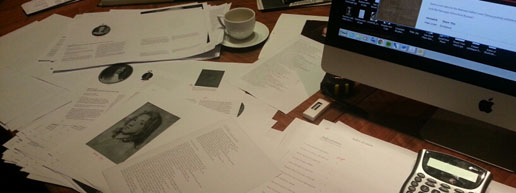
Update II - a reader writes:
There's your problem!!!! Your espresso cup is empty...
Elizabeth I's Tate debut
October 7 2013

Picture: BG
I was pleased to see the above portrait - the 'Hampden portrait' - of Elizabeth I at Tate Britain this weekend, where it has been lent by a private collector. Not only is it the first full-length portrait of Elizabeth, it is also, as we found here at Philip Mould & Co. when we acquired the painting, the only portrait to show her as a possible wife. The portrait ties into a 1563 speech she gave in the House of Lords (hence the throne and cloth of state) re-assuring Parliament that she would get married and have children. The fruit and flowers in the background allude to her fertility. So it's quite a contrast to our usual image of the Virgin Queen, and consequently did not become one of the frequently repeated portraits of Elizabeth. In fact, remarkably, it was hardly ever published or referred to until we bought it and restored it, and spent most of the 20th century hanging in the judges' changing room at Aylesbury crown court. You can read more about the portrait's history here, and for further discussion on the portrait's attribution, to Steven van Herwijck, see my article in the British Art Journal here.
Update - in a splendid piece of show 'n tell, a reader sends in his 16th Century portrait of Elizabeth I based on the head type seen above.
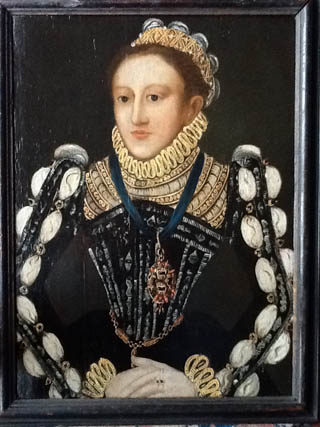
Move along folks, nothing to see here...
October 4 2013

Picture: Die Welt
How do you get a story in practically every paper in the world, with little or no effort? Easy, mention the words 'Leonardo', 'discovery' and 'expert' in the same press release. Hey presto, global media attention. The writer Fiona McLaren got wide coverage last year for claiming that she owned Leonardo's 'last commission'. She doesn't, but she's still going great guns with the idea, as this lecture at the University of Dundee shows.
Anyway, the latest claim is the above portrait, of Isabella D'Este, which relates to the known Leonardo drawing in the Louvre. I find it hard to believe that it is by the greatest painter that ever lived, judging by the photo. I know it's dangerous to speculate from images, but AHN-ers don't like it when I sit on the fence. The drapery is really feeble. And did the same artist who painted the sublime hand in The Lady with an Ermine really paint that limp and formless thing above? I doubt it. But Leonardo 'expert' Carlo Pedretti has said he did. From The Guardian:
"There are no doubts that the portrait is Leonardo's work," said Carlo Pedretti, an emeritus professor of art history at the University of California.
If acknowledged as genuine – and if experts concur it was painted before the Mona Lisa – the portrait could shake up academic studies of one of the world's most famous painting.
The 61cm by 46.5cm portrait, which uses the same pigment in the paint and the same primer used by Leonardo, is the completed version of a sketch he made of D'Este, which, like the Mona Lisa, hangs in the Louvre in Paris.
The unnamed family which owns the portrait, and asked for it to be analysed, has kept a collection of about 400 paintings in Turgi, Switzerland since the start of the 20th century, reported the Corriere della Sera newspaper.
It's painted with old paint, on old primer - so it must be by Leonardo, right? Or might there have been thousands of artists around at that time who happened to use contemporary paints and techniques?
Regular readers will remember the most recent Pedretti blessing, for the so-called Isleworth Madonna, which just isn't, not in a million years, by Leonardo (as the highly respected Leonardo scholar Prof. Martin Kemp has vainly tried to point out). Pedretti was also involved in that weird 'Leonardo sculpture' business I mentioned last year. You'd think by now that the press would be wary of people claiming to discover Leonardos without amassing a proper consensus among Leonardo scholars. But on it goes.
Update - The Telegraph has spoken to Martin Kemp:
Martin Kemp, professor emeritus of the history of art at Trinity College, Oxford, and one of the world’s foremost experts on da Vinci, said if the find was authenticated it would be worth “tens of millions of pounds” because there are only 15 to 20 genuine da Vinci works in the world.
But he raised doubts about whether the painting was really the work of Leonardo. The portrait found in Switzerland is painted on canvas, whereas Leonardo favoured wooden boards.
“Canvas was not used by Leonardo or anyone in his production line,” Prof Kemp told The Daily Telegraph. “Although with Leonardo, the one thing I have learnt is never to be surprised.”
There are further doubts – Leonardo gave away his original sketch to the marquesa, so he would not have been able to refer to it later in order to paint a full oil version.
“You can’t rule out the possibility but it seems unlikely,” Prof Kemp said. It was more likely to have been produced by one of the many artists operating in northern Italy who copied Leonardo’s works.
Update II - Professor Kemp has further written on his blog:
Another promotion of a non-Leonardo, pushed by the Corriere della Serra, which has been a great newspaper. I was contacted by someone called [...]* - not, apparently, an accredited arts journalist. I declined to express a visual opinion on the basis of the poor reproductions I had seen but made it clear that any attribution to Leonardo was not consistent with the documentation. The result is that I am implicitly cited as a supporter of the attribution. I will be asking for a retraction.
Having looked further at this, it is clear that the painting cannot be by Leonardo, on the basis of the documented account of Leonardo's relations with Isabella d'Este and his evident failure to paint her portrait.
Update III - a reader writes:
These "Leonardo" discoveries are getting quite tedious as you rightly point out. What is even more annoying is the unreflective acceptance by people and organizations that really should know better. Today, I found it on the TEFAF [The European Fine Art Fair] facebook-page. They are not really helping critical thinking, are they?
I wonder what this tells us about Tefaf vetting.
Update IV - TEFAF gets in touch to tell us:
We believe it's always a good thing to be very critical regarding the authenticity of a piece of art. TEFAF Maastricht is unrivalled in its standards and the methods it applies to establish the authenticity, quality and condition of every painting and object on sale at the fair. Without any exception a TEFAF vetting committee consists of several experts rather than one. By sharing news about (proclaimed) discoveries on our facebook page we hope to enable the discussion amongst our friends. Feel free to participate, we value your thoughts. We are excited to have this discussion and remain curious what further examination will teach us.
* Bizarrely, I got a letter from an Italian lawyer asking me to remove the name the Prof. Kemp had mentioned.
First photo of Titian's(?) 'Concert'
October 4 2013

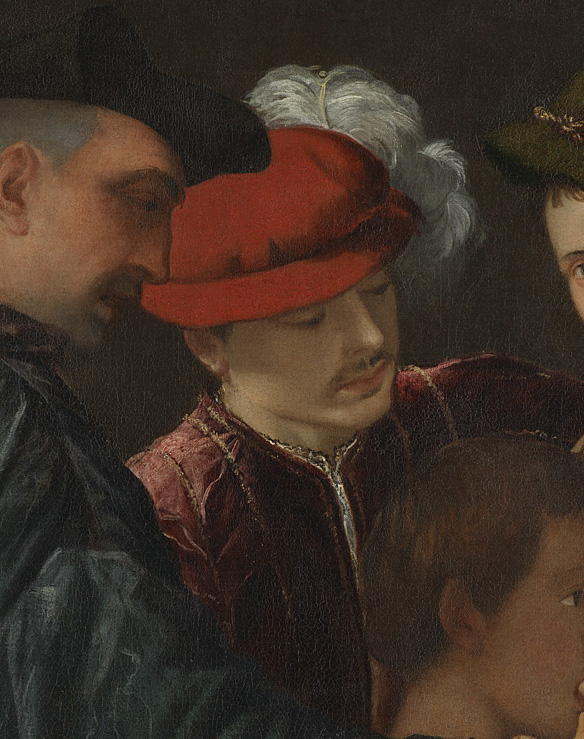
Picture: NG3, Possibly by Titian, 'The Music Lesson', about 1535, Oil on canvas 100.4 x 126.1 cm, (C) National Gallery, London
The National Gallery have kindly sent me a photo of the newly cleaned 'Concert', or as it is now called 'The Music Lesson', which I posted about below, and which is featured in the latest issue of The Burlington Magazine. The Gallery catalogues the work as 'Possibly by Titian'. It's hard to judge the picture from this, not least because it has obviously suffered significant damage in the past. The best bit is the central figure below, which, in his jacket, is quite Titian-esque.
Turner's Scottish Welsh Turner
October 4 2013

Picture: Telegraph
The Telegraph reports that the above Turner in the Fitzwilliam Museum, which was formerly thought to show a scene in Wales, has now been identified as a scene in Scotland:
Inspired by the majestic Scottish landscapes during his first visit to the highlands in 1801, Joseph Turner created the watercolour painting, entitled The Traveller - Vide Ossian's War of Caros, the following year.
It was exhibited at the Royal Academy in London during 1802, but was incorrectly catalogued as a Welsh Mountain Landscape in the Fitzwilliam Museum of Cambridge University during the 1970s.
Now artistic detective work by Professor Murdo MacDonald, of Dundee University, and Eric Shanes, a former chairman of the Turner Society, has proved the painting is a depiction of the Loch Lomond area.
The pair used maps to scout the Scottish countryside to pinpoint the location as Rubha Mor, six miles to the south of Inveruglas.
I was driving along Loch Lomond earlier this week, and very beautiful it was too. I can see why Turner felt the place was worth painting. Full details of the discovery will appear in the next issue of Turner Society News, the journal of the Turner Society.
Trouble 'n strife at Sotheby's
October 4 2013

Picture: NY Times
Get out the popcorn and pull up a comfy chair, because it's all kicking off at Sotheby's. One of the company's largest shareholders, Daniel Loeb (above), has launched a series of zingers at the board. From the New York Times:
“Sotheby’s is like an old master painting in desperate need of restoration,” Mr. Loeb wrote. He also disclosed that he was the company’s biggest shareholder with a 9.3 percent stake. The letter and disclosure were in a filing with the Securities and Exchange Commission.
Mr. Loeb, who is a prominent art collector, is agitating for change at the top of Sotheby’s, contending that a “crisis of management” has created “dysfunctional divisions and a fractured culture.”
“As with any important restoration, Sotheby’s must first bring in the right technicians,” Mr. Loeb added. He wants to join the board immediately and recruit several new directors and a new chief executive. He also does not want the same person to be chairman and chief executive. [...]
He then focused on Sotheby’s management. “Sotheby’s malaise is a result of a lack of leadership and strategic vision at its highest levels,” Mr. Loeb said.
He attacked Mr. Ruprecht’s pay package — $6.3 million in salary in 2012 — and limited stock holdings, adding that it had created a misalignment with other shareholders.
He also chastised Sotheby’s senior directors for an extravagant lunch and dinner at a notable “farm to table” New York restaurant, where he said “senior management feasted on organic delicacies and imbibed vintage wines at a cost to shareholders of multiple hundreds of thousands of dollars.”
Sotheby’s responded several hours later with a statement calling Mr. Loeb’s comments “incendiary and baseless,” and signaling it might not back down without a fight.
In a penetrating analysis of Sotheby's position, the Grumpy Art Historian agrees with me that it was a mistake by Sotheby's to retreat from their middle and lower end operations (for example, closing their Olympia saleroom in London).
Masterpieces in Schools
October 4 2013

Picture: BBC
So yet another great idea from the Public Catalogue Foundation - 'masterpieces in schools'. A series of paintings from public collections will be taken to schools around the country, to introduce children to great art. And it really is great art - this is not just 'let's find any old painting to show da kids', but, as you can see above, works by the likes of Turner (Dolbadarn Castle) . More here.
NPG buys Anne Clifford portrait
October 4 2013

Picture: The Guardian
The National Portrait Gallery has acquired a newly identified portrait of Lady Anne Clifford by William Larkin. The portrait was found by the Weiss Gallery in London. More details here.
Connoisseurship and that new Van Gogh
October 3 2013

Picture: NYTimes
Art historian Gary Schwartz (whom regular readers will know for his expertise on that recently discovered Saenredam) has raised some interesting questions about the new Van Gogh 'discovery' - specifically, how did it ever get turned down in the first place?
It was submitted for judgment in 1991, at which time the museum notified the owner that “we think that the picture in question is not an authentic Van Gogh.” The quotation is from the scholarly publication on the re-attribution in the October issue of the Burlington Magazine, the art-historical equivalent of an article in Nature or Science. (Louis van Tilborgh, Teio Meedendorp and Oda van Maanen, all curators at the Van Gogh Museum, “’Sunset at Montmajour’: a newly discovered painting by Vincent van Gogh,” The Burlington Magazine 155 [2013], nr. 1327, pp. 696-705.) Given this embarrassing fact, the rhetoric surrounding the announcement should have been toned down considerably. The painting should not be called “newly discovered,” certainly not in a journal of record like the Burlington. A more accurate title for the article would have been “Sunset at Montmajour: the Van Gogh Museum changes its mind about an attribution and corrects an old error of its own."
Schwartz goes on to highlight all the strong evidence in favour of the picture, including a large '180' written on the back of Sunset at Montmajour, which matches up exactly with an inventory compiled just after Theo Van Gogh died, where the picture is listed as '180 soleil couchant a Arles', and with the same dimensions. Montmajour is in Arles. The more I read about it, the more I wonder how Van Gogh connoisseurship ever went so off beam?
