


Guffwatch - charity edition
February 3 2015
Video: Darren Bader
Ever seen an auction estimate like this?
Click on the image above to find out more.
New Veronese drawing discovered? (ctd.)
February 3 2015

Picture: The Saleroom
A quick update on a 'sleeper' story I featured last year. The above drawing came up for sale in the shires here in the UK catalogued as 'attributed to Veronese', and made £15,500.
At the time, a sharp-eyed reader (who underbid it) wrote in to say he thought it was by Jan van der Straet, and related to an engraving in the British Museum. Well, he was right, for now the picture has been acquired by the Metropolitan Museum in New York, as by van der Straet. The provenance on the Met site reveals that it was acquired through the Old Master drawings dealer Katrin Bellinger.
Strikes - National Gallery fights back
February 3 2015

Picture: Museums Journal
A five day strike organised by the PCS union has begun at the National Gallery in London. Many rooms are closed, but the Gallery remains open. For the background on all this, see earlier AHN here (or type PCS union into the search box).
For too long, the National Gallery has taken a passive view when it comes to arguing its case. The PCS union, always up for a bit of free publicity, has been able to lead the narrative with regular strikes, aided by the likes of Polly Toynbee in The Guardian.
But now the National Gallery has decided to fight back, and in response to the strike has issued this press release, which contains many unanswerable points:
The National Gallery is a public asset and we have a duty to ensure the collection and the Gallery itself is accessible as much as possible, to as many people as possible. We take this task seriously and therefore have an ongoing modernisation programme designed to encourage a broader audience to access the wealth of cultural inspiration the National Gallery has to offer – so far this has included initiatives such as introducing Wi-Fi, a Membership scheme and photography. We also have ambitious future plans to further extend our Education programme and public events.
However in order to allow these plans to be implemented we need to introduce a new roster for some visitor facing and security staff to enable the National Gallery to operate more flexibly.
The PCS union leadership oppose these changes and, despite months of dialogue, we have not been able to reach any agreement with them. During these discussions, we proposed not only to meet the London Living Wage, but also to pay a basic salary in excess of it. As a result, the National Gallery will now appoint an external partner to manage these services. There will be no job cuts and terms and conditions will be protected.
The National Gallery is one of the last major national UK museums to take this step.
We believe the proposed changes are essential to enable us to deliver an enhanced service to our 6 million annual visitors for many years to come, and to remain as one of the world’s leading art galleries. It is unfortunate the PCS union do not share this aspiration with us.
NOTES TO EDITORS
- There are 604 staff employed at the National Gallery.
- Approximately 300 members of staff are employed as Gallery Assistants.
- 204 National Gallery staff are members of the PCS.
- 153 PCS members are employed in the Visitor Services and Security Department (which includes Gallery Assistants).
- 132 people voted in the strike ballot (60.8% of the National Gallery PCS membership). This is 22% of all staff employed by the National Gallery.
- The PCS has held a strike at the National Gallery on average every two months for the past nine years.
The last statistic is particularly damning for the PCS.
Update - a National Gallery employee* has written to say:
You claim that over the past nine years, PCS staff have on average gone on strike every two months. This is patent rubbish. I have worked at the National Gallery for four years and in that time there has only been one strike, over a related issue.
I would hope that you would correct your `notes to editors`, though perhaps this is the triumph of hope over experience. [...]
If you had bothered to check your facts, rather simply regurgitate propaganda from the very people, mostly ex G4S managers, attempting to gerrymander the situation, you may have some justification for your arrogant and dismissive attitude. [...]
Do your own research, as any self respecting journalist should. You claim to know about the art scene and art galleries, surely it is as plain as the nose on your face that your strike claims are to put it diplomatically, untrue. Who do you imagine tells the NG Press officer`s what to say? Shoddy journalism masquerading as documentary fact, disgraceful
Just to be clear, the bit in the green box above is information put out by the National Gallery in the form of a press release. It is not a claim by me, and they are not my facts. I am merely reporting what the National Gallery has said. As I am now reporting what the employee has said. I have asked the National Gallery for more information on their 'every two months' claim.
After a couple of minutes Googling, I can see that, in addition to this week's strike, there was one in October last year, in May 2012, in January 2012, and in August 2012. So the employee's 'one strike' in four years claim cannot be true.
Update II - the employee writes back:
Most respectable journals would at least make some reference to the other side of the argument, you make not even a passing mention of the reasons why a majority of staff in the areas to be privatized, feel aggrieved. You may not have the professional integrity to do your own research, rather than swallow unquestioningly the claims of one side, whilst attempting to muddy and confuse the argument. I am telling you that in my period at the Gallery there has only been one strike, which suggests that for the proceeding five years there must, according to your quoted claim, have been a strike every month. Patently absurd, on a par with` Freddie Starr ate my Hamster'.
Evidently, this employee refuses to accept that there has been more than one strike at the National Gallery in the last four years. They also must have missed my post on the Polly Toynbee article, which gave extensive coverage to the PCS union's claims.
Update III - The employee is fast becoming AHN's number 1 troll. He writes again:
Having been shown up for a charlatan you compound the issue with obfuscation and avoidance of the point. I`m sure Vladimir Putin has a position for a press spokesperson, he`d appreciate someone who plays fast and loose with the truth and doesn`t ask too many questions.
This last email was in response to me pointing out that he was wrong about the number of strikes. Apparently, news outlets like the Guardian and the Museums Journal are 'biased', and reported strikes that never actually happened. Is it all a vast conspiracy?
Update IV - and so it continues:
[this blog is] blatantly biased propaganda which you are happy to regurgitate, liar.
Update V - and another one this morning:
Definitely a fake rather than a fortune, must be aristocratic inbreeding.
Update VI - and more!
[...] your claims are demonstrably wrong and your comments blatantly biased. Either you are a liar or you believe your own bull excrement. Perhaps you just need help
Help!
* at least, he claims to be an employee, but he won't say which part of the gallery he works in, and his website makes no mention of it either. Out of pity, I have decided not to name him.
Export block for newly discovered Claude
February 2 2015

Picture: Guardian/DCMS
The UK government has placed a temporary export block on Claude's Embarkation of St Paula, which was recently discovered by Christie's, and sold by them in 2013 for £5m. A UK museum has until May 1st to express any interest.
The picture was scheduled to be sold in a minor Christie's South Kensington sale as 'After Claude', but was pulled out at the last minute.
More here.
Exclusive - Museum swap-shop
February 2 2015

Picture: Tate/NPG
Tate Britain is to transfer the above portrait, Mrs Jordan as Hypolita by John Hoppner, to the National Portrait Gallery. Tate, along with the National Gallery, has a statutory power to do this, and it doesn't formally count as a 'de-accession'.
It is a de-accession, of course, and it's worth noting that once upon a time this picture used to belong to the National Gallery, before that institution transferred it to Tate in 1979. The portrait had been bequeathed to the National Gallery by Sir Edward Stern in 1933.
The picture's change in fortunes (in terms of the relative 'status' of each gallery) charts the curious decline in Hoppner's reputation. At the beginning of the 20th Century, he was more or less seen on a par with the likes of Romney, Gainsborough and Lawrence, as the holdings of institutions like the Metropolitan Museum demonstrates. Now he isn't so highly regarded, though there's no doubting his talent as a painter.
Tate's website says that the picture is not on display, and I suppose we can assume that it hasn't been regularly shown there for some years now.* Personally, I'm all in favour of such transfers, if pictures go from an institution which doesn't value them to one that does. Regular readers will know my views on Tate's woeful ratio of pictures in store to pictures on display (see my piece on this in the FT here). Indeed, of Tate's ten oil paintings by Hoppner, none are currently on show. I'd say 'Mrs Jordan' (who was an actress, and William IV's mistress) is Tate's best Hoppner. But now it's the NPG's. Lucky them.
*I'm told the picture has been on loan at the NPG for 'many years'.
Who painted the Met's 'English School'?
February 2 2015

Picture: Sotheby's
The Metropolitan Museum in New York sold the above, 19th Century 'English School' landscape at Sotheby's last week. It was estimated at $25k-$35k, but made $197,000. An optimistic bidder thinking it was by Gainsborough? I hope not, because it isn't.
But it is by someone good, probably early to mid 19th Century. I give up entirely in about 1820, so I've no idea who painted it. But I'd wager it'll turn up somewhere in the trade soon, with the attribution nailed. In which case, do we have to ask, why did the Met sell it?
Update - a reader suggests 'Swiss School':
[...] a closer look at the trees and foliage may suggest to me a lost composition by Pierre-Louis de Larive-Godefroy (1735-1817). He was a key painter from the Geneva school in the last decades of the XVIII century and very much influenced by XVII century Dutch landscape. A painting by him of this size and quality would definitely command the price paid at the auction.
Update II - Another reader sends in the below photo of the painting at Sotheby's view, and writes:
The ex-Met landscape: the general feeling is that it’s Ramsay Richard Reinagle. [...]
A stupid sell-off by the Met. It used to hang in the British period rooms.
It was a picture of remarkable quality - not a run-of-the mill landscape at all. And the Met’s British picture collection is not strong enough so they can afford to lose a picture like this.

Michelangelo bronzes discovered
February 2 2015
Video; BBC, Pictures: Guardian
The Fitzwilliam Museum in Cambridge has announced (and put on display) the discovery of Michelangelo's only known surviving bronze sculptures. The museum 'firmly believes' they are early works by the artist. The two allegorical male figures astride panthers were bought in 2002 at Sotheby's in London for £1.65m as 'Florentine School', and have since been subjected to various tests, as well as some more traditional art historical sleuthing.
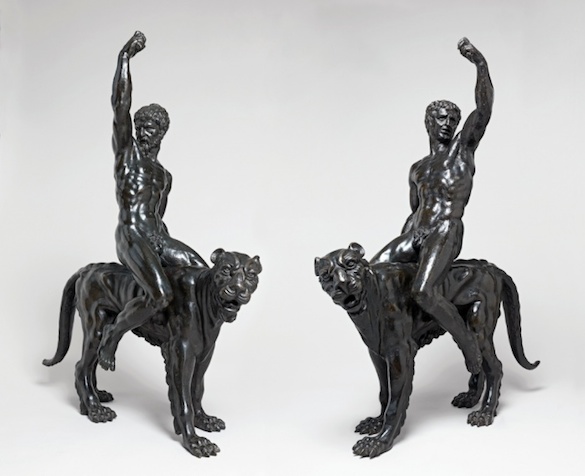
The key discovery was made last year by Professor Paul Joannides of Cambridge University, who found the below drawing in the Musée Fabre in France. The drawing is not by Michelangelo, but is thought to be 'a faithful copy' of one of his drawings, made by an unknown student, and it is, according to the Fitzwilliam;
[...] drawn in the abrupt, forceful manner that Michelangelo employed in designs for sculpture. This suggests that Michelangelo was working up this very unusual theme for a work in three dimensions.
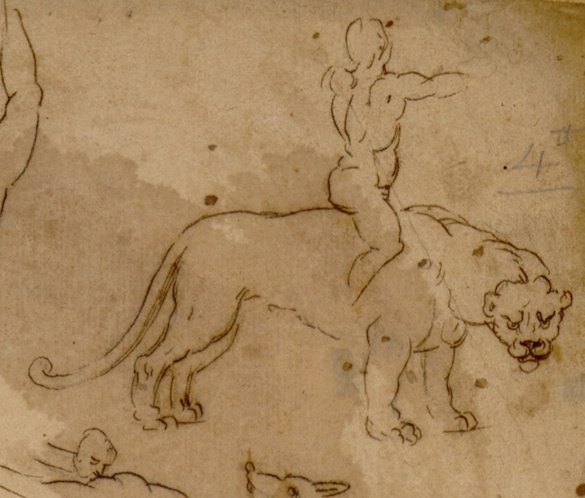
Dr Victoria Avery of the Fitzwilliam says (in the above video on the BBC) that the drawing shows 'precisely this composition'. Sharp-eyed readers will see that it doesn't, in fact; the beast's head is lowered, the figure is more twisted, and the arm is placed differently. Also, while the drawing shows a finely feline, poised creature, the scrawny bronze beasts appear somewhat caricatural, and even dog-like, by comparison. Still, the Fabre drawing seems to be enough to show that Michelangelo was working on this subject.
The bronzes were also tested by 'neutron scan x-rays', which showed that they were made in either the late 15th Century, or early 16th Century.
There is no pre-19th Century provenance for the pieces - when they were in the Rothschild collection. The earliest recorded attribution is to Michelangelo.
Another piece of evidence released by the Fitzwilliam is analysis of the anatomy carried out by (reports the Guardian):
[...] clinical anatomist Professor Peter Abrahams, from the University of Warwick, [which] suggested every detail in the bronzes was textbook perfect Michelangelo – from the six packs to the belly buttons, which are as artist portrayed them on his marble statue of David.
“Even a peroneal tendon is visible, as is the transverse arch of the foot,” Abrahams writes in the book that accompanies the discovery.
Avery said: “Whoever made them clearly had a profound interest in the male body … the anatomy is perfect.”
Of course, we must all wait to read the full evidence on the attribution (which is in a new book), but I must say I find the involvement of a 'clinical anatomist' slightly alarming. Is it really necessary? I've no doubt that Professor Abrahams is a leading authority in his field. But my experience of 'cross-over' analysis like this is that it's sometimes hopelessly misplaced; science most certainly has a role to play in making attributions, but it has to be done from within art historical confines, by people who absolutely understand the artistic point of view. But here, science is being used not to prove whether a material is of a certain date, or whether the technique of the casting is demonstrably that of Michelangelo, but whether a work of art is 'good' or not. And I'm sorry, but you just cannot judge artistic genius and human creativity on the basis of binary, yes-or-no scientific analysis. Indeed, while there's no doubting Michelangelo's gift for drawing the human figure (or, as we must call it here, 'anatomy') was amongst the finest in art history, I defy anyone to look at his Sibyls in the Sistine Chapel, and say, 'here is the perfect anatomy of a woman, it must therefore be by Michelangelo'. As one of the studies shows, the anatomy is sometimes that of a bloke.
Anyway, this is just me nit-picking. The most important evidence when assessing these sculptures must be the overall quality - are they good enough to be by Michelangelo? I haven't seen them, and I'm no Michelangelo scholar, but they are certainly very fine things. It's hard to disagree with Professor David Ekserdjian's initial view in Apollo Magazine:
This is neither the place nor the time to pass judgment on the matter, not least since the various contributions to a not insubstantial book presenting the case in favour of Michelangelo’s authorship will need to be digested thoroughly, but it is tempting to surmise that much will hinge on what people make of the connection between the bronzes and a drawing in the Musée Fabre in Montpellier, which is generally agreed to be a copy of a lost early sheet of studies by Michelangelo, and certainly features spidery pen sketches of men on big cats. Whether posterity comes to the conclusion that the bronzes are by big M or not, they are unquestionably works of extraordinary quality.

You can see more images here, and while the 2002 Sotheby's catalogue is no longer online it seems, you can see their catalogue images here. The pair were estimated at £100,000-£150,000, and sold for £1.65m.
Update - a reader writes:
Clearly much hinges on the drawing but also surely, in that context, whether other artists are known to have taken 'men astride big cats' as their subject matter? It does strike me as a very particular form and if nobody else took it up then this must add considerably more weight to the Michelangelo attribution.
Another writes:
[...] about the “Michelangelo” sculptures exhibited at the Fitzwilliam, you are very cautiously right (!), strange way to “attribute” such an important discovery. They look definitely more Venetian than Florentine…
Update II - a sculptor writes:
The nude 'bacchic' figures of bearded men astride panthers, formerly in the Rothschild Collection were clearly made by an artist with an exceptional knowledge of male anatomy. The wonderful feet and the musculature of the chests and backs of both figures are certainly in a very Michelangelesque style. I wouldn't be surprised if he knew Michelangelo's drawings first hand as he was clearly very influenced by them, and his finished murals.
The heads are not however in the style of Michelangelo at all, apart from the twist of the neck, familiar from Lorenzo de Medici's tomb effigy and the great David.
The give away is the hair.
The hair and the beards have curls deliniated and emphasised by deep curved, quite crude, parallel lines; something that Michelangelo never did in drawings or sculptures.
Look at the hair of the early 'Angel with candelstick', the infant Jesus in the 'Bruges Madonna', the head of the David'. The hair is always built up from a series of interlocking domed shapes. The direction of the hair is indicating by a series of radiating (rather than parallel) arabesque lines. The impression of volume in the hair is further enhanced by hollows creating shadows.
Secondly, the curves of the lower eyelids are again too parallel and do not sufficiently radiate from the tear duct.
These are marvellous 'mannerist' decorative bronzes but are not on the same level of artistry as any of Michelangelo's surviving sculptures.
Update III - Alastair Sooke in The Telegraph has this overview of 'lost art', and what else might turn up:
One of the things I love about art history is that its grand narrative is never set in stone. When I was studying at the Courtauld Institute of Art, seeking out obscure journals interred within mouldering book stacks, it sometimes felt as though everything that it was possible to say about the great art of the past had already been recorded. In triplicate.
But then along comes a news story like the announcement that the Fitzwilliam Museum in Cambridge has “found” two bronze sculptures by Michelangelo, when previously none was thought to have survived.
If the attribution proves to be correct, then at a stroke countless “definitive” tomes about the Italian genius will need to be rewritten. Isn’t that exciting? And tantalising when you consider what else is yet to be discovered?
He also, very kindly, quotes me in the piece.
Update IV - US artist Matthew Best has also revealed, on Twitter, two Michelangelo discoveries of his own:
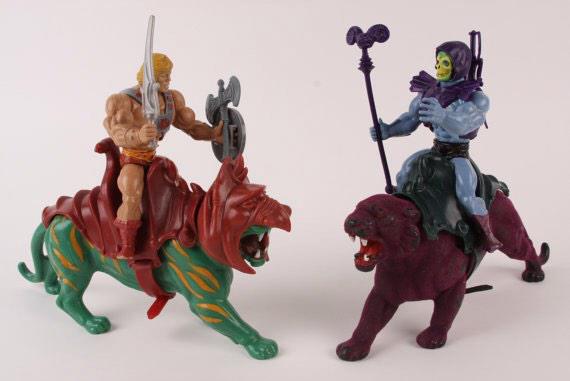
In with a chance, I'd say...
Update V - The Art Newspaper has more on the team behind the new attribution, and what they did:
The Michelangelo attribution was made by Paul Joannides, the emeritus professor of history of art at Cambridge. His study of a sheet of drawings of around 1508 by a student of Michelangelo in the Musée Fabre, Montpellier, showed a composition remarkably similar to the bronzes, not to mention the highly unusual bacchic subject matter. This triggered further art-historical research by Joannides along with Victoria Avery, keeper of applied arts at the Fitzwilliam, two conservation experts at the Rijksmuseum, Amsterdam, Robert van Langh and Arie Pappot, and Peter Abrahams, the professor of clinical anatomy at Warwick University Medical School. The team was assisted by Charles Avery, the art historian, Andrew Butterfield, an Old Master dealer and Verrocchio specialist, and Martin Gayford, the art critic.
Scientists at Oxford University’s laboratories that specialise in researching authenticity questions used thermoluminescence dating and determined that the bronzes were cast between 300 and 500 years ago, while conservators at the Rijksmuseum subjected samples from the statues’ cores to neutron imaging, establishing that the method of casting fits completely with what is known of contemporary Florentine practices.
A minutely detailed anatomical examination of the nude male figures not only proved their exact correspondence with features (for example, belly-buttons, posterior back grooves, exaggerated abs) of other of Michelangelo’s male sculptures, but showed that their observation of musculature and torsion was anatomically correct in every way, a characteristic particularly of Michelangelo.
Update VI - another reader writes:
Far from the same cat.
The drawing has a cat with ears on the side of its head and weight leaning forward as if to move rather than the upright cats in the bronzes - also a wonderful long tail.
These could have been a commission for a particular purpose, but one might expect some written comment about them from their first three centuries.
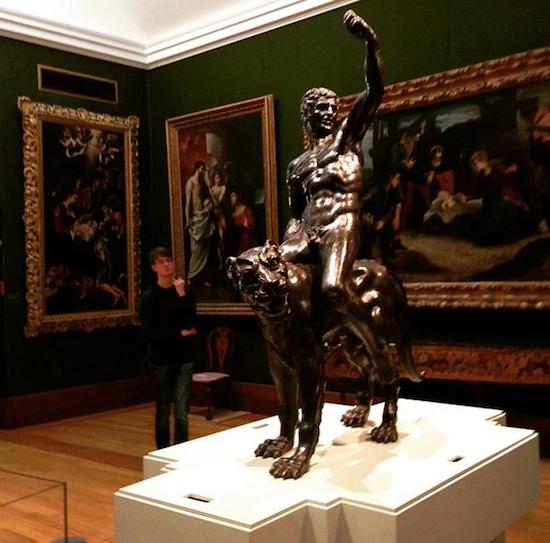
Update VII - here they are in situ in the Fitzwilliam, as spied by the Simon Dickinson Twitter account:
Update VIII - another reader takes issue:
The expertise involved in the attribution is very impressive, and I am no expert on Michelangelo at all, just a fascinated amateur. Yet the cats do seem underwhelming, and to my eyes the postures of the two men are oddly unstable and unconvincing, especially (in both aspects) compared to the drawing. A great deal of the attribution seems to rest on the musculature: so was Michelangelo really the only Cinquecento sculptor capable of that, among those who might have had access to his drawings?
Sotheby's wins, $63.5m vs $25m
January 31 2015

Picture: Sotheby's
It was a pretty impressive trouncing by Sotheby's in the New York Old Master sales this year. The headline totals of $63.5m & $25m include both auction houses' seperate 'Renaissance' sales. Take those out and just stick to the 'Part 1' sales, and the totals are Sotheby's $57m vs Christie's $9.2m. That's not even a contest.
The 'Part 2' sales were also a bit of mismatch: Sotheby's $10.2m vs Christie's $2.9m.
For comparison, below are the totals for the 'Part 1' sales going back over the last seven years, together which whatever major seperate sales the auction houses have also held (be it a 'Renaissance' sale or, for one year only at Christie's, 'The Art of France'). I've included only the January sales, as these are the larger of the two annual sales in New York (similarly, in London, the July sales are traditionally seen as the more important of London's two annual sales):
Christie's
- Jan 15 $25m (Part 1 $9.2m & Renaissance $15.7m)
- Jan 14 $60.7m (Part 1 $15.8m & Renaissance $44.9m)
- Jan 13 $62.5m (Part 1 $19.9m & Renaissance $42.6m)
- Jan 12 $44.3m (Part 1 $34.3m & 'Art of France' $10m)
- Jan 11 $28.1m
- Jan 10 $39.5m
- Jan 09 $15.1m
Sotheby's
- Jan 15 $63.5m (Part 1 $57m & Renaissance $6.5m)
- Jan 14 $67.7m (Part 1 £51.3 & 'Courts of Europe' $16.4m)
- Jan 13 $72.1m (Part 1 $58.2 & 'Baroni Estate' $13.8m)
- Jan 12 $62m
- Jan 11 $102.5m (Part 1 $90.6m & Safra Collection $11.9m)
- Jan 10 $61.6m
- Jan 09 $63.9m
Totals
- Christie's $275.2m (average $39.3m)
- Sotheby's $493.3m (average $70.5m)
I hope I haven't missed anything out. But it seems that Sotheby's have consistently had the better results. I know the headline totals are chicken feed compared to contemporary, but this is the sort of performance Sotheby's activist shareholder Dan Loeb should think about next time he slags the company off.
How, then, do Sotheby's New York do it? My impression over the years is that they usually manage to capture the better pictures, which of course is essential. Maybe it helps too that they have the better premises (by some distance). A key ingredient of their success (but an underrated one perhaps) is that they have Henry Wyndham (above) at the rostrum - for me, the best auctioneer in the business; cajoling bids out of the punters is a real art, and harder than it looks. But also, as one leading New York Old Master dealer writes:
Somehow George and Christopher can really sell their pictures. I am always in admiration of how they do it.
Me too. The George and Christopher referred to are George Wachter and Christopher Apostle, the two long-standing heads of Sotheby's Old Master department in New York. Wachter is above closest to Henry Wyndham, and Apostle is far left. I know the latter better - and can attest that he's one of the good guys in the art trade - but both have always struck me as formidable operators, as well as having an excellent 'eye'. Whatever it is, they're unbeatable at the moment.
What a difference a sale makes...
January 29 2015

Picture: Sotheby's
...and a good eye, of course. Sotheby's New York today sold two 'sleepers' that had recently been spotted by sharp-eyed dealers in London. The first was the Constable sketch I wrote about here earlier; bought for just £3.5k at Christie's in South Kensington in 2013, it soared triumphantly to $5.25m (inc. premium) earlier today. What a great vindication for close-looking and dedication; a good profit richly deserved.
The other case wasn't quite as well hidden as the Constable, but required calm nerves nonetheless; this El Greco, a very fine picture, sold at Bonhams in 2012 as 'attributed to El Greco' for £790,000. Today it made $2.74m (inc. premium).
Update - sour grapes from Christie's - Bloomberg reports their statement post-sale:
“We are aware that Sotheby’s have sold this work as by Constable,” Christie’s said in an e-mailed statement. “We took the view at the time of our sale in 2013 that it was by a ‘‘follower of.’’ We understand that there is no clear consensus of expertise on the new attribution.”
From what I understand, that's flat out wrong. Unless I suppose you define 'expertise' so loosely as to include, I dunno, Christie's legal department.
Stolen Gauguin and Bonnard found in Italy (ctd.)
January 29 2015

Picture: Guardian
I mentioned back in December the case of two paintings stolen in London in 1970, a Gauguin and a Bonnard, which surfaced in Italy. Italian police said could that although there was no doubt the paintings were stolen, they could be kept by a fellow named only as 'Nicolo', who had innocently bought them from a lost property auction in Turin for about twenty quid in 1975. Apparently, Italian law says that if you own something which is nicked, but you don't know it's nicked, you can keep it after ten years have elapsed. Bizarrely, if you do know it's nicked, then you just have wait a bit longer until it's legtimately yours - 20 years.
Anyway, when the case first came to light, it was announced that the original owner, or nobody from their estate, was around to lay claim to the paintings. So 'Nicolo' was free to sell the paintings, and pocket his windfall.
But not so veloce Nicolo! Now, Ivan Macquisten in the Antiques Trade Gazette, says that a claim has been made at the last minute by the heir of the original owners, Mathilda Marks and Terence Kennedy. It looks entirely plausible. Full details here.
Dutch museum buys picture twice.
January 29 2015

Picture: Codart
In 2002, the Dordrechts museum bought the above painting by Jacob Cuyp for €76,000 - but they've just announced that they bought it again, after discovering it was in fact a painting looted in WW2. From the Codart site:
The Dordrechts Museum announced today it bought a painting by Jacob Cuyp (1594-1652) which was already in its collection. Research showed the work of art once belonged to textile producer and art collector Jacques Hedeman. He stored his collection in an Amsterdam bank vault before it was confiscated and sold off by the Nazi’s. The scene with a shepherdess in a landscape, acquired by the museum in 2002 from a German art dealer, will now stay in Dordrecht. Heirs of Hedeman, who passed away in 1948, have sold the painting to the museum.
The transaction is a result of the provenance research presented by the Netherlands Museums Association in October 2013. In 41 of the participating museums, 139 objects were found that have presumably been stolen, confiscated or forcibly sold as a consequence of the Nazi regime. Since then the commission received six claims by heirs and a further seven have been announced.
Bronzino gets away at $9.12m
January 29 2015

Picture: Christie's
Christie's managed to spare some blushes yesterday by selling the above Bronzino for $9.12m (inc. premium) against an $8m-$12m estimate. The picture had failed to sell a couple of years ago at $12m-$18m.
I noted earlier the curious slant in the catalogue note for the picture, which tried to claim the picture as an inspiration for many contemporary artists, including Warhol. On ArtNet, eminent Old Master dealer Robert Simon (he who worked on and sold the newly found Leonardo 'Salvator Mundi') takes apart Christie's rather desperate contemporary packaging:
Perhaps most blatant and irrelevant (and offensive) are the analogies carted out to supplement the impressive Portrait of a Young Man with a Book by Agnolo Bronzino. As a preface to the erudite entry on the painting by scholar Carlo Falciani, we are treated to a bizarre mash-up of the history of portraiture starring Cindy Sherman, Joseph Cornell, Lucian Freud, and Andy Warhol. Somehow they are all being presented as coequals of Bronzino, if not tacitly superior to him due to their contemporaneity. Warhol's Mao (illustrated) is presented as a counterpart to the Bronzino portrait, echoing “Bronzino's fascination with power and fashion"— neither quality, it might be noted, being especially evident in the painting being auctioned. The catalogue dutifully informs us that “Although there is no evidence of any knowledge of his work, there is a parallel between the portraiture of Bronzino and that of Andy Warhol, the most celebrated purveyor of ‘iconic' images of the 20th century."
Yes, there are of course parallels, just as we might all look identical to a Martian first visiting Earth. But attempting to validate established Old Master painters through specious associations with the darlings of the contemporary market lowers the credibility of the auction house and weakens the authority they have successfully promoted for themselves over the past few decades. And for many who love the art of the period, it lessens the significance of the works being offered, reducing these often complex paintings to simple cognates of their more celebrated contemporary descendants.
The Bronzino total helped push up the total for Christie's seperate 'Renaissance' sale to $15.8m. 29 lots sold, and 25 bought in.
So Christie's combined 'day 1' Old Master total was a more respectable $25.3m.
31 out of 55 lots 'BI' at Christie's
January 28 2015

Picture: Christie's
So there's me merrily chirping away about the Old Master market, and how it doesn't all need to be doom and gloom, and then there's a car wreck of a sale at Christie's New York 'part 1' auction. The one which is supposed to have all the good stuff in. 31 out of 55* lots failed to sell, or 'BI'd' as we say in the trade (that is, 'Bought In'). See the results here.
Except, there wasn't really a lot of good stuff, and much was over-priced. For example, $2m-$3m was always going to be a big ask for this unexciting painting by Theodoor Rombouts, who has never previously made anything like that level (as far as I can make out, the record for Rombouts is $270k). Probably the less said about the $3m-$5m 'Caravaggio' (above), which also failed to sell, the better. And I wasn't suprised to see this painting by Philippe Mercier fail to sell either, at $70k-$100. I really like Mercier's work, but he's never going to be a 'Part 1' kind of artist, especially not in New York. As I said back in January, Sotheby's (who go tomorrow) has the better sale.
On the other hand, this sensibly priced Reynolds got away at $233k, and I wasn't surprised to see more 'contemporary' pictures do well, such as this Fuseli (at $377k), whose style and story are easily translatable in the modern world.
Of course, there's Christie's seperate 'Renaissance' sale to come this afternoon. I'm still not sure of the wisdom of seperating the Renaissance works out from the main Old Master sale.
So, despite the poor sale rate at Christie's, I don't see much to change my optimistic view of the Old Master market - the right pictures, properly priced, will continue to do well, and at all levels. Can you tell I'm an optimist by nature?
Update - at Sotheby's drawing sale this morning we had an example of the kind of Old Master image that is just right for today's market; the below head by Federico Barocci made $221k against an estimate of $50k-$70k.

Update II - Brian Boucher on ArtNet tells us the sale was Christie's worst since 2002:
The sale tallied just $9.3 million, a quarter of the pre-sale high estimate of $39 million. It was the worst result of a January old master sale since 2002. [...] “The estimates were just too high," Amsterdam dealer Salomon Lilian told artnet News. “Many of these works were known to the market, having been shown previously at TEFAF."
This is an unfair comparison though, for we need to add in the $15m plus total from Christie's seperate 'Renaissance' sale. The trouble with hiving off the Renaissance works into a seperate sale, though, is that it can make the 'Part 1' total look too low.
I should note another casualty of the Part 1 sale - a small copper by Guido Reni, which failed to sell at $1.2m-$1.8m, despite having been bought by Richard Feigen at Sotheby's in London in July 2008 (just pre-crash) for $3.6m. Those were the days...
* My first headline said 32 out of 55 lots BI's, but in fact one picture was withdrawn.
Wanted: new 'Monuments Men'
January 28 2015

Picture: NYTimes
The Art Newspaper reports that the US Army is to recruit a new batch of 'Monuments Men' (and women, of course), to:
[...] help preserve sites and cultural property in combat zones and to advise troops on heritage. After years of war in Afghanistan and Iraq, and a new conflict in Syria, including the large-scale looting of ancient objects and the intentional destruction of heritage sites, the army recognises the need for experts in the field to advise commanders and work with civilian authorities after battles to help restore order. It is turning to museum directors, archaeologists and preservationists to fill these posts.
Make me a Colonel, and I'm in.
It's always worth looking at the back...
January 28 2015

Picture: BBC/Scottish Gallery
Here's nice discovery story from my neck of the woods; the Scottish Gallery in Edinburgh has discovered a lost work (above) by the Scottish colourist Francis Cadell, which had been painted over by the son of another colourist, Samuel Peploe. Says the BBC:
The lost Cadell work was painted around 1909 from his studio at 112 George Street, Edinburgh, and looks across the street to Charlotte Square. When the artist died in 1937, his sister Jean Percival Clark, well-known as the actress Jean Cadell, came up to Edinburgh to sort out his affairs.
She was helped by Denis Peploe, son of Samuel, who was a student at Edinburgh College of Art. She gifted him some of her brother's art material and included among the canvases, probably including "George Street and Charlotte Square", taken off its stretcher, turned and re-stretched ready to be used again.
It is not known why Cadell abandoned the painting, which is finished and bears a strong signature.
Years later, Denis Peploe painted his own picture, Begonias, a still life on a trestle table and whitewashed over the Cadell exposed on the other side.
The Scottish Gallery acquired the Denis Peploe and in the process of conservation discovered the Cadell on the reverse.
And in a final twist, the director of the Scottish Gallery is Guy Peploe, Denis Peploe's son.
The history of the ruff
January 27 2015

Picture: Artvalue.com
Sotheby's Old Master specialist Jonquil O'Reilly has a new column in Harper's Bazaar* on ruffs, and their importance in pictures:
Popular in the mid-17th century were the larger cartwheel ruffs, which were worn tilted forward to better show off the visage and to prevent you from inhaling a face full of lace. One of fairly impressive circumference is sported by the lady in Johannes Cornelisz. Verspronck’s portrait from the 1640s (pictured top), which will be offered in the Sotheby’s Master Paintings sale on 29 January. The angle was achieved with the help of a supportasse or “underpropper,” made of stiffened, fabric-covered cardboard. Resting on the shoulders behind the head, it served to slant the ruff upward at the back and downward at the front.
Achieving the more diaphanous ruff styles required the very finest linen. A close look at the ruff in the Portrait of a Young Lady by Anthonie Blocklandt van Montfoort (pictured above left) reveals how the flat linen has been looped into figure eights. For her cap, the same linen is shown in a single layer and you can see just how delicate and gauzy it is; it’s so transparent you can almost make out the lines of her ear beneath. But wafer-thin linen came with its own draw-backs. The more delicate the fabric, the more likely it was to droop when it came in contact with the elements. A wilted ruff was bad for anyone’s look.
*NB, Mr Feigen et al, this is one of the ways you can engage new audiences with Old Masters.
Caravaggio's lost 'Card Sharps'? (ctd.)
January 27 2015

Picture: James Mulraine
Fellow art sleuth, and blogger, James Mulraine took this photo of the Mahon/Thwaytes 'Cardsharps' when he went to see the painting in its distant and impossible-to-see loan location at the Museum of the Order of St John in London. There, the painting is labelled as 'Caravaggio'. But if ever a hang told a story...
Portraits of Auschwitz
January 27 2015

Picture: CNN
It's Holocaust Memorial Day. On CNN there's a piece on some of the 100 plus illicit portraits drawn at Auschwitz by Franciszek Jaźwiecki, a Polish artist and political prisoner there. They're now in the camp museum, along with many other haunting art works, such as:
[...] a sketchbook containing 22 pictures most likely drawn in 1943 by an unknown prisoner at Auschwitz. The sketchbook is the only artwork documenting extermination at Birkenau. The sketches were found in 1947, two years after liberation, near Birkenau's crematoriums. They had been stuffed into a bottle and hidden in the foundations of one of the buildings.
Guaranteeing Giacometti
January 27 2015

Picture: CNBC
In her valedictory piece on leaving the New York Times, the eminent Carol Vogel tells us that - amazingly - Sotheby's are believed to have lost 'several million dollars' when they sold Giacometti's Chariot, above, for $101 million last year. Apparently, they'd guaranteed the vendor more. Crazy. But their financial interest probably explains the hyperbolic catalogue entry.
Vogel also looks at that ever-present question, will the contemporary and modern bubble burst?
The auction houses are currently in a state of upheaval, having lost their chief executives. Faced with sagging profits and rising costs, both houses are struggling to figure out how to be competitive without giving away revenue streams like the fees they charge buyers. The big sales in London next month will signal whether buyers are feeling flush. Those sales precede May sales in New York, where experts are said to be scaling back on the amount of money each company will invest in guarantees — the undisclosed sums promised to sellers regardless of the outcome of a sale — without the safety net of an outside party putting up the cash and assuming the risk.
Guarantees have helped make the market what it is. I'm not sure it can survive without them.
Clothing in Tudor portraits
January 27 2015
Video: BBC
I greatly enjoyed Waldemar's film about Holbein - catch it here on iPlayer if you missed it. It was entertaining and informative stuff, which you're guaranteed to get with Waldemar. Some people don't like his rather direct presenting style, but I do, and the great thing about Waldemar's programmes is that you come away not only learning new things, but remembering them too.
Also, he gave us, with his theory on the meaning of Holbein's Ambassadors [National Gallery, London] a proper, ten minute long art history lecture, of the kind you hardly ever get on telly these days. I suspect he gets away with this because he writes and directs everything himself.
Anyway, the film-ette above is an 'extra' he made for the BBC Arts website about clothing in Tudor portraits. Basically, the bigger your codpiece the better.
