


The other Gurlitt
January 19 2015

Picture: TAN
There's an excellent article by Flavia Foradini in The Art Newspaper on the 'other' Gurlitt, Wolfgang, who was Hildebrand Gurlitt's cousin. Wolfgang's dealing activities were similarly muddled up with the Nazis and looted art, but after the war he used much of his 'collection' to found a museum in Linz, now called the Lentos Kunstmuseum, which until recently bore the Gurlitt name. The above portrait of him is by Munch. More here.
Vermeer on loan to Minneapolis
January 16 2015

Picture: Rijksmuseum
Here's a nice story - to celebrate their centennial, the Minneapolis Institute of Arts is planning a series of high-profile loans, and the first is Vermeer's Woman Reading a Letter (on loan from the Rijksmuseum). But to liven things up, the MIA isn't making any early announcement of the loans, just on the morning that the pictures are hanging. I think I prefer things that way - museum PR campaigns can sometimes happen so far ahead of time, that you forget about the event or exhibition by the time it comes around. More here in The Art Newspaper.
One of the MIA loans is a major discovery I was involved with last year. But I have to keep shtum till it's announced.
Update - the Vermeer and the National Gallery's Raphael Madonna of the Pinks are also being lent to the Timken Museum in San Diego. The loans are quid pro quos for Rembrandt loans to the National Gallery's current Late Rembrandt.
Je Suis... Voltaire
January 16 2015

Picture: Palais de Versailles
The New York Times reports that, in response to the Charlie Hebdo murders last week, the palace of Versailles will re-hang 'a rarely seen' portrait of Voltaire by de Largillière (above) in a more prominent place. The picture will form part of a display of French enlightenment thinkers.
Says the NYT:
The installation was conceived by Catherine Pégard, the palace’s president. Ms. Pégard explained in a telephone conversation in French that the project was a way to honor the victims, “because at Versailles we’re in a certain sense an emblem of ‘l’esprit français,” she said, referring to the enlightenment thinkers on view in the museum’s collection and on its website. “It’s also the liberty to say things, the liberty to think, the liberty to express oneself. And all these authors express this humanity.” She added: “The homage that Versailles is showing is a ‘just’ homage. Just in the exact sense. Just in the sense of the continuity of French history.’’
More here on the Versailles website.
Update - a reader writes:
M Voltaire was known to express anti-semitic opinions, and in Frederick the Great's Prussia even started a vexatious court case against a Jewish money broker; there are loads of quotes, eg
" C’est à regret que je parle des Juifs: cette nation est, à bien des égards, la plus détestable qui ait jamais souillé la terre."
( Voltaire dans son Article du « Dictionnaire philosophique », 1765 « Tolérance », section I).
Caravaggio's lost 'Card Sharps'? (ctd.)
January 16 2015

Picture: TAN
The man suing Sotheby's over the apparent mis-attribution of a 'Caravaggio' has lost his case. Lancelot Thwaytes consigned his 'Cardsharps', above, to Sotheby's in 2006, where it was sold as a copy for £46,000. The picture was bought by the late Sir Denis Mahon - a Caravaggio collector and scholar - who announced to the world that it was by Caravaggio. It is now hanging in a small museum in London, as a 'Caravaggio', and insured for about £10m.
Sotheby's stuck to their guns - rightly, I think - and said the picture was indeed a copy; they had therefore not been negligent in selling it as 'follower of Caravaggio'. For more background on why Mr Thwaytes could only sue Sotheby's on grounds of negligence, and not simply because they might have got the attribution wrong, see my earlier post here (where I also forecast that Mr Thwaytes would likely lose).
Today, The Telegraph reports that Sotheby's arguments won the day:
Mrs Justice Rose, sitting in London, ruled there had been no negligence by Sotheby's, which disputed the claim that the work was by Caravaggio.
The judge ruled Sotheby's experts had reasonably come to the view that the quality of the painting "was not sufficiently high to indicate that it might be by Caravaggio". [...]
A judge found that the auction house was "entitled to rely on the connoisseurship and expertise of their specialists", who were " highly qualified and examined the painting thoroughly".
"They reasonably came to the view on the basis of what they saw that the quality of the painting was not sufficiently high to indicate that it might be by Caravaggio," she added.
After the ruling, a Sotheby's spokesman said: "Sotheby's is delighted that today's ruling dismisses all claims brought against the company and confirms that Sotheby's expertise is of the highest standards.
"After a four-week trial in which five witnesses for Sotheby's and three independent experts gave testimony, the judge concluded that Sotheby's was not negligent and that the Sotheby's Old Master Painting specialists who assessed the work were 'highly qualified,' examined the painting 'thoroughly,' and reasonably came to the view that the quality of the painting was 'not sufficiently high' to merit further investigation."
Where this leaves the picture I'm not sure, and I will get hold of a copy of the judgment as soon as I can. I'll be interested to hear whether the judge came to any opinion on the attribution.
Update - there's an interesting 'PS' in this article in The Art Newspaper, which quotes Mr. Thwaytes' lawyer as saying:
Thwaytes's lawyers at Boodle Hatfield released a statement saying he "is extremely disappointed with the decision delivered this morning and maintains that Sotheby’s failed to spot the painting’s potential". The legal team added that they "have concerns regarding the approach taken by the Judge in relation to the duties of Sotheby’s to their consignors, not least in view of the upcoming auction of an early Caravaggio by Christie’s at the end of January".
The 'early Caravaggio' they mention is this curious picture I discussed on the blog a couple of weeks ago. I've no idea how Christie's practices can be considered at all relevant to this case. But maybe the lawyers are saying, 'if Christie's can call that painting a Caravaggio, when only a few people say it is, why could not Sotheby's have accepted that 'The Cardsharps' is a Caravaggio, which was similarly 'endorsed'?' To which the answer is [answer deleted pending legal advice].
Update - a reader writes:
[...] barmy is the word; a 97 year old millionaire art collector was able to afford £50,000 simply to annoy Sotheby. Does Mr Thwaytes not understand that dealers & collectors view auctions every day of the week in the vanishingly-small hope of acquiring a life-changing bargain?
Actually, towards the end Sir Denis somewhat ran out of money (as I suppose any centenarian is entitled to do), and to avoid having to sell the paintings he had promised to bequeath to the National Gallery, the Gallery agreed to pay his rent.
Who should write catalogues raisonné?
January 15 2015

Picture: Christie's
I've been asked to write an article for The Art Newspaper on who should write catalogues raisonné. What are the possible conflicts of interest? Must it be a purely academic domain? How do we decide who is qualified? Or, who authenticates the authenticators? I'm interested to hear what readers have to say about this. Especially those of you who have written one. If you have a minute, email me your views.
Thanks
To enjoy art, see it on your own?
January 15 2015

Picture: NY Times
How do you 'consume' your art? Do you prefer to go to galleries with a friend or partner? Or do you prefer to go on your own? A new report commissioned by Arts Council England seems to suggest that we prefer going to galleries tout seul.
The ACE report isn't able to tell us why that is. And indeed if you look at their methodology (the findings are generated by users pressing buttons on an app - and are you more likely to do such a thing, and concentrate on the questions, if you're on your own?) you might think the whole thing is a waste of time and money; the point of the report was to show that culture in general 'makes us happy', and surely we know that already.
But anyway, how does it work for you? Let me know if you prefer to look at pictures on your own or with others. I personally find them very different experiences. If you were to ask me, do you prefer to examine pictures on your own or with others, I'd certainly say on my own; after all, not everyone wants to spend half an hour or more looking at a painting with binoculars, as I do. And I'd say that if I came out of a gallery after a few hours immersed in close-looking I'd probably be more 'relaxed' than if I'd been with someone else. But I'd have more fun - I'd enjoy myself more - if I was with, say, my partner or friends.
Update - a reader writes:
I think this voxpop Arts Council statistic gathering is nonsense, a bit like the politicians wanting to create a ‘happiness’ index.
Any visit to an exhibition or collection made by anyone remotely informed will be an entirely different experience or initiative depending on whether it is to be alone / carried out with similarly-interested colleagues / personal friends or ‘loved ones’.
ANY broad-brush conclusion is going to be meaningless. It is simply pandering to their ticking-boxes agenda.
Hard to disagree with really.
Another reader writes:
I like to go with someone then we split up and meet after a couple of hours and compare notes over lunch.
Whilst another is adamant:
Definitely go alone if possible.
Update II - a reader adds:
I attended a drinks party at Highclere Castle before Christmas, which as you will know is bursting with wonderful art. My friend and I delighted in wandering around the castle chatting about the works, debating which particularly excited us and those that we didn't like much at all.
A lovely time was had, but I did come away with a longing to go back there on my own. I want to look at the paintings that really interest me and to linger for as long as I want to with no other opinion than mine to consider. So I would say, go to a gallery with a friend if you want a fun day, with a bit of art thrown in, but to experience the art properly and really enjoy it, for me it has to be solo.
And here's another:
I like to have my cake and eat it too: go with my wife, then we each wander back and forth, looking as long as we want at particular works alone and then together, comparing reactions. But we are not professionals…
Fashion in Old Masters
January 14 2015
Video: Sotheby's
This is a great video from Sotheby's, on fashion in Old Master pictures. The standard of these little films is getting better and better. In the past they've tended to be a bit estate-agenty - and too male - but now they're getting more inventive. And here we have a star in the making with Sotheby's specialist Jonquil O'Reilly, who tells us about fashion and haircuts in renaissance paintings in an informative, even humorous way.
Auction houses and Old Master dealers often wonder how to attract new audiences to look at, let alone buy, Old Master paintings. This video from Sotheby's also asks the same question, but provides less convincing answers. One of the best ways to do it is in the straightforward, engaging manner we see in O'Reilly's film; take a matter people think about in their daily lives - like haircuts and what clothes to wear - and show how the same concerns were addressed in, say, the 16th Century.
The same solution is advocated by the National Gallery's 17th Century curator Betsy Wiesman who says (in this story on the BBC):
"The way you make Old Master paintings relevant is to find a good hook in terms of explaining the social and historical context, which is fascinating when told in the right way."
'Told in the right way' is important, of course, and the main thing to avoid is any suggestion of dumbing down.
A lost Wright of Derby?
January 14 2015

Picture: Your Paintings/Derby museum
The excellent Derby Museum and Art Gallery has secured a £15,000 grant to help them decide whether the above painting is by Joseph Wright of Derby. The subject is The Colosseum by Night, and the picture belongs to the museum. However, its authorship has, reports the Derby Telegraph, been doubted. Presumably on account of what appears to be the curious drawing of the arches on the right. Wright painted The Colosseum by Day, which also belongs to the Derby museum.
£15,000 is a lot of money to find out an attribution, and I presume this sum allows for the picture to be cleaned, and analysed. I can only find this not especially good photo online. Though at first sight the painting looks too wobbly (that's the technical term) to be by Wright, the sky and foliage top left looks convincing enough. Probably there are some condition issues going on, which are affecting how the picture appears. I'm trying to get a better photo, and will put it up if I can.
Update - Lucy Bamford, the curator at Derby, has kindly sent a high-res image, and below are some close ups. I'm sure that the picture is indeed by Wright - we can tell that alone from the little figure in the window, and also the foliage and sky at the top left.
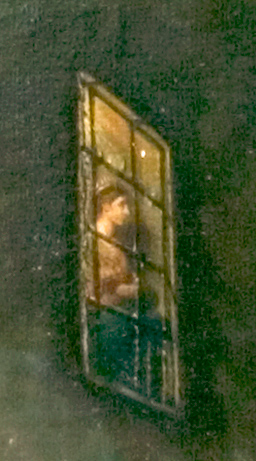
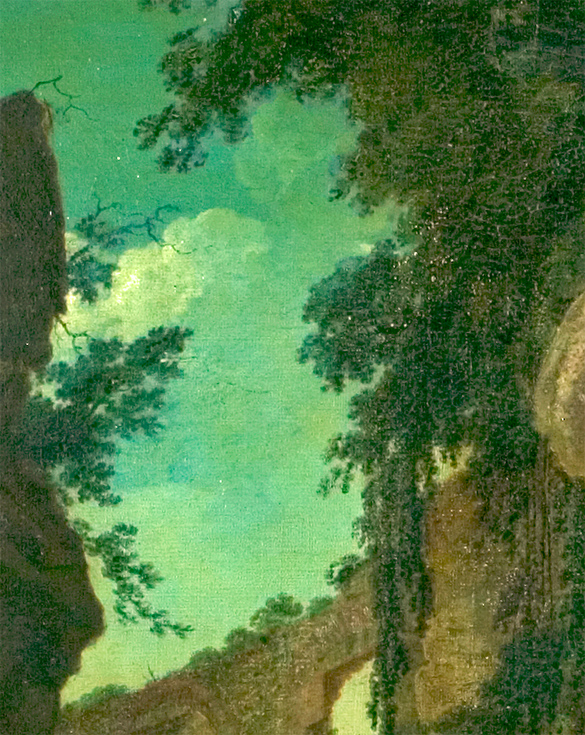
But the rest of the picture has been savagely 'restored' by someone in the 1960s or 70s, with huge areas entirely over-painted (as seen in the last image below). The question is, why was it done - to cover up old damage? Or just ineptness. Often it's simply a case of the latter.
Lucy Bamford tells me, however:
Worryingly, I had a tip-off from someone who had some dealing with a painting that was also over painted by the same restorer as the Colosseum back in the 60s or 70s. Their approach seems to have been to sand down the original to make a smooth surface on which to lay new paint, ‘improvement’ being the chief concern I presume.
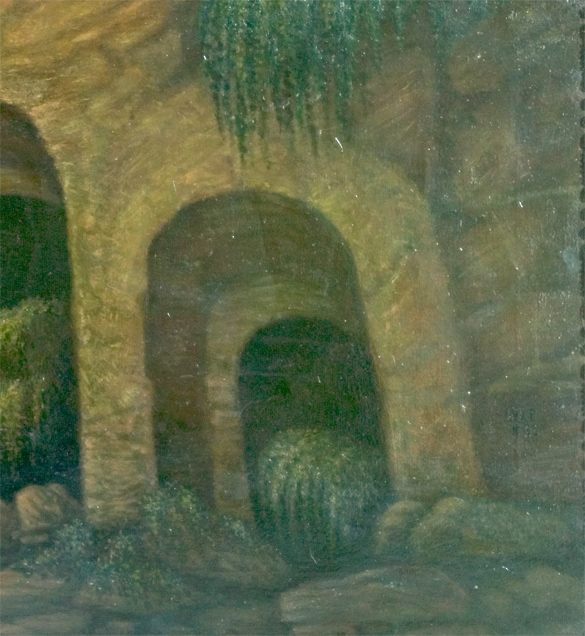
Yikes. The tale such woeful restoration may be a bizarre one to modern ears, but in my experience it's not unusual. No single group of people has done more damage to paintings in history than those who at some point have fancied themselves as 'art conservators'. Ironic but true. Those pictures that are in the best condition are those that have never been 'cleaned'.
The problome is, every generation of restorers (or, in days of old, simply domestic cleaners, who would scrub pictures with a potato if you were ucky, or a scourer if you weren't) thinks it has come up with the latest answer to 'improve' paintings: once it was 'transferring' (with disastrous results) panel paintings onto canvas; then it was wax re-lining (until people realised how the wax damaged the paint surface). Sometimes it seems art restoration is a giant, intra-generational job creation scheme by restorers.
But anyway, I have no doubts that this time around the work will be done well and carefully. And I look forward to seeing a Wright emerge from beneath the work of that sinful earlier restorer.
'Spot the Fake' at Dulwich picture gallery
January 12 2015
Video: Dulwich Art Gallery
At the Dulwich Picture Gallery, 'conceptual artist' Doug Fishbone has come up with a new display, called 'Made in China'. For £120, the Gallery commissioned a copy of one of their permanent collection from an artists' workshop in China - and swapped it for the original, even hanging the copy in the original frame. Visitors have to see if they can spot the interloper. Says Dulwich senior curator Dr Xavier Bray (in The Guardian):
“The replica is excellent quality, and when it arrived we were delighted with it - but when I put the two side by side, it was a very interesting experiment. The difference was instantly apparent."
No shit.
Anyway, it's a fun idea. I'm all in favour of getting people to look more closely at the actualy object. More interesting, perhaps, would have been to pull in some period copies and studio works, to really test the public's sense of connoisseurship. More here. Opens 10th Feb.
Update - a reader writes:
Upon some rumination, I suggest you might want to reconsider your use of what Americans call an 'expletive', for posterity, when you might be considered for a swanky position, or the like.
I fear my chances of attaining any swanky position have long gone.
Update II - in The Guardian, Jonathan Jones is not at all impressed. He says the idea is 'moronic':
It will confuse the public, undermine the pleasure of looking at the great paintings on its walls, and replace the joy of learning about art with a glib postmodern game that is pretentious and destructive. I personally don’t intend to go anywhere near Dulwich until this silliness is done with.
Fakes are not fun. They are not cool. And the postmodernist cult of the replica is getting seriously old. Umberto Eco wrote his seminal essay on this theme, Faith in Fakes, decades ago. The easy claim that replicas are just as good as the real thing and no one can tell them apart anyway is now a hackneyed idea, recently wheeled out like the most boring of dinner party bons mots when the V&A reopened its Renaissance cast court. [...]
It is [...] daft to think a hidden fake adds to the interest of Dulwich picture gallery’s paintings. The anxiety it creates can only detract from a genuine experience of the collection. Museums should not join in the moronic celebration of the replica. Their job is to preserve originals, and make those accessible. Art only matters when it is the real thing.
And another reader writes, further to my suggestion above that a wider display of copies and studio works might encourage even closer looking:
The Kunsthistorisches in Vienna did just that, when I was there a couple of years ago. It was a brilliant display that put copies next to a number of their works, including (if I recall correctly) anonymous contemporaries, a nineteenth century copyist of Tintoretto, a nineteenth century chromoprint of Titian and Heintz's copy alongside Parmigianino's Cupid Making his Bow. Vistors were invited to work out which was which, helped by excellent information cards. It was well thought out and well presented, but without fanfare. On the other hand, the Dulwich initiative looks a bit gimmicky to me.
Another reader adds:
Comparing historic copies to originals is indeed a very interesting exercise for the viewer. It may be worth noting that The National Palace Museum in Taipei (constituting the main part of the former Chinese imperial art collection) held ‘solo exhibitions’ last year of works by the four great painters of the Ming Dynasty. These exhibitions included some good period copies displayed next to the originals with detailed explanations. Interestingly, some of these copies were held together with the originals in the imperial collection.
Guffwatch - the banned list
January 12 2015

Picture: Artnet News
Three cheers to art critic Ben Davis, who, tiring of the contemporary artspeak we call 'Guff' here on AHN, has introduced a new 'banned list' of the 30 most banal guff words. The best are:
4) challenges
Particularly in these usages: “challenges the viewer…" or “challenges ideas of…." Very few things are genuinely challenging, particularly when the art crowd is so very blasé about being challenged.
10) haunting
This is a popular shortcut to making it sound like a work is really good if there is not that much more to say about it.
16) informed by
To me, when a writer says that an artist's work was “informed by" a certain set of ideas, that can be translated to, “What this show was about was unclear to me—but then I read the press release and it said the artist had read something."
18) interrogates
This is so common it hurts every time I read it. It makes art sound literally torturous.
24) profound
As a rule, it seems that artworks aren't just moving these days; they are “profoundly moving." An artist doesn't just get it; she has a “profound understanding" of what's going on. So much profundity out there! This is similar to just adding an exclamation point to things for emphasis!And so the list goes on. The trouble is, once you remove these 30 key words from the guff-writer's lexicon, what else can they say?
More here on Artnet News.
Neil MacGregor's favourite painting
January 12 2015

Picture: National Gallery
The great British Museum director says (in Country Life's 'My Favourite Painting series) of Hans Holbein the Younger's 'A Lady with a Squirrel and a Starling':
‘Hans Holbein the Younger is not yet 30. He knows he’s good and he wants you to know it, too—and then to commission him. How many whites can a painter paint? For him, there is no limit. Here, he has conjured any number of whites as the bonnet curves, the heavy stole folds and falls, the crisp cuff stands sparkling and proud and the fine lawn bodice seductively reveals the flesh below. All white, all distinct. And in the centre, a miniature miracle—the single pearl button, lustrous below the throat. Blue sky and vine leaves behind a sitter wearing a cap of Russian fur, accompanied by a starling and a squirrel. Absurd combinations, impossible in life—enduringly real in Hans Holbein’s art.’
The Holbein is one of 85 pictures that entered the National Gallery when he was director there. I wonder, would he have bought that Wilkie?
Update - a reader writes:
At the time of its acquisition, I recollect the curator in charge being interviewed and remarking that it was an important addition to the collection as it was an “ordinary” Holbein – given, I suppose, the National already owned the artist’s only surviving full-length portrait, and only surviving full-length double portrait.
It struck me at the time as a rather arrogant comment given that authentic works by this very significant painter, not the least for the history of art in Britain, are not particular common in the country – and certainly not outside the metropolis if that includes the Royal Collection. Off the top of my head, I can think of only two.
It’s one of those works the National seems to buy because it’s the only institution that can afford to and would have more substantially enhanced other galleries’ collection. One could add others to this category; by Poussin, Titian, and van Dyck for example.
A truly lovely thing though.
£30m Monet?
January 12 2015

Picture: Sotheby's
Sotheby's are hoping Monet's 'Le Grand Canal' fetches up to £30m in next month's impressionist sale. The picture has until recently been on loan at the National Gallery in London. Helena Newman of the auction house said:
“The market for works by Claude Monet has now reached an all-time point of strength, with bidders coming from four times as many countries as a decade ago.”
More here.
New Nevinson discovered on Your Paintings
January 12 2015

Picture: BBC
Here's another nice discovery story from Your Paintings: a job applicant for the post of Director of the Atkinson Arts Centre in Southport, UK, discovered a lost work by CRW Nevinson in the Atkinson's collection when he did some pre-interview swotting up about the Centre on Your Paintings. And he got the job. Says the BBC:
An art expert who identified a mystery painting at a job interview has been made manager of the gallery storing it.
Stephen Whittle revealed his "strong hunch" about a painting that has been stored at the Atkinson arts centre in Southport since the 1920s.
He told the panel he thought it was Limehouse, a work by CRW Nevinson, a futurist painter.
"When I saw this unattributed image on the BBC Your Paintings website, it was very reminiscent of Nevinson," he said.
Mr Whittle, who came across the painting as part of his interview research, added: "I mentioned my supposition at interview, but I don't know if it led to me finally getting the job."
See the new picture and other Nevinsons here on Your Paintings.
DIA's Graham Beal to retire
January 12 2015

Picture: TAN
The Art Newspaper reports that Graham Beal, director of the Detroit Institute for Art, is to retire next year. Beal, of course, recently helped save the DIA from a disastrous disposal to help pay for Detroit's bankruptcy. But that extraordinary achievement was not all he did, says TAN:
During his [16 year] tenure, the British-born director oversaw a sweeping $158m renovation and reinstallation of the collection and put the museum on stable financial footing for the first time in decades. Under his leadership, locals passed an innovative property tax that is due to contribute $23m to the DIA over ten years and attendance has grown more than 90%, according to the Detroit Free Press.
Has there been a more heroic museum director in modern times?
Update - a reader writes:
Is he available to be prime minister?
Better than the current candidates.
Great idea!
A Jacobean bargain? (ctd.)
January 12 2015

Picture: Savills
I mentioned a couple of years ago English Heritage's inability to sell Apethorpe Hall, a large Jacobean mansion which they had bought in 2004 and spent £8m on, saving it from total collapse. At last, reports the Telegraph, someone has come forward to buy the house (for £2.5m) and complete the restoration. He is a French aristocrat, called Jean Christophe Iseux, Baron von Pfetten, who apparently was once a member of the Chinese parliament. I'm not sure how me managed that, but he sounds like the sort of fellow who can rescue a great house. Congratulations to him, and a hearty AHN good luck with the restoration. I daresay he'll be needing a few pictures...
New drawing gallery at the Courtauld
January 12 2015

Picture: Courtauld
A new gallery dedicated to works on paper is opening at the Courtauld Collection in London. More here at Apollo.
Vive La France
January 9 2015

New Constable discovery at Sotheby's
January 9 2015

Picture: Sotheby's
One of the star pictures at Sotheby's forthcoming Old Master sale in New York is, reports Martin Bailey of The Art Newspaper, a sleeper from a minor Christie's sale in London. Constable's study for Salisbury Cathedral from the Meadows is for sale at Sotheby's with an estimate of $2m-$3m, but was sold by Christie's at South Kensington for just £3500 in 2013. There, it was catalogued as by a 'follower' of Constable, in a sale of the contents of Hambleden Hall, the home of the Viscounts Hambleden. It had been in their collection since the late 19th Century. Says The Art Newspaper:
When the oil sketch came up for sale at South Kensington in July 2013, Christie’s catalogued it as by a “follower of John Constable” and estimated it at £500-£800. The unnamed buyer later confirmed that the work had been heavily retouched in the late 19th or early 20th century, depriving it of its lively, sketchy quality, but it has now been cleaned.
The painting was examined by Anne Lyles, a specialist on Constable, who dated it to 1829-30. She determined that the oil sketch is by the artist’s hand and was among the preparatory works for the final painting, which Tate bought in 2013 for £23m. Lyles describes the study as “one of the most exciting and important additions to the master’s oeuvre to have emerged in recent decades”.
I saw the picture at Sotheby's preview last year in London, and had no doubt whatsoever that it's 'right'. And that was before I read Anne Lyles' persuasive essay in Sotheby's catalogue, which places the picture in its context, and analyses all the key evidence. One of her conclusions is that Constable - who was in the habit of making numerous preparatory sketches and studies for his large scale landscapes - relied on the Hambleden picture most when making the final painting, which (having been recently bought) is now in Tate Britain.
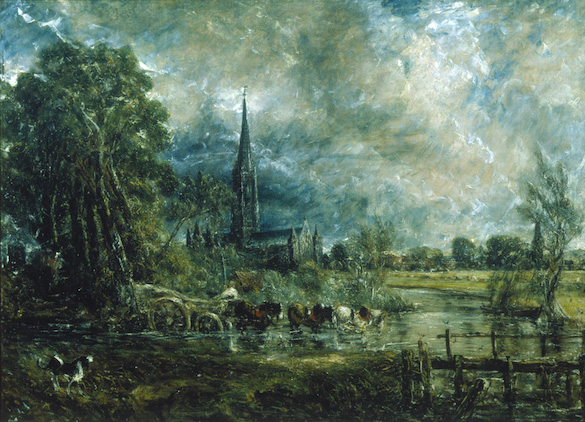
One of the clinchers in the Hambleden picture's favour is that the dramatic, horn-shaped cloud formation it shows looming over the cathedral was copied by Constable for a larger sketch in the Guildhall art collection in London. But, crucially, Constable then painted over that horn-shaped cloud, to make the sky slightly less stormy in that area. Over time, that original cloud structure has become visible through the paint layers; if you look at the image of the Guildhall picture above you can just make out the 'horn shape' to the right of the spire, underneath Constable's later cloud formation. The point is - and apologies for my rather unscientific cloud descriptions - the Hambleden painting cannot be the work of a copyist, because only Constable himself developed that structure of the sky. As Anne Lyles says in her note:
[...] all the other preparatory sketches show the cathedral building more or less in shadow [...]. Moreover, the dramatic stormy sky in the full-scale sketch in the Guildhall (fig. 4) also derives more closely from the Hambleden study than the other sketches. Indeed the cluster of black storm clouds in the full-scale sketch to the right of the cathedral spire was once closer in appearance to the formation seen in the Hambleden picture until Constable decided to knock them back in the former by overpainting parts of them in white.
Anyway, the other clincher for me was the sheer quality of the painting. It's too good to be a copy. Yes, some elements, such as the structure of the cathedral are a little simplistic, but that's to be expected in a study like this, for the emphasis, the compositional development, is all about areas like the sky and stream, and they're pure Constable. For what it's worth, I also know that Anne Lyles - who used to be the Constable scholar at Tate Britain* - is no pushover when it comes to endorsing Constable attributions. So if it's good enough for her, that means it's really good.
Now, here's the humbling bit - I missed the picture entirely when it came up at Christie's South Kensington, in July 2013. Indeed, I also missed the other 'sleeper' in that sale, The Embarkation of St Paula, which (regular readers will remember) was catalogued as a copy after Claude, but which was withdrawn at the very last moment and sold for £5m at Christie's main salerooms in London in December 2013. In my defence, the South Kensington sale was in the week immediately after all the main Old Master sales, and after South Kensington's own Old Master sale, when you'd normally expect things like the Constable to be sold. Also, the sale was branded as 'Colefax and Fowler [famous English interior decorators], Then and Now', so it sounded like the sort of sale you'd only find chintzy sofas in. Anyway, the fact is, I had my eye off the ball, and can only congratulate the sharp-eyed buyer.
But, AHNers, we must also sympathise with the buyer as well as congratulate them. For when the main press picked up The Art Newspaper's story today (e.g. here in The Mail), Christie's gave this rather unhelpful comment:
'We took the view at the time of our sale in 2013 that it was by a 'follower of'. We understand that there is no clear consensus of expertise on the new attribution.'
Which I think is a little mean, to be honest. Who are the dissenters? Christie's should say so, rather than just casting unspecified doubts like that. I suspect the truth is that no serious Constable scholars doubt it. The Mail's coverage also looks into whether Christie's might be vulnerable to legal action from the Hambleden vendors, and the paper quotes the editor of the Antiques Trade Gazzette, Ivan Macquisten:
'There was a legal case in 1990 that set a precedent for this when provincial auctioneers Messenger May Baverstock of Surrey failed to recognise something that ended up selling for a lot more and was sued by the vendor.
'In the High Court, a judge established a degree of responsibility that auctioneers have.
'If you are a small auction house holding your sales in a village hall it is reasonable that you may not identify such a painting.
'But if you are a Sotheby's or a Christie's with specialists departments with some of the leading specialists in the world, then you probably are. The burden on these bigger auction houses to get it right is far higher.
'That is not to say they are negligent or liable, that depends on how easily the work would be to identify and what due diligence was carried out to identify it.
'Have they been negligent by not carrying out checks on things like the composition of the painting and, in the case of Constable who was known for his cloudscapes, the quality of the clouds?
'I would be surprised if the previous vendor was not considering taking the matter further.'
Factors in Christie's defence include: the fact that the general subject matter - Constable's 'Salisbury Cathedral' - is one of the more copied compositions in British art, and Christie's were thus not negligent in assuming the Hambleden picture was another; the fact that the picture was quite heavily overpainted, thus making certain elements hard to read; the fact that the sale price of £3,500 meant that only one other person thought it worth taking a closer look at.
In favour of the Hambledens, should they wish to pursue the matter: the fact that Christie's evidently did not show it to Anne Lyles, the leading Constable authority, before the sale; the fact that Christie's only recognised at the last minute that there was a £5m Claude in the same sale, which suggests that, when preparing the sale, not as great care was taken with the pictures as one might expect; the fact that Christie's did not put in the catalogue entry the fact that the painting might have had a 19th Century Christie's provenance.
But it's a very difficult area, and I wouldn't want to place too much blame on Christie's specialists. They work to extremely tight deadlines, and, especially in house sale situations, they only get a short period of time to look at each picture. Inevitably, things will slip through the net. Probably the culprit here, if there is one, is the system in which auction house specialists have to operate - if the bean counters further up the food chain gave them more time and staff, fewer mistakes might be made. But then what would we all do without the occasional discovery story?
* It's a matter of great regret that they don't have one any more, of course.
Apologies
January 8 2015
For the lack of action today. I was doing my tax return. Ugh.
$20.1m
January 7 2015

Picture: TAN
That's the amount which, according to Melanie Girlis in The Art Newspaper, Sotheby's spent defending itself against the criticism of their shareholder, Dan Loeb - in the first nine months of 2014 alone. That's nearly half Sotheby's profit for the entire period. $20.1m. I can hardly believe it.
The article is an interesting one. First, it looks at the lack of profitability on those 'mega sales' of modern and contemporary art:
“Both houses are after headline prices, which limits profitability,” Schick says, attributing this to “a number of soft years” since the 2008 downturn. Plus, the auction houses have been offering incentives such as guarantees and profit shares to prime sellers.
“They’ve made it harder by competing against each other … you hear about some suicidal deals,” says Pilar Ordovas, a London dealer, formerly the deputy chairman of Christie’s Europe’s post-war and contemporary art department.
Also, Girlis quotes the chief executive of Phillips, Edward Dolman, as saying:
hat the “massive change in taste” towards contemporary and Modern art should lead to certain departments going—he cites furniture and even Old Masters. “They could shed half of their business,” he says.
While 'the money' is indeed currently chasing modern and contemporary art, I don't believe for a second that Christie's and Sotheby's Old Master departments are going anywhere. I think to suggest they are is bulls**t, frankly. Earlier today I reported that The Louvre was the most visited museum in the world, with half its visitors under 30. You won't find any contemporary art there. People will always want Old Masters, and if they're cheap - at the moment - then that suits me fine.
Finally, Girlis tells us that profits at Bonhams were 'more than £30m for 2013'. The secret of their success? They've gone in the opposite direction, and have more than 60 departments, catering for everything from clocks to Spitfires. If you're ever looking for the sorts of things you can't find on Amazon, or in Harrods, chances are you'll buy it at Bonhams.
