


'National Gallery - the Movie' (ctd.)
January 7 2015
Video: Via YouTube
Jonathan Jones of The Guardian has been to see Frederick Wiseman's new three-hour long documentary of the National Gallery. He didn't like it:
God it’s boring. I love the National Gallery and I was squirming in my seat. Why doesn’t Wiseman let the paintings speak for themselves? Again and again, he films audiences listening to curators or guides give lectures about the National Gallery’s works of art. One such talk would make sense in a portrait of the museum. But why repeat the exercise, again and again – and again?
More here.
Kelvingrove acquires sleeping fair-scape
January 7 2015

Picture: Glasgow Herald
Here's a nice story from my new locale, up here in Scotland; the Kelvingrove art gallery has acquired, for £220,000, a lost landscape by the Scottish artist John Knox (1778-1845), which shows the 'Glasgow Fair' around 1820. The picture had been discovered in 2013 by Edinburgh-based dealer Patrick Bourne, who spotted it at Sotheby's described as showing a scene in Aberdeen, and attributed to William Turner De Lond. It was bought for £76,900.
I heartily approve of the Scottish version of the 'White Glove Photo-op'.
More here.
De-accessioning in France?
January 7 2015

Picture: BG
A committee of French legislators looking into the national debt has sought the opinion of the head of Sotheby's in France for his view on whether de-accessioning should be allowed. He said yes, of course:
'Action is needed to tackle the grotesque waste in national collections. In the Louvre alone, some 250,000 works are currently hidden away in overflow rooms.
'Museums should also be given the option of selling works that have been in public collections for at least 50 years.'
More here.
Meanwhile, Art Daily reports that the Louvre is the most visited museum in the world, with 9.3m visitors a year. It's good that the Louvre's new director, Jean-Luc Martinez, is adding another two entrances to cope with the numbers.
More than half the Louvre's visitors, says the museum, are under 30 - which is impressive, and a nice riposte to those who always assume high art is not for younger people.
Turner's house wins £1.4m grant
January 7 2015

Picture: Guardian
Regular readers will know I've been covering fundraising attempts by Sandycombe Lodge, which was the country villa designed by Turner in Twickenham. I'm very glad to report that they've been awarded £1.4m by the Heritage Lottery Fund, to help preserve the site. Well done to all involved. More here in The Guardian from Maev Kennedy.
Job Opportunity
January 7 2015

Picture: The Burlington Magazine
The estimable The Burlington Magazine is advertising for a new editor. Says the magazine's website:
On the retirement of Richard Shone, Editor, The Burlington Magazine is looking for an Editor to lead the publication forwards in both print and digital formats. The successful candidate will be responsible for maintaining the integrity and academic standards of the editorial content, including selecting, commissioning and editing articles with the assistance of an experienced editorial team. The successful candidate must have a bachelor’s degree, but an advanced degree in art history, literature, or a related field is desirable. A high professional standing in a scholarly press, museum, university or equivalent environment is required. The ideal candidate will have a broad knowledge of art and publishing, a tested understanding of the editorial process, and be able to work to tight deadlines. The successful candidate must also have proven leadership skills and the ability to create a positive and productive team environment. The candidate should be able to collaborate effectively with a wide range of colleagues and contacts, both external and internal, and must possess excellent communication skills. This is a board-level position that reports to the Chairman and so requires a candidate who is organized, able to set priorities and juggle competing demands. Some travel is required.
The salary is negotiable, and the closing deadline is 27th February.
The magazine has many strengths to build on, with a strong brand, and superb production values. But clearly some changes need to be made if the magazine is to continue to be relevant in the future.
A priority for the new editor is to sort out the magazine's online offering, along with its pricing structure. There's something wrong with the magazine's website if one-man-band blogs like this deliver some of its highest traffic. It should be the other way around. At the moment, only the headlines of each new article get put online, and if you want to access details of, say, 'New Titian discovered', it's £15, just for a PDF of that article. That's pretty ridiculous for an educational magazine which is charitably funded - via a trust - and which claims to be a world leader. How many art history students can fork out the £28 cover price? For better or worse, the trend these days for academic publications like The Burlington is towards open access, easily searchable material - or at least much cheaper access. If The Burlington wants a guide, then Apollo magazine has got its online offering about right, with new blogs and online features.
The magazine also needs to liven up a bit. Too many articles are impenetrable, pitching the reader straight in, in media res (though I admit this is a wider problem across art history). Some introductions and conclusions would be good, as well as more engaging prose overall. The reviews really need livening up; they're sometimes (with the occasional honourable exceptions) as dull as a three hundred year old varnish. And the magazine also needs to relax about any work of art connected with 'the trade'. It'll happily take dealers' cash in advertising, but it won't touch with a bargepole anything a dealer or auction house might have discovered - even though, overwhelmingly, most discoveries come from the trade these days.
I would put many of the magazine's weaknesses down to the rather creaky ownership and management structure, so that needs to change as much as the magazine itself.
Anyway, if you apply, good luck! And if readers have other recommendations for the magazine, do send them in.
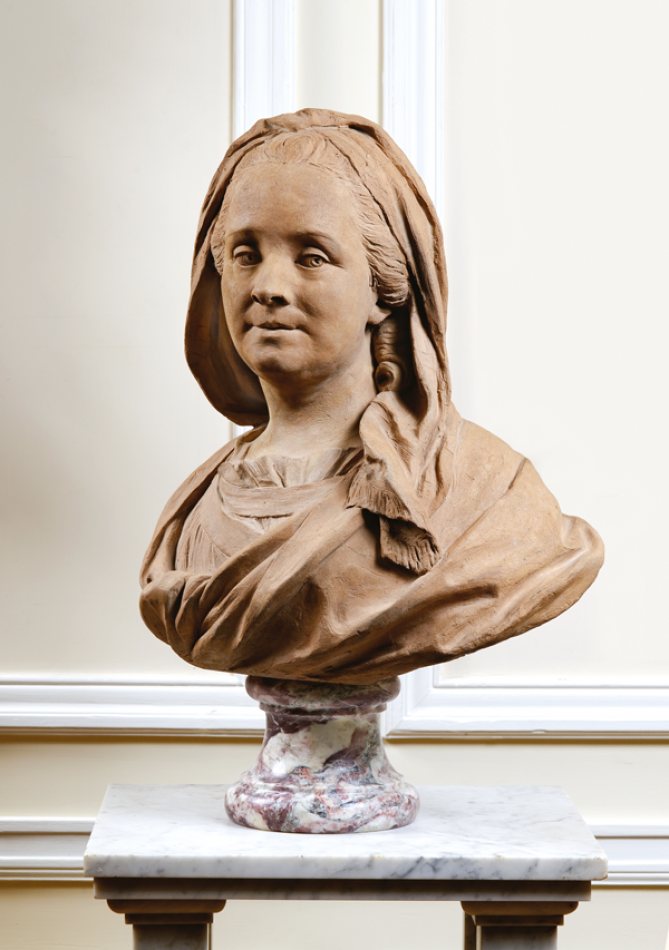
In the latest edition of The Burlington you can read about a newly discovered bust by Jean-Baptiste Lemoyne, above, in an article by Marie-Noelle Grison, and a review of the V&A's Constable exhibition by the leading Constable scholar Anne Lyles.
Update - a reader writes:
Indeed the estimable The Burlington Magazine has a midlife identity crisis. Is it a professional magazine or an academic journal?
If it is the former then it must serve the entire profession and if the latter then adapt to the current standards for such principally online publications and join a JSTOR type group.
In either case the current generation is web rather than print oriented and its beautiful production standards are expensive like the product of a Savile Row tailor and eventually will have as limited a market.
You can get back issues of Burlington on Jstor up to 2004.
Update II - another reader writes:
I'm sure their attitude will change. They're the last bastion. Remember when everywhere was like that - having to pretend in the Heinz you weren't working for a dealer!
I wonder if the new editor will Trojan-horse the Trade in by introducing more contemporary art, where the Trade/museum lines are even more blurred.
Waldemar on Rubens
January 6 2015

Picture: BBC
I greatly enjoyed Waldemar's hour-long programme on Rubens, which was on BBC2 last weekend. I can't think of a better presenter to do Rubens justice - you get the sense watching the film that Rubens and Waldemar would have been best buddies. You can catch it here on iPlayer.
Update - ahead of the Royal Academy's new show on Rubens, Jonathan Jones of The Guardian says he wasn't much cop:
The very energy of Rubens has something brittle about it. He cannot stop for fear of looking into the dark. He seems terrified of Caravaggio’s shadows, Rembrandt’s eyes, Velazquez’s mirror. His art endlessly moves on, through a bewildering range of genres. It also assimilates a staggering variety of influences.
That's the opinion of someone who probably hasn't looked closely enough at Rubens. I don't mean; not seen enough of his work, but; sniff-the-canvas close-looking. Which, for me at least, reveals that when it comes to the sheer technical ability of applying paint to canvas, or as he mostly did, to panel, Rubens was an unsurpassed genius. Say what you like about Rubens' fat women and crowded compositions, but go and look at some of best-preserved, entirely autograph oils on panel, and you'll find few better passages of painting. Rubens could paint as easily as you and I breathe.
Lining the Jabach
January 6 2015

Picture: Met
Regular readers will know that I've been following the Met's restoration of Le Brun's Portrait of Everhard Jabach and his Family, and here is a fascinating video of the Met's conservators unrolling the painting after it has been given a new strip lining. The more I see how this fascinating painting has come to life, the more saddening I think it is that a leading UK institution like the National Gallery didn't make an effort to keep it in the UK.
Still, the Met's excellent online posts about the restoration help show that it's not just about where a painting is displayed, but who displays it. The Met is streets ahead of UK institutions in their online offering.
Starkey & Worsley on Holbein's Henry VIII & Edward VI
January 6 2015
Video: BBC
Now here's a presenting line up I'd never thought I'd see... Above is a clip is from a forthcoming programme on Hampton Court, which goes out this Saturday on BBC2, presented by Lucy Worsley and David Starkey.
I used to live in the park at Hampton Court, in an old mews. For the story on a picture I discovered of another royal baby which now hangs there, see here.
New York Old Master sales
January 6 2015

Picture: Christie's
The catalogues for Christie's and Sotheby's New York January Old Master sales have gone online. Sotheby's had theirs up long before Christmas; Christie's went up yesterday. Therefore, over the holiday, yours truly pressed refresh quite a few times on the Christie's website.
To be honest, though, when the Christie's sale did go online, I skipped through it mighty quick. There's a few nice things, including this depiction of 17th Century dentistry by Guido Reni at $1.2m-$1.8m, and a pair of Canalettos at $3m-$5m.
There's also an interesting painting attributed in full to Caravaggio, above, which, as the literature listing makes pretty clear, has variously been called both 'Caravaggio' and a copy right up until the most recent catalogue raisonné, by John Spike, who said it was a copy. In their catalogue note, Christie's cites the opinion of the Met's Keith Christiansen:
Keith Christiansen, who has closely studied the present painting, considers it to be among the finest of surviving versions, but notes that it is difficult to go beyond this judgment, given the picture’s condition. He notes that at this early date, when Caravaggio was working for the market, the artist may well have painted more than one version. For Christiansen, that in the Queen’s collection (Hampton Court) is the best preserved and the most convincing of the versions that he knows.
Not much of an endorsement. Here's the Royal Collection picture. It's better.
Christie's note continues:
Interestingly, the contours of the Queen’s Boy peeling a fruit line up precisely with our painting, suggesting that the two were made from a common design.
Or that it's a copy. Then the catalogue mentions an X-ray:
The x-radiograph of the present work (fig. 4) does not reveal any tracing, and primarily shows that Caravaggio built up the folds of the boy’s shirt with lead white.
An artist using lead white for the shirt? It must be Caravaggio. The estimate is $3m-$5m. And for that I'd expect a better catalogue note. Still, the note concludes with this roster of those who support, or supported, the attribution:
While its autograph status has been questioned by some over the past several decades, many scholars support the attribution to Caravaggio, including Sir Denis Mahon, Barry Nicolson, John Gash, Luigi Salerno, Mina Gregori, and Beverly Louise Brown.
Christie's, as is their habit of late, has a seperate 'Renaissance' sale, the highlight of which is a Bronzino portrait, with an estimate of $8m-$12m. This picture failed to sell in 2013 at $12m-$18m. It's still a little expensive, it seems to me. The cataloguing is interesting, as, doubtless in a bid for the 'cross-over' market, they're straining to make a contemporary resonance angle:
The reverberation of this golden age of portraiture [by the likes of Bronzino] haunts us even today in ways as varied as the original function of the older paintings. A celebrated artist who adapted the conventions and superficial appearance of Renaissance portraiture for her own ends is Cindy Sherman, whose History Portraits (1988-1990) ransack sources as readily identifiable as Raphael’s La Fornarina (Untitled 205) or as generic as Untitled 209, a portrait of a lady in an elaborate 16th-century costume who confronts the viewer with all the haughtiness of a Bronzino aristocrat. Naturally art using photography, or Sherman’s performance art version of it, lends itself to the appropriation of historical images, and with no post-war artist was this accomplished to greater effect than with Joseph Cornell, whose Medici Slot Machines were executed in the 1940s and 50s using printed reproductions of such paintings as the Portrait of Bia de Medici by Bronzino (Galleria degli Uffizi, Florence) (fig. 1), which gaze poignantly out at us from behind the glass, part devotional object, part arcade entertainment.
In fact, I think that's the point of the stand alone 'Renaissance' sales - they're meant to appeal to modern and contemporary buyers. Doubtless 'baroque' or 'rococo' wouldn't quite work in the same way.
Sotheby's has the richer sale, with a monochrome Van de Velde maritime picture at $2m-$3m, a study by Constable of Salisbury Cathedral also at $2m-$3m, a Ribera of St Paul at $600k-$800k, and a $3m-$5m Salomon van Ruysdael.

Regular readers may recognise the above St Joseph by El Greco, which is estimated at $2m-$3m; it's the picture I discussed in 2012, after it made £790k (inc. premium) in Bonhams, where it was called 'Attributed to El Greco'. I thought then that it looked 'right', and it looks even better now, cleaned. Will it matter that it's a relatively quick turnaround between the sales? It shouldn't. Someone's taken a brave punt, and it's paid off; good for them.
You can compare the pre-restoration image on the Bonhams website here. Despite the obvious ding, the picture is in fundamentally excellent condition.
Finally, Sotheby's has the below head study catalogued as by Van Dyck, estimated at $100k-$150k. It's a new discovery, and though I can only judge it from the image, I'd say the attribution is most likely correct. Indeed, I remember seeing the picture in a black and white photo once in the Witt Library, and making a mental note that it looked good - one for the 'sleeper radar'. But here it is, awake and looking shiny bright. It was previously attributed to Dobson. The condition looks excellent. The estimate is cheap.

Update - a painter writes:
When respectable art critics and auction houses attribute a ghastly painting, like this so-called Caravaggio to the man himself, I ask myself, 'did Caravaggio- for whatever reason, drugs, drink, or disease, go through a phase in his career, where he was no longer capable of imitating himself?'
Are great painters in fact capable of producing work without a single piece of correct anatomy or redeeming brush stroke?
Personally, I think not.
Perhaps they think it will 'clean up nicely...'
New NPG director
January 6 2015

Picture: NPG
Congratulations to Dr Nicholas Cullinan, who has been appointed the new director of the NPG in London. He takes over from Sandy Nairne, who has been director for the last 12 years. Says the NPG:
Dr Nicholas Cullinan, Curator of Modern and Contemporary Art at The Metropolitan Museum of Art, New York, and co-curator of last year’s hugely successful Henri Matisse: The Cut-Outs exhibition at Tate Modern, has been appointed Director of the National Portrait Gallery, London, it was announced today, Tuesday 6 January 2015.
The appointment by the Gallery’s Board of Trustees, which has been approved by the Prime Minister, was made following the resignation of current Director Sandy Nairne in June 2014. Nicholas Cullinan will take up his new post in spring 2015.
Since joining The Metropolitan Museum of Art, New York in early 2013, Dr Cullinan has taken an important role in developing a number of projects including the programme for the museum’s occupancy of the Whitney Museum of Art’s Marcel Breuer building in 2016 (following the Whitney’s move to another location), expanding and redisplaying the permanent collection and increasing the Modern and Contemporary Department’s base of supporters. At the Met, he organised the exhibitions Venetian Glass by Carlo Scarpa: The Venini Company, 1932-47 (2013); Amie Siegel: Provenance (2014); and devised and led, together with co-curator Andrea Bayer, one of the Met’s opening exhibitions at the Breuer building for March 2016. He has been responsible for a number of major works being acquired by the Met. Significant gifts he worked on include the donation to the Museum of forty-four pieces by Carlo Scarpa and fifty-seven works from the Souls Grown Deep Foundation, dedicated to African American artists.
Previously Curator of International Modern Art at Tate Modern (2007-2013), he worked on exhibitions such as Henri Matisse: The Cut-Outs (2014), Malevich (2014), Edvard Munch: The Modern Eye (2012), Tacita Dean: FILM (2011), Duchamp, Man Ray, Picabia (2008) and Cy Twombly: Cycles and Seasons (2008). While at Tate, Dr Cullinan also worked on acquisitions and collection displays, founded a committee for Russian and Eastern Europe art and was involved with many aspects of the second phase of the Tate Modern project, for which the new building, designed by Herzog & De Meuron, is scheduled to open in 2016.
Prior to joining Tate, he was the 2006-7 Hilla Rebay International Fellow between the Solomon R. Guggenheim Museum, New York; the Guggenheim Museum Bilbao and the Peggy Guggenheim Collection, Venice. Previous experience includes in 2006 a Helena Rubinstein Internship at the Photography Department of the Museum of Modern Art, New York and Lecturer in Art History at the University of Wales Institute, Cardiff from 2003-2004.
Dr Cullinan was educated at the Courtauld Institute of Art, London, where he was awarded First Class Honours for his B.A. in History of Art, a distinction for his M.A. and where he also gained his PhD. In 2003 Dr Cullinan was visiting teacher for the M.A. Course at the Courtauld Institute. While studying there he was a part-time Visitor Services Assistant at the National Portrait Gallery, London from 2001-2003. He also served as board member of the Courtauld Association from 2011-2013. Dr Cullinan is British and grew up in Yorkshire although he was born in Connecticut, USA in 1977.
The National Gallery trustees have chosen their new director, and so we should hear that decision soon. There has been all sorts of talk about who got the gig, and who applied, but I've decided not to put anything up here I'm afraid; I don't think such gossip would be fair on the unsuccessful applicants. Evidently, making the new appointment has been a rather leaky process.
Merry Christmas!
December 20 2014

Picture: Courtauld Institute Gallery, 'The Adoration of the Shepherds', by Sir Anthony Van Dyck
Right, I think that's it for the moment folks, time for me to trim the goose and all that. I wish you all the happiest of Christmases/holidays, and may your stockings bulge with art historical goodies.
Can I also take this opportunity to thank you for all your interest and support over the last year. To those of you who have written in with comments, an extra special thanks; if, in the fogs of my inbox, I have not replied to every email, apologies - they're all much appreciated.
Finally, if you think anything deserves special praise in a 'Best of the Year' sort of way, be it something like an exhibition, discovery or acquisition, please send me an email, and I'll put it up.
Otherwise, see you in 2015!
Update - many people have praised 'Late Rembrandt' at the National Gallery in London, and also the Met's Pieter Coecke van Aelst and Renaissance Tapestry.
Update II - Happy New Year! I'm just polishing off a chapter for a history book (I've been back to Victorian foreign policy over Christmas), and will get back to the blog tomorrow, Tuesday 6th Jan.
Many thanks to all those who kindly emailed over the holidays.
Building on the Frick's garden (ctd.)
December 19 2014

Pictures: Huffington Post & WSJ
It seems that the great and good of New York are coming out to slate the Frick's plans to build an extension. I learn via the Grumpy Art Historian that the Wall Street Journal has an article on the latest developments, which is well worth reading. The Frick's proposed plans, to increase library and exhibition space, are still some months away from being put to the relevant city authorities, and evidently the institution is somewhat bruised by the reaction so far.
The opprobrium seems to centre on the building over of a small garden (above, which is not open to the public) designed by 'the world famous' British landscape architect Russell Page (1906-1985). I'd never heard of him until now.
In the WSJ article the current Frick director Ian Wardropper says:
“What I find frustrating sometimes, is people seem to brush right by the needs of the museum.”
Quite. I find it astonishing how reactionary some in the museum world can be sometimes. The fact is, going to museums has become far more popular than it ever was. Visitor numbers are soaring, which, to me, is a Good Thing. Now, large institutions like the Metropolitan Museum or the Louvre can - just about - cope adequately with the burgeoning numbers. But smaller institutions like the Frick cannot. They just don't have the space. Anyone who has been to the Frick recently will know that over-crowding is a real issue.
So the Frick has two options; either go down the route of some Italian galleries like the Borghese and introduce time-allocated ticketing (which in practice leads to either a disappointed trip, or a rushed one), or expand. Since the Frick has a great deal to offer the world, with both its cherished collection and excellent exhibitions, it would seem to me a great shame if it gave in to the New York culturati, shelved the expansion plans, and remained a 'boutique' museum. It's a shame to say it, but sod the garden. There's a much bigger one over the road anyway.

Update - my mother writes, saying she's worried about my education:
[Page] is an extremely well known English garden designer along with Gertrude Jekell. And if you say you don't know who she is...
It's spelled 'Jekyll', Mother, tut tut...
Update II - Nord Wennerstrom, Director of Communications for The Cultural Landscape Foundation, writes:
Per your recent post about the proposed Frick expansion, let me direct you to two articles in the Huffington Post written by Charles A. Birnbaum, founder and president of The Cultural Landscape Foundation - Here's What's Missing in the Debate Over the Frick Collection's Proposed Expansion and That 'Temporary' Frick Garden - It Was Created to Be Permanent. Together, they provide some context for why the Russell Page-designed garden is a central issue in this debate.
As for the physical addition, along with opening space on the museum's second floor, we know there will be a net increase of some 42,000 square feet, but be have yet to get an accounting of how all this space is being allocated. The most recent architectural rendering (attached) does not discuss the disposition of more than 35,000 square feet – how much of this addition is going for office space? And, do all of the museum's components have to be contiguous?
The Cooper-Hewitt, also sited in an historic Gilded Age mansion on Fifth Avenue, just managed to increase their exhibition space by 60% without a massive addition or the destruction of their garden – and they moved some offices offsite to other properties they own on East 90th Street.
The Guggenheim Museum has curatorial offices down in SoHo.
In addition, the Russell Page-designed garden is a site specific work of art, which Frick officials have deemed an interim land use. This is a particularly disconcerting aspect of the entire debate. Cultural custodians are making a judgement about the worth of a specific work of art, and an entire genre – what are the criteria? On what basis is this unique work of art, a commissioned site specific work that is part of their permanent collection, being deemed of less value than other parts of their permanent collection?
[The Frick's director, Ian Wardropper, has said that the Frick currently has three gardens, and will continue to after the expansion because the Page garden will be replaced by a rooftop garden. Ergo, gardens are all the same and interchangeable. That's a devastating indictment of the entirety of landscape architecture and design – and because it's being rendered by otherwise esteemed cultural custodians, it will be taken at face value and not challenged. Substitute building for garden and see if that response is still valid. What if Wardropper said of their three Vermeers: because of space considerations we're replacing one of the three Vermeers with a newly acquired black velvet painting – don't worry, we started with three paintings and we end up with three paintings. That, in essence, is what is being proffered].
Nord also writes the ever valuable blog, Nord on Art.
First, 'contiguosness', if that's the right word, is important. I think the suggestion that the Frick's curators could work 'off-site' is a bad one. It's a mistake for curators not to be physically immersed in their collections.
Second, I may well be a garden philistine for saying this, but I absolutely don't buy the idea that the garden is a fixed work of art comparable to a Vermeer. It wasn't created as a work of art, but as a garden. Something nice to look at, and occasionally go into. Gardens, by their very nature, are living creations which at some point do and must die. If the garden had been built by Henry Clay Fick himself, the situation might be different. But in this case, the space taken up by the garden has been decided by the Frick's staff and trustees to be more valuable in another purpose. And as the garden came, so, alas, it can go. Or perhaps be moved. Or somehow built over.
Another reader points me to an interview with former Frick Director, Everett Fahy, who is opposed to the expansion, and wants the frick to remain a smaller-minded institution. The interview was conducted by Manuela Hoelterhoff, who says:
[...] let’s ruin it! Let’s make it big and noisy and crowded!
Alas the Frick is already crowded, that's the point. Hoelterhoff also says:
A big part of the [expansion] pitch is education. But last I checked the Frick doesn’t allow children under 10 and hopefully that won’t change.
Which gives you an idea of what the current Frick director is up against...
Update III - another (US) reader writes:
The Frick garden is charming but is an ornament which is viewed but unused. The museum has genuine needs which the addition will serve and will benefit the public. As you mention Central Park is just across Fifth Avenue.
Update IV - a former museum director tells me of the Golden Rule of Former Museum Directors:
Keep your mouth shut.
Update V - here's a good article by Christopher Gray in The New York Times, which sets out the history of the Frick's various additions and changes. It tells us that the neo-classical walls surrounding the garden were designed by three different designers. In other words (he says, provocatively), Russell Page just produced the trees, the pond, the little pots, and two small lawns. Hardly Versailles...

Gray writes:
The debate revolves around several points. Is the 1970s garden, given its recent vintage, important enough to be protected? Would the loss of the garden harm the townhouse character of the street — which historically had no such gardens? A really correct restoration would replace the three townhouses — why isn’t that on the table? Will the new wing overpower the original Frick, even though the original Frick long ago disappeared?
The lightning rod is the garden itself, a simple, innocent thing. With foresight the Frick has never made the garden public, and it’s “don’t touch” aspect is part of its considerable charm. But is it “charm preservation” we’re after?
In relation to the last question, I'd say 'no'. After all, New York is hardly famed for its preservation history. Or even, some might say, its charm.*
Update VI - Nord Wennerstrom writes in response to my response to his response, above:
I think the question is whether or not this garden (and by extension, landscape architecture) is considered a work of art – and not compared to works by Vermeer, Watteau, Franceso di Vannuccio, etc. Is this art? In deciding to demolish the garden, Frick officials have tacitly endorsed the idea that it's not. Shouldn't it be incumbent on them, as cultural custodians to whom we look to for guidance, education and understanding and who we believe have a broader context, to outline their criteria and explain why they believe so? The garden's fate is in their hands. Thus far, this has been absent from the debate.
* I mean architecturally, New Yorkers, not the people!
Constable before 'n after
December 19 2014

Pictures: US NGA
There's a nice piece on the US National Gallery's website about the restoration of their 'White Horse' by Constable. Before conservation, above, the picture was thought to be a copy of a picture in the Frick. But cleaning (below) and x-rays revealed otherwise.

Help restore Brunelleschi's 'Pazzi Chapel' in Florence (ctd.)
December 19 2014

Picture: Pazzi Chapel
I mentioned earlier the Pazzi Chapel's attempt to raise $95,000 to restore a loggia designed by Breunelleschi. Splendidly, they've raised the money. Well done if you helped out.
But the work is not yet done, for they're hoping to raise a teeny bit more to restore the door, above. More here.
Fighting graffiti
December 19 2014
I was delighted to find out that here in the UK we have a policeman dedicated to eradicating graffiti. His name is Detective Constable Colin Saysell (above), and, says The Guardian he:
[...] is the man graffiti artists love to hate. His relentless and increasingly hi-tech pursuit of graffiti writers for almost 30 years has earned him the reputation as the graffiti bogeyman.
His name is frequently spray-painted on walls as a taunt to the authorities. Abusive comments about him have even been spotted on goods wagons in Germany. Saysell has helped convict at least 300 graffiti offenders in his time, first in Bristol and more recently in London for British Transport police. As the only detective registered as an expert witness on graffiti, Saysell regularly helps police forces across the UK and Europe.
Saysell says the police are winning the war on graffiti. But his tactics and hardline approach are being questioned. He is seen by many as out of step with a society that celebrates rather than prosecutes graffiti artists. Even some officials tout the idea of decriminalisation.
Pah. Keep going Detective Constable, and good on you.
$100m Cézanne deaccession
December 19 2014

PIcture: Detroit Free Press
The Detroit Institute of Arts may have successfully resisted efforts to flog off their art, but another Detroit institution has decided to take the moolah; the Edsel & Eleanor Ford House in Grosse Point Shores just outside Detroit accepted an unsolicited offer of a reported $100m for Cézanne's c.1904 "La Montagne Sainte-Victoire vue du bosquet du Château Noir". The puzzle is, the Ford House hardly needed the money. Says the Detroit Free Press:
The Ford House, which is on solid financial footing and carries no debt, is using proceeds from the sale to create a special endowment for preservation, conservation and restoration of the collection — defined as the 1929 English Cotswold-style mansion designed by architect Albert Kahn, the landscape and gardens created by Jens Jensen and furnishings and objects inside the house.
The Ford House, which draws about 60,000 visitors a year for tours and events, has a separate operating endowment of $86 million.
Mullins said that the Ford House trustees received an unsolicited offer for the Cézanne painting in the middle of 2013 but at first turned it down. The buyer came back with a second offer that also was refused. Mullins said that when the buyer came back a third time, the seven-member board — comprised of six Ford family members and the family's lawyer — decided to discuss with a wider circle of family members the possibility of selling.
"This was really a once-in-a-lifetime offer," said Mullins. "The family thought it was a way to guarantee the estate would be taken care of the way Eleanor would have wanted."
In other Cézanne news, Christie's will soon sell the artist's “Vue sur L’Estaque et Le Château d’If” (below) from the estate of the emminent British collector Samuel Courtauld. The estimate is 'up to £12m'.

Personally, I'd rather have the £12m picture. Though it'll doubtless make more than that...
Six new Dorés for Canada
December 19 2014

Picture: National Gallery of Canada, Ottawa
Six works by Gustave Doré, reports Art Daily, have been acquired by the National Gallery of Canada, including the above 'Souvenir of Loch Lomond'. Says the National Gallery’s Chief Curator, Paul Lang:
“It is important for us to remember that French art of the second half of the nineteenth century is not only Impressionism, Naturalism and Symbolism, but that there were also figures who were mainly driven by their imagination. This is the ‘other French nineteenth century,’ and it is equally influential.”
'The Girl with the Fake Pearl Earring'.
December 16 2014

Picture: Mauritshuis
A professor of Theoretical Astronomy, Vincent Icke, says the earring on Vermeer's famous subject is from Poundland, or whatever the 17th Century Dutch equivalent was. Guilderland I suppose. Says the Mauritshuis website:
In the December issue of popular science magazine New Scientist, Icke, a professor of Theoretical Astronomy at the University of Leiden, states that the pearl on the ear of the famous Girl with a Pearl Earring by Vermeer, could not have been a real pearl. The way in which a pearl would reflect the light does not match the reflection of the light in the painting, says Icke.
The article by Vincent Icke confirms what we at the Mauritshuis have been thinking and writing about Vermeer's Girl with a Pearl Earring for some time now. In fact, it's one of the most fun facts about this painting. Just like the fact that it was purchased in 1881 by the previous owner at an auction for 2.30 guilders. At the museum, the caption for the painting also mentions the unrealistic size of the pearl. Vincent Icke reaches the same conclusion, but through a very different understanding and research. The Mauritshuis has taken note of his findings with great interest. This illustrates what makes seventeenth-century paintings so interesting to look at: nothing is what it seems.
The Mauritshuis has written previously about the jewel in the ear of Vermeer's girl, saying it was not a true pearl. Indeed, just like the turban, the "pearl" was no daily outfit for Dutch girls in the seventeenth century. Quentin Buvelot (Mauritshuis chief curator) described the painting together with fellow curator Ariane van Suchtelen in the catalogue for an exhibition on highlights of the Mauritshuis in Bologna earlier this year. They then wrote: "Some of the most salient features of Vermeer's painting include the girl's headpiece and the pearl in her ear. The headpiece consists of yellow fabric, with blue fabric on top of it, knotted around her forehead. The yellow-green jacket is painted in such a loose style that it isn't clear which material it's made from. It is probably wool fabric. This garment is often seen as part of the girl's exotic costume, but it is indeed a contemporary jacket. The low-set sleeve and small pleats are typical of the fashion in the 1660s, when this painting was made. The pearl on the girl's ear is remarkably large. Whereas most pearls nowadays come from farms, in the seventeenth century, they were natural ones. Pearls were formed in oyster-like sea mussels. Large pearls were rare and ended up in the hands of the richest people on the planet. In the seventeenth century, cheaper glass pearls, usually from Venice, were also quite common. They were made from glass, which was lacquered to give it a matt finish. Maybe the girl is wearing such a handcrafted 'pearl'."
I think we can generally assume that most of those whopping pearls we see in 17th Century portraits - at least the English ones with which I'm familiar - were 'fake' (sometimes made out of compressed fish scales), or indeed simply artistic creations.
Tate Archive goes online
December 16 2014

Picture: Tate - Graham Sutherland, sketchbook colour study for the Path in Wood theme. (circa 1957-1959)
From Culture24:
One of the richest and most comprehensive digital art and archival resources in Europe and the world’s largest archive of British Art - Tate Archive - is being made available online for a worldwide audience.
Sketchbooks, drawings, family photographs, personal letters and intimate diaries from artists including Paul Nash, Graham Sutherland, Jacob Epstein, Barbara Hepworth and Ben Nicholson will be available on the free archive, which has been supported by the Heritage Lottery Fund with a grant of £2 million.
Highlights of the project, which will be released in stages, include Barbara Hepworth’s sculpture records compiled by the artist throughout her life. They featuring original photographs, handwritten notes and details of exhibitions, giving a comprehensive record of her sculptures from 1925-1975.
Diary entries include tender love letters with intimate sketches sent by Paul Nash to his wife detailing their early life together as well as his service as a soldier and war artist during the First World War.
A good move. Obviously, the less said about the bits of the archive they chucked out, the better.
Chartres' 'Black Madonna'
December 16 2014

Picture: New York Review of Books
They've been busy 'restoring' the interior of Chartres Cathedral, one of the great architectural wonders of the world. The restoration seems to consist of painting the limestone walls various gaudy colours, with fake marbelling to boot, and many, including Martin Filler in the New York Review of Books, are agog. One casualty of the restoration is the cathedral's well known 'Black Madonna', which is now, er, no longer black. The close up below shows how the Madonna used to look, with its patina caused by centuries of dirt and candle smoke.
Incroyable...

More on the restoration here at ArtWatch.
Update - a reader writes:
My wife and I would like to add a very loud ''hear hear'' to Martin Filler's article. We used go out of our way to stop-over in Chartres whilst driving to and from our house in the south-west in France. Even for a confirmed atheist such as myself, the cathedral interior was the most spiritual and awe-inspiring building that I have ever experienced and it truly became an inspirational place of pilgrimage for us. We were shocked and heart-broken, indeed out-raged, when we visited last year to find that the French had wilfully embarked on this catastrophic campaign of so-called restoration. The result is that now we sadly have no wish to return, as we prefer to retain the memories of this Gothic masterpiece when it still retained the accretions of centuries which were responsible for so much of its mystical character.
Perhaps we can now expect the French state to countenance the cleaning of the Mona Lisa?
Update II - there are some good 'before 'n after' photos here at ArchDaily. The 'restored' bits look like something from the wedding cake shop.


Update III - the 'restoration' at Chartres is the work of the Monuments Historique division at France's Culture Ministry - the same people responsible for this boneheaded scheme to build on top of an ancient Roman site. People of France - what is going on?
Update IV - supporters of the 'Restoration' have responded in the NYRB, but their arguments are pretty ineffective, and miss the point.
